
Best Low Pressure Pressure Gauges for Delicate Readings
Choosing the right low pressure gauge is essential for accurate readings in air, water, gas, and automotive applications. This guide highlights five reliable options designed for precise measurements at low ranges, featuring durable housings, clear dials, and robust wetted parts. Each product below is optimized for stability, readability, and consistency under varying conditions. Use the Buying Guide at the end to compare key purchase considerations and find the best fit for your setup.
| Product | Brand | Range | Mounting | |
|---|---|---|---|---|
| BPSSDI 0-5 Psi Low Pressure Gauge | BPSSDI | 0-5 Psi | 1/4″ NPT Lower Mount | Capsule design, brass connection, stainless steel case |
| JACO Elite Low Pressure Tire Gauge | JACO Superior Products | 0-15 Psi | Handheld with swivel chuck | ANSI-standards accuracy, built-in bleed valve |
| WYNNsky Low Pressure Pencil Tire Gauge | WYNNsky | 1-20 Psi | Pencil style | Precision low range, durable materials |
| SENCTRL 0-15 Psi Low Pressure Gauge | senctrl | 0-15 Psi | Lower mount 1/4″ NPT | IP67 waterproof, stainless steel case |
| SENCTRL 0-30 Psi Glycerin Filled Gauge | senctrl | 0-30 Psi | Lower mount 1/4″ NPT | Glycerin-filled for vibration dampening |
BPSSDI 0-5 Psi Low Pressure Gauge

The BPSSDI 0-5 Psi Low Pressure Gauge uses a capsule measurement system and a brass material connection for measuring non-corrosive liquids and gases. Housed in a durable 304 stainless steel case, this gauge emphasizes stability across varied environments. Its 2.5″ dial, protected by a clear polycarbonate lid, delivers readable, single-scale measurements with an accuracy rating of ±2/12%. The design prioritizes low-range precision, making it suitable for air, water, and gas pressure testing where small fluctuations matter.
JACO Elite Low Pressure Tire Gauge
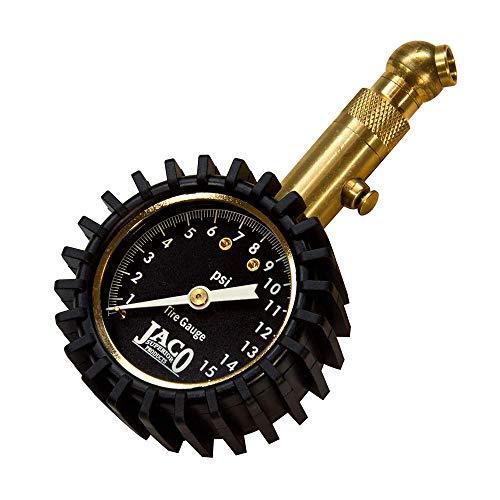
JACO’s Elite Low Pressure Tire Gauge is designed for precise tire and low-pressure readings up to 15 PSI. It’s built with rugged brass components and a shock-resistant guard, delivering ANSI-standard accuracy (±1.5%) in a portable, battery-free package. Features include a built-in air bleeder valve to reduce overinflation quickly, a thick 2.25″ brass stem for easy access to valve stems, and a 360-degree swivel chuck for versatile positioning. Ideal for ATVs, dirt bikes, tractors, and other low-pressure tires that demand reliable, repeatable readings.
WYNNsky Low Pressure Pencil Tire Gauge

The WYNNsky pencil gauge concentrates on precision within a 1-20 PSI range. Its chrome-plated zinc head and aluminum tube offer resilience for repeated low-pressure checks common with golf carts, ATVs, and air springs. The compact, slim profile makes it easy to carry in a pocket or tool kit. The gauge prioritizes readable scale increments and reliable performance for routine checks where low-pressure accuracy is critical, such as inflating small tires or validating air systems.
SENCTRL 0-15 Psi Low Pressure Gauge

SENCTRL’s 0-15 Psi Low Pressure Gauge employs a capsule measurement system within a chrome-plated steel housing, offering solid durability and corrosion resistance. Brass wetted parts handle non-corrosive liquids and gases, including air and water, with compatibility for ATV tire testers, steam boilers, HVAC components, and air regulators. It provides a single-scale readout with an accuracy of ±2.5% across the range, emphasizing compact low-range reliability and environmental resilience with IP67 waterproofing to reduce condensation fogging.
SENCTRL 0-30 Psi Glycerin Filled Gauge

The SENCTRL 0-30 Psi Glycerin Filled Gauge features brass and stainless steel wetted parts for measuring non-corrosive liquids and gases, including water and oil tests. It uses glycerin filling to dampen pointer flutter and protect internals from vibration, with a dual-scale display (Psi/Bar) and an accuracy rating of ±3% over its range. The 2.5″ dial is encased in a 304 stainless steel shell, offering durability and reliable readings in demanding environments such as water tests, HVAC, and industrial testing.
Buying Guide: Key Purchase Considerations And Comparisons
When selecting a low pressure gauge, consider the following factors to ensure the best fit for your application:
- Range and resolution: Choose a gauge whose range matches your expected pressures. For delicate systems, 0-5 or 0-15 PSI ranges with fine increments yield more precise readings.
- Wetted parts material: Brass and stainless steel wetted parts resist corrosion and suit water, air, and gas tests. For non-corrosive fluids, brass components provide good compatibility.
- Dial size and readability: A larger dial (2.5″ or more) with a clear lid improves readability in bright or cluttered environments. Protective housings and polycarbonate lenses prevent fogging and scratches.
- Mounting type: Lower-mount 1/4″ NPT is common for inline installations; consider swivel chucks or bleeder valves for easier access and adjustment in tight spaces.
- Protection and durability: IP ratings (like IP67) protect against moisture and dust. Glycerin-filled gauges dampen pulsations, reducing pointer flutter and wear in vibration-prone setups.
- Accuracy and calibration: Look for certifications or factory calibrations (±1.5% to ±3%) to ensure readings remain within acceptable tolerance for your task.
- Application compatibility: Some gauges are tailored for tire pressure, HVAC, or water/oil testing. Ensure the device is suitable for your specific test medium and environment.
- Maintenance needs: Glycerin-filled gauges require minimal maintenance but must be inspected for seals and leaks over time; dry gauges may be simpler but more prone to pointer flutter under vibration.
In summary, for ultra-low pressures, capsule or pencil-style gauges with robust construction and accurate readings at 0-15 PSI offer reliable performance across automotive, HVAC, and water-testing scenarios. For vibration-heavy settings, glycerin-filled gauges provide steadier indications, while portable tire gauges excel in fieldwork where quick checks are frequent. Always verify mounting, range, and wetted parts to ensure compatibility with your system.