
Best Low Frequency Power Inverter for Reliable Off-Grid Power
Answering the needs of off-grid living, RV travel, and backup power, the best low-frequency power inverters deliver robust performance for heavy appliances and chargers. This guide features five strong options and explains who each is best for, along with practical buying tips. Use this to compare in one place which model matches your battery setup, load needs, and expansion plans.
| Product | Best For | Key Benefit |
|---|---|---|
| Ampinvt 3000W Peak 9000W | Home, RV, campers needing high surge | High transfer efficiency; built-in AVR |
| Giandel 4000W | Off-grid solar and heavy loads | UL458/GFCI outlets; pure sine wave |
| Aninerel 12000W | Large off-grid systems; parallel setups | Dual MPPT; expandability to 72kW |
| VEVOR 6400W 48V | Industrial off-grid and split-phase needs | High output; 99% efficiency |
| BELTTT 2000W | Compact solar/ RV minor loads | Dual outlets; USB and remote |
Ampinvt 3000W Peak 9000W Pure Sine Wave Inverter Charger

This 12V DC to 120V AC inverter combines an inverter, battery charger, and AC auto-transfer switch. It offers high transfer efficiency above 90% and complete isolation between input and output for clean power delivery. It is suited for home backup and RV use with a broad battery compatibility including SLA, AGM, GEL, and Li-ion. A built-in AVR stabilizer helps maintain stable output under varying loads. Useful for users who need continuous, stable pure sine wave power with strong surge capability.
Best for: Home backups and RV setups requiring reliable surge handling and integrated charging. The included adjustable charging current (0–35A) lets you tailor charging to your battery bank. Caution: ensure your battery type setting matches your pack to avoid charging or discharging issues.
Giandel 4000 Watt 24V Pure Sine Wave Inverter

This 4000W inverter converts 24V DC to 110/120V AC with a surge of 7000W for short periods, making it suitable for powerful appliances like microwaves and air conditioners. It features a large LCD to monitor input/output, load, voltage, frequency, and protection modes. UL458 listing and GFCI outlets provide safety and reliability for off-grid or vehicle installations.
Best for: Off-grid solar and RV installations needing a higher continuous rating and protective features. Choose this if you value a clear display and federal safety listings. Limitation: bulkier unit due to its high power rating may require a larger install space.
Aninerel 12000W Solar Hybrid Inverter

This 12,000W continuous, 24,000W peak inverter is designed for heavy off-grid power with 2 MPPT controllers and high battery charging capability (up to 220A). It supports up to 6,000W+6,000W PV input and works with multiple battery chemistries, including Li-ion and LiFePO4. It offers scalable parallel operation up to six units, enabling up to 72kW total output for larger systems.
Best for: Large solar-plus-battery systems needing high parallel capability and advanced charging efficiency. Use this when you plan to expand power gradually or require strong solar matching. Caution: complex setup and higher initial cost may be a consideration for smaller loads.
VEVOR 6400W 48V Hybrid Inverter
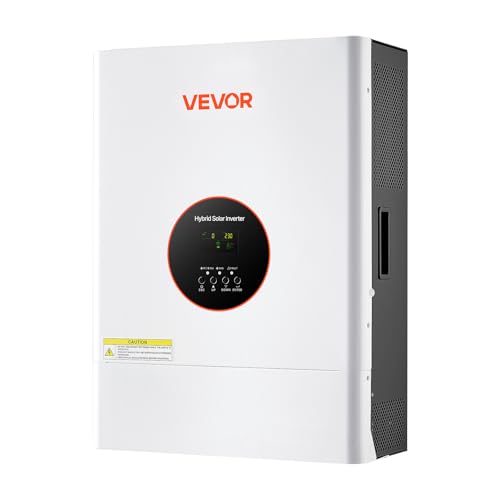
This low-frequency inverter integrates inverter and charger with a built-in MPPT controller, delivering up to 6400W continuous output and 99% efficiency. It supports 110–120V and 220–240V split-phase outputs, making it versatile for heavy loads and mixed-voltage configurations. It’s designed for lead-acid and lithium batteries and is suitable for off-grid home or workshop use.
Best for: Users needing robust, utility-like power with a high efficiency inverter/charger combo. Better for larger cabins or workshops that require reliable power with dual-voltage support. Limitation: no Wi-Fi connectivity, so remote monitoring isn’t built-in.
BELTTT 2000W Pure Sine Wave Inverter

This 2000W continuous inverter supplies up to 4000W peak with pure sine wave output. It includes dual AC outlets and a 5V 2.1A USB port, plus a remote control option. It is suitable for RVs, solar setups, and portable use where a compact power source is key. It offers high conversion efficiency and user-friendly monitoring through its LCD display.
Best for: Smaller loads or compact RV setups needing reliable clean power and handy USB charging. Choose this if space is limited or you need a straightforward solution. Caution: lower continuous rating means limited capability for heavy or sustained appliances.
Buying Guide: Key Considerations For Low Frequency Inverters
- Power Rating and Surge: Match continuous power and surge capacity to your heaviest appliance loads. Low-frequency inverters typically excel with higher surge handling for motors and compressors.
- Battery Chemistry and Voltage: Confirm compatibility with your battery bank (12V, 24V, or 48V) and chemistry (LFP/LiFePO4, Li-ion, AGM, GEL, SLA). Some models support multiple chemistries; others require specific packs.
- Voltage Output Type: Decide between 120V/240V split-phase or single-phase 120V, based on your location and appliances. Split-phase models are useful for larger draws and certain equipment.
- Charging and MPPT: If integrating solar, look for built-in MPPT controllers with adequate current. Higher charging current and multiple MPPTs improve energy harvesting in variable conditions.
- Efficiency and Heat: Higher efficiency reduces waste heat. Ensure adequate ventilation and consider devices with AVR or soft-start features to protect sensitive devices.
- Safety Features: Look for over-voltage, under-voltage, over-temperature, and short-circuit protections. GFCI outlets or UL listings add safety for permanent installations.
- Expandability: If future capacity is likely to grow, prefer parallel-capable units or modular architectures to scale without replacing the entire system.
- Monitoring and Controls: LCD displays, remote control, and data logging help manage operation and troubleshooting. Consider whether you need remote monitoring or integration with a broader energy system.
FAQ: Low Frequency Inverters Answers
- What is a low-frequency inverter?
Answer: It uses a transformer-based design and delivers stable power with strong surge capability, suitable for motors and heavy appliances. - Do these inverters require a special battery?
Answer: They work with common lead-acid and lithium-based batteries; check voltage and chemistry compatibility before purchase. - Can I run a microwave or AC with these inverters?
Answer: Yes, many models support high surge power; verify the continuous wattage rating and appliance requirements. - Is parallel operation safe?
Answer: When using models designed for parallel connections, it can be expanded safely; follow manufacturer guidelines and sequence steps. - Which features matter most for RV use?
Answer: Reliability, quiet operation, clear voltage readings, and protection against outages. A built-in transfer switch is beneficial for seamless handover. - Do all inverters support lithium batteries?
Answer: Not all; some models specify compatibility with LiFePO4 or Li-ion batteries, while others are designed for traditional lead-acid chemistries. Check the compatible battery list.