
Best LED Sconce Light Bulbs for Elegant Home Lighting
Looking for the ideal LED sconce bulbs to upgrade your wall lighting? This guide highlights five top options that deliver energy efficiency, steady brightness, and mood-enhancing warmth for living spaces, bedrooms, and entryways. Suitable buyers include: style-focused homeowners seeking decorative glow; energy-conscious shoppers prioritizing long life and low maintenance; and renters needing easy, non-dimmable or dimmable replacements. Below is a quick summary of the picks to compare at a glance.
| Product | Base | Brightness | Color Temp | Best For |
|---|---|---|---|---|
| GoBright E12 Candle LED Bulbs | E12 | 460 lm | 2700K | Chandeliers, decorative fixtures |
| FLSNT Dimmable E26 B11 | E26 | ~620 lm | 2700K | Warm, soft dimmable ambience |
| PHILIPS BA11 E12 Pack | E12 / BA11 | Not listed | 2700K | Accent lighting with high CRI |
| Brightever Dimmable E12 | E12 | 620 lm | 2700K | Dimmable, cozy spaces |
| MAXvolador E12 60W Eq | E12 | 600 lm | 5000K | Bright daylight for task lighting |
GoBright E12 Candle LED Bulbs, 4W 460 LM Flame Tip

Best for decorative chandeliers and wall sconces that benefit from a flame-tip silhouette. These 4W LED bulbs deliver about 460 lumens with a classic flame tip and exposed filament look, creating a vintage-inspired glow. They are energy-efficient and promise long life, reducing bulb swaps in fixtures with tight access. The bulbs are dimmable across a broad range (10%–100%), compatible with many modern dimmers, enabling customized ambiance for dinner parties or movie nights. A potential limitation is that brightness is fixed at 460 lm; rooms needing higher light levels may require additional fixtures.
FLSNT Dimmable Candelabra LED 60W Equivalent

Best for people who want high-energy efficiency with a warm, classic look. These E26-based B11 filaments replace 60W incandescents with about 4.5W LED, yielding roughly 25,000 hours of use. They are dimmable and designed for broad compatibility with many dimmers. Note that the bulbs are non-replaceable in certain fixtures with integrated electronics; ensure your dimmer type matches the bulb’s capabilities before use. Ideal for living rooms and bedrooms seeking a soft, continuous glow.
PHILIPS LED BA11 E12 Chandelier Bulbs, 3-Pack

Best for fidelity-focused lighting with high color accuracy. Philips emphasizes a CRI 95, which helps colors look natural under indoor lighting. The bulbs also feature EyeComfort design to minimize harsh glare during extended use. Environmental considerations include packaging reductions. They deliver a soft 2700K glow, making them well-suited for traditional and transitional decors. A caveat is the lack of explicit dimming support in the listed data, so verify compatibility if dimming is required.
Brightever Dimmable E12 LED Candelabra 60W Equivalent

Best for mood-flexible fixtures that demand smooth transition between bright and soft lighting. Brightever emphasizes eye comfort and a flicker-free experience, with a 2700K warm white that suits cozy interiors. The bulbs are designed to work with a wide range of dimmers, enabling subtle shifts in brightness for dinners or gatherings. A limitation is the absence of explicit long-term lumens maintenance data in the listing; expect performance to align with standard LED lifespans but confirm fixture compatibility when planning a multi-bulb setup.
MAXvolador E12 LED Candelabra Daylight Bulbs, 6W
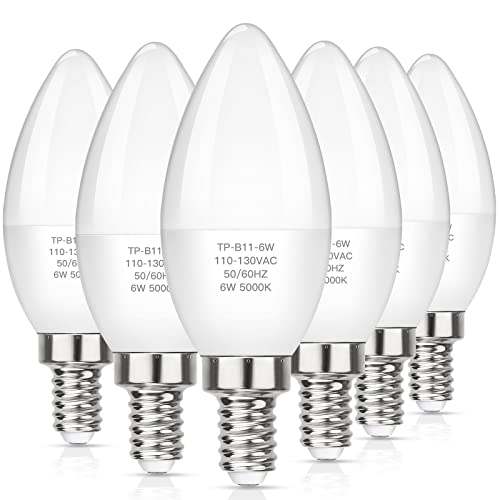
Best for bright task lighting in open fixture designs. These 60W-equivalent bulbs use 6W, producing 600 lumens at 5000K daylight. The non-dimmable design simplifies compatibility with fixtures where dimming is not desired. They use an E12 base and are suitable for chandeliers or wall lanterns requiring bright, crisp light. The 5000K color temperature is not ideal for warm, intimate spaces, so pair with warmer fixtures if a cozier mood is preferred.
Ascher Vintage LED Edison Bulbs, 6W

Best for classic, warm ambience with a prominent filament look. Ascher’s 6W E26 filament bulbs deliver around 700 lumens at 2700K, offering an antique appearance with modern efficiency. They are non-dimmable and emphasize long life with low energy use. An important caution is to avoid using them with dimmer switches, as dimming can cause flicker or damage in non-dimmable designs. They are well-suited for open or decorative fixtures where the filament is a design feature.
Buying Guide: Key Considerations For LED Sconce Bulbs
- Base compatibility: Confirm your fixture’s base type (E12, E26, BA11) before purchasing. Mismatches prevent installation.
- Brightness and mood: Choose lumens around 400–700 for most sconces; higher brightness works for task lighting, lower for ambient mood lighting.
- Color temperature: 2700K is warm and cozy, 3000K–3500K is soft white, and 5000K is daylight. Match to room function and decor.
- Dimming: If your fixture supports dimming, pick a dimmable bulb and check compatibility with your dimmer model to avoid flicker.
- CRI and eye comfort: A higher CRI (CR I 90+) helps colors look natural; EyeComfort features reduce glare for extended use.
- Lifespan and maintenance: Longer-rated lifespans reduce replacements in hard-to-reach fixtures; verify published hours and warranty terms where listed.
- Environmental impact: Look for energy-saving LEDs with lower heat output and recyclable packaging where possible.
FAQ
- What is the main benefit of LED sconce bulbs? They use less energy, last longer, and provide consistent light for ambiance and task needs.
- Do all sconce bulbs need to be dimmable? Not always. If your sconces are not dimmable or you don’t want adjustable brightness, non-dimmable bulbs are fine.
- Which base is most common for decorative sconces? E12 candelabra bases are widely used in chandeliers and small wall sconces.
- How do I choose the color temperature for a hallway? A warmer 2700K creates a welcoming feel, while 4000K–5000K supports visibility in transitional spaces like entryways.
- Is high CRI important for sconces? Yes, CRI 90+ helps render colors accurately near artwork or textured walls.
- Can I mix bulbs of different colors in the same fixture? Mixing color temperatures is possible but can create uneven room lighting; use consistent temperatures for a cohesive look.