
Best LC Fiber Patch Panel Options to Boost Your Network in 2026
When choosing an LC fiber patch panel, aim for equipment that simplifies wiring, supports your fiber type (singlemode or multimode), and fits your rack. This guide highlights five top LC patch panels well-suited for small to enterprise networks, differences between multimode and singlemode options, and practical buying tips. Ideal buyers include IT managers upgrading data centers, network technicians expanding rack space, and facilities teams needing modular, maintainable fiber distributions.
| Product | Type | Best For | Key Benefit |
|---|---|---|---|
| 48 Port LC Fiber Patch Panel, 1U Loaded | Singlemode | Small to mid-size data centers | Pre-loaded with 24 duplex LC adapters for quick install |
| Cable Matters 1U Patch Panel with 48 LC (OM3/OM4) | Multimode | High-density rack deployments | Supports OM3/OM4 multimode for fast campus networks |
| Cable Matters 1U Patch Panel with 48 LC to LC OS2 | Singlemode OS2 | Singlemode backbone links | OS2 compatibility for long-distance runs |
| Cookinkitch 48 Port LC Patch Panel (OM3) | Multimode | Budget-friendly multimode setups | Detachable back bar and replaceable adapters |
| 12 Duplex 24-Port LC-OS1 Enclosure Kit | Singlemode | Modular 19″ racks with splice trays | Includes pigtail and LGX compatibility |
48 Port LC Fiber Patch Panel, 1U Loaded

This patch panel comes pre-loaded with 24 duplex LC UPC singlemode adapters, a detachable back bar, and mounting hardware. Its detachable back bar simplifies cable threading, then reattaches to secure cables. It supports easy adapter replacement, helping you adapt to network changes without full panel swaps. Best for environments requiring reliable singlemode connectivity and straightforward maintenance.
Best for: small to mid-size offices or data closets with a singlemode backbone. Limitation: limited to pre-installed adapters; adapter changes are straightforward but may require planning for future expansions.
Cable Matters 1U Fiber Patch Panel with 48 LC OM3/OM4

This 1U panel adds 48 LC connectors for multimode OM3/OM4 in a standard 19-inch rack. It’s ideal when upgrading to higher-density campus or data center networks that require fast, multimode fiber runs. Best for: networks that run on multimode fiber and need scalable, rack-mounted expansion. Limitations: OM4/OM3 compatibility is great, but ensure your transceivers match multimode requirements.
Cable Matters 1U LC to LC OS2 Patch Panel
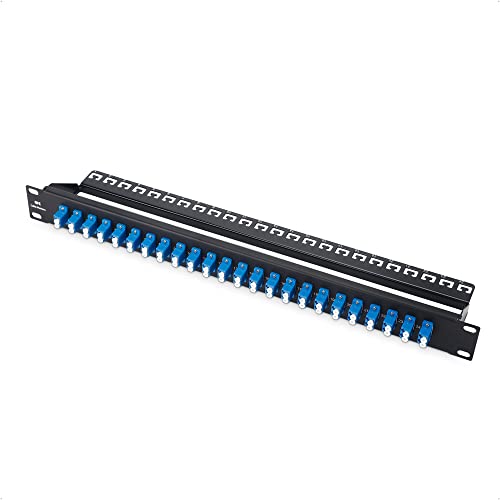
This 1U patch panel uses LC to LC OS2 singlemode connectors, suited for long-distance, high-bandwidth links. It supports 48 LC ports and is compatible with 19-inch racks. Best for: long-haul or backbone applications that prioritize singlemode performance. Caution: OS2 solutions require compatible transceivers and correct fusion splicing practices.
Cookinkitch 48 Port LC Patch Panel (OM3)
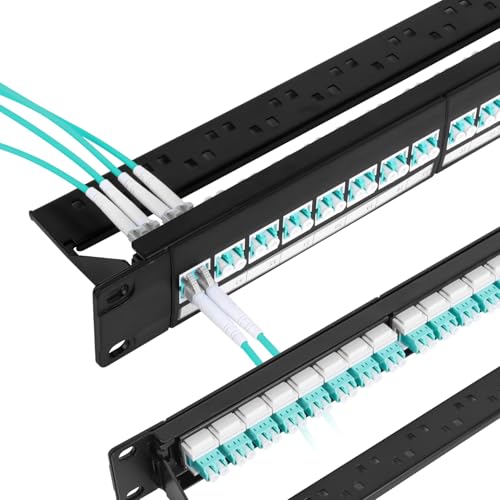
This multimode patch panel ships pre-loaded with 24 duplex LC OM3 adapters, plus a detachable back bar and basic mounting hardware. It supports easy threading and quick adapter replacement. Best for: budget-conscious multimode deployments in small to mid-size networks. Limitation: OM3-focused, so verify your fiber type before purchasing.
12 Duplex 24-Port LC-OS1 Enclosure Kit

combines a 19″ rack-mount enclosure with 24-strand fiber pigtails and LC-UPC adapters in a ready-to-install kit. It features color-coded cabling and a splice tray system for organized fiber management. Best for: modular, expandable singlemode networks requiring structured fiber splicing. Caution: setup complexity may be higher due to splice trays and LGX compatibility requirements.
Buying Guide
What type of fiber should you choose?
Singlemode (OS2) is common for long-distance and backbone links. Multimode (OM1/OM2/OM3/OM4) is typical for short to mid-range data centers and campus networks. Choose OS2 for longer runs and OM3/OM4 for higher bandwidth at shorter distances.
Density and rack compatibility
Most 1U panels fit standard 19-inch racks. If you’re expanding across multiple cabinets, ensure a consistent connector type and port count to simplify management and future growth.
Adapter replacement and maintenance
Panels with replaceable LC adapters offer flexibility as your network changes. Consider panels that clearly label ports and provide easy back-bar removal for streamlined cabling.
Back-bar design and cable routing
Detachable back bars speed up threading and reduce downtime during upgrades. Look for panels that allow reattachment after cable routing to maintain organization.
LGX compatibility and modular expansion
LGX slots and compatible patch panels enable future expansion without replacing the entire panel. This is useful in evolving data centers with growing fiber requirements.
Installation considerations
Check included hardware (screws, ties) and any splice trays or pigtails. Pre-loaded panels save time, but ensure the adapters match your fiber type and transceivers.
Which product is best for you?
- Best for singlemode backbone: 48 Port LC Fiber Patch Panel, 1U Loaded (pre-loaded, straightforward maintenance).
- Better for multimode campus upgrades: Cable Matters 1U LC OM3/OM4 (high density, OM3/OM4 support).
- Choose this if OS2 singlemode is required: Cable Matters 1U LC to LC OS2 (OS2 compatibility).
- Budget-friendly multimode option: Cookinkitch 48 Port LC Patch Panel (OM3).
- Modular, splice-ready setups: 12 Duplex 24-Port LC-OS1 Enclosure Kit (LGX-ready, includes pigtails).
FAQ
- What is the main difference between OM3/OM4 and OS2 fiber in patch panels?
OM3/OM4 are multimode fibers suited for shorter distances and high bandwidth, while OS2 is singlemode for longer distances with lower attenuation.
- Do I need a detachable back bar on a patch panel?
A detachable back bar eases cable threading and improves maintenance, especially in dense or frequently updated racks.
- Can I mix multimode and singlemode panels in the same rack?
Yes, but ensure transceivers and patch cables match each panel’s fiber type to avoid performance issues.
- Is pre-loaded patch panels better than blank panels?
Pre-loaded panels save installation time and reduce miswiring, but choose blanks if you require full customization.
- What should I consider for future expansion?
Look for LGX compatibility, modular adapters, and clear labeling to simplify scaling without replacing existing panels.
