
Best L Shaped Dryer Plug Adapter Options for Easy Old-to-New Connections
Looking for a reliable L-shaped dryer plug adapter to connect an older dryer to a newer outlet without rewiring? This guide highlights five top picks that fit common 3-prong and 4-prong configurations, with clear guidance on who each product is best for. Each option prioritizes safety, ease of use, and compatibility, helping you choose the right adapter for your home, apartment, or small workspace.
The following quick-reference table summarizes the featured adapters, including cable length and core purpose. Use it to compare at a glance and then read the detailed sections for practical buying advice.
| Product | |||
|---|---|---|---|
| SURIEEN NEMA 10-50P to 10-30R | 10-50P Male to 10-30R Female | 1.5 ft | Older clothes dryers to modern outlets; heavy-duty use |
| Strightinc 4 Prong to 3 Prong | 4 Prong New Dryer Female to 3 Prong Old Dryer Male | — | Older apartments with 3-prong outlets |
| PlugSaf 3 Prong to 4 Prong | 14-30P Male to 10-30R Female | 1.5 ft | Converting older 3-prong 30A to modern 4-prong needs |
| WELLUCK 3 Prong to 4 Prong | 14-30P Male to 10-30R Female | 1.5 ft | Simple, flexible old-to-new dryer connections |
| Eversimpleinc 4 to 3 Prong | 4 Prong New Dryer to 3 Prong Old Receptacle | — | Older outlets in homes pre-1997 with 3-prong setups |
SURIEEN NEMA 10-50P to 10-30R Dryer Adapter

Reference features: This adapter converts an old 10-50P dryer outlet to a 10-30R receptacle. It’s a heavy-duty, ETL-tested unit with copper wiring and a STW jacket for durability. The design emphasizes plug-and-play use with no wiring required.
Best for: Buyers who need to connect an older 50A dryer to a 30A dryer inlet without rewiring. This model is suitable for home or light industrial use where a straightforward conversion is needed.
Limitations: The adapter is a 1.5-foot length option; if you require more reach or different configurations, consider alternatives with longer runs or different NEMA combinations.
Strightinc 4 Prong to 3 Prong Dryer Adapter
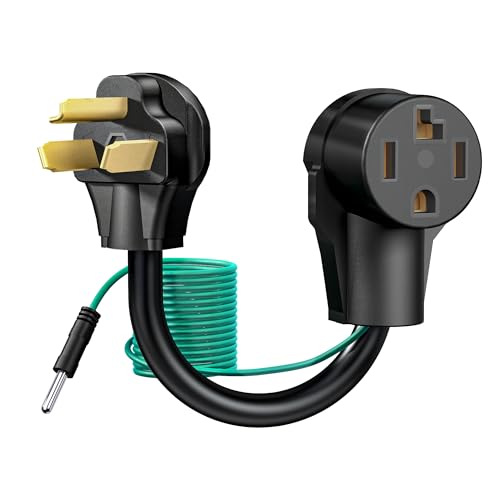
Reference features: Converts a new 4-prong dryer outlet to an older 3-prong dryer plug. Intended for homes with pre-1997 outlets, it enables use of modern dryers without replacing outlets.
Best for: Renters or homeowners with older wiring who want a quick, non-invasive solution to run a newer dryer with a 3-prong outlet.
Limitations: Works when your wall outlet is 3-prong; if your space has 4-prong wiring, this adapter may not provide optimal safety or stability for continuous heavy use.
PlugSaf 3 Prong to 4 Prong Dryer Adapter

Reference features: NEMA 14-30P to NEMA 10-30R configuration with 10-gauge wiring and ETL listing. Includes a protective cover for safety and a space-saving right-angle design.
Best for: Consumers upgrading to a 4-prong receptacle while preserving compatibility with a 3-prong dryer cord. Also noted for its rounded safety features and durable construction.
Limitations: Designed for 125/250V operation; not suitable for high-power devices beyond dryer use like EV chargers or stoves.
WELLUCK 3 Prong to 4 Prong Dryer Adapter

Reference features: Converts a 3-prong dryer connection to a 4-prong outlet with 1.5 ft length. Emphasizes ease of use, flexibility, and a practical grip design for easy plugging and removal.
Best for: Households moving from older 3-wire systems to modern 4-wire outlets; well-suited for apartments or homes with limited space around the dryer outlet.
Limitations: Similar to other 3-to-4 adapters, it does not replace a need for correct grounding in all setups; verify that your outlet and dryer are compatible with 14-30P/10-30R configurations.
Eversimpleinc 4 to 3 Prong Dryer Adapter

Reference features: Replicates the Strightinc design by enabling a 4-prong dryer to connect to a 3-prong outlet, aimed at older homes with pre-1997 wiring. Includes green grounding wire for safety emphasis.
Best for: Users who need a straightforward retrofit option in homes with older outlets while retaining a 4-prong dryer connection. It’s a practical pick when a quick swap is needed without wiring work.
Limitations: As with similar adapters, ensure the outlet configuration matches the appliance’s power needs; misalignment can reduce safety or performance in high-load scenarios.
Buying Guide: Key Considerations For Dryer Adapters
- Outlet compatibility: Confirm whether your dryer and wall outlet use 3-prong or 4-prong configurations. Match the adapter type to connect safely without rewiring.
- Current rating and voltage: Check the amperage and voltage ratings (commonly 30A/125V or 30A/250V). Do not exceed recommended power limits to prevent overheating.
- Length and form factor: Short, 1.5 ft adapters fit tight laundry areas; longer cords may add flexibility but increase clutter. Consider right-angle designs to save space against walls.
- Grounding and safety features: Prefer adapters with grounding provisions and ETL or similar listings. A grounded connection minimizes shock risk in older outlets.
- Material and durability: Look for copper conductors, heat-resistant jackets, and weatherproof or water-resistant features in humid laundry spaces.
- Installation approach: Most of these adapters are plug-and-play; avoid attempting electrical wiring changes. Ensure the appliance is off and unplugged during use.
- Usage scope: Some adapters are intended strictly for dryers and similar loads. Do not use 14-30P/10-30R adapters with high-power devices not designed for dryers.
Frequently Asked Questions
- Can I use a 4-prong to 3-prong adapter with any dryer?
It depends on the outlet and dryer compatibility. If your dryer requires a 4-prong connection, ensure the adapter matches the dryer’s plug and the wall outlet’s receptacle. - Is it safe to use an adapter for high-power appliances?
Only if the adapter is rated for the device’s amperage and voltage. Do not use adapters beyond their listed capacity. - Do these adapters require tools to install?
Most listed adapters are plug-and-play and do not require tools or wiring knowledge. - What should I do if my dryer outlet is older than the adapter’s design?
Choose an adapter designed for old outlets and verify the grounding and compatibility before use. - Are these adapters ETL listed?
Several options mention ETL listing, indicating compliance with safety standards. Check product pages for verification. - Can I leave the adapter plugged in all day?
Adapters are designed for regular use, but avoid leaving high-load devices running indefinitely if the outlet or adapter heats up noticeably.