
Best Hot Plates for Chemistry: Top Magnetic Stirrer Combos for Lab Work
When selecting a hot plate for chemistry, researchers need reliable temperature control, solid stirring performance, and compatibility with glassware and accessories. The following picks combine high-temperature capability, strong stirring power, and practical extras like stir bar recyclers and support stands. Each option below is designed to handle demanding lab tasks—from simple heating to precise reactions requiring stable agitation.
Summary of chosen products
| Product | Brand | Max Temp | Stirring Range | Notes |
|---|---|---|---|---|
| LABHOUSE 300℃/ 572℉ Magnetic Stirrer Hot Plate 2L Set | LABHOUSE | 300°C / 572°F | 0–2000 RPM | Includes stir bar recycler and probe stand |
| LABHOUSE 300℃/ 572℉ Magnetic Stirrer Hot Plate (Non Digital) | LABHOUSE | 300°C / 572°F | 0–2000 RPM | Sturdy aluminum heating plate; dual control design |
| HYCC Magnetic Stirrer Hot Plate | HYCC | 716°F / 380°C | 100–2000 RPM | Supports rapid heating and stirring |
| ANZESER Magnetic Stirrer Hot Plate w/Stir Bar | ANZESER | 520°F / 271°C | 100–2000 RPM | Durable aluminum construction; corrosion resistant |
| FOUR E’S SCIENTIFIC 280℃ Digital Hot Plate Stirrer | FOUR E’S SCIENTIFIC | 536°F / 280°C | 100–1500 RPM | Digital PID control; ceramic coated plate; stir bar retriever |
LABHOUSE 300℃/ 572℉ Magnetic Stirrer Hot Plate 2L Set
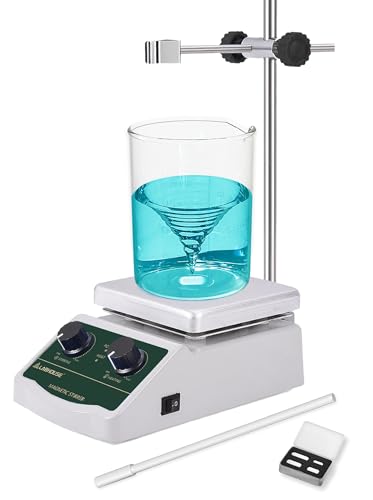
The LABHOUSE 2L set combines a high-temperature aluminum heating surface with independent control of heating and stirring. The device reaches up to 300°C (572°F) for robust reaction heating, and the stirring system operates up to 2000 RPM. The included bar recycler and PTFE-coated stirring rods enhance durability and reduce downtime between experiments. A support stand accommodates probes and meters, facilitating precise temperature monitoring during complex syntheses or extractions. The dual knobs allow separate adjustment of temperature and speed, supporting both fast heating and careful agitation when needed.
LABHOUSE 300℃/ 572℉ Magnetic Stirrer Hot Plate (Non Digital)

This non-digital LABHOUSE model prioritizes simplicity with precise heat distribution across a corrosion-resistant aluminum plate. Like its sibling, it provides reliable temperature control up to 300°C with a broad stirring range (0–2000 RPM). The durable construction and compatibility with standard lab accessories make it well-suited for chemistry labs needing dependable, repeatable results without digital readouts. It is an ideal pick when straightforward operation and robust heating are paramount.
HYCC Magnetic Stirrer Hot Plate

The HYCC model emphasizes rapid heating alongside stable stirring, with a max range up to 380°C (716°F) and a 100–2000 RPM range. The aluminum heating surface distributes heat quickly and evenly, reducing hot spots during high-temperature reactions. A magnetic stirrer is integrated, enabling simultaneous heating and mixing. Its higher temperature capability makes it suitable for reactions requiring intense thermal input, while maintaining practical control for routine experiments.
ANZESER Magnetic Stirrer Hot Plate

The ANZESER hot plate emphasizes durability and corrosion resistance with an aluminum plate design that efficiently conducts heat. With a stirring range up to 2000 RPM and a max temperature around 520°F, it suits a wide array of lab tasks—from simple dissolution to heat-assisted synthesis. The combination of strong magnetic coupling and sturdy construction makes it a dependable option for education settings and research labs alike, especially where frequent, varied experiments are performed.
FOUR E’S SCIENTIFIC Digital Hot Plate Stirrer

The DIGITAL model from FOUR E’S SCIENTIFIC combines precise control with a wider testing range, offering up to 536°F (280°C) and 100–1500 RPM. It features an internal PID controller for accurate and safe heating, along with a ceramic-coated surface that improves heat distribution and reduces the risk of chemical damage to the plate. An integrated stir bar retriever and a probe holder add convenience for long-running experiments and automation-friendly workflows. This option is well-suited for labs that prioritize digital precision and safety features.
Buying Guide: Key Purchase Considerations
- Temperature range and stability: Consider the maximum temperature you need and whether the unit provides precise control (PID or manual with independent knobs). High-temperature tasks demand stable heating to avoid fluctuating heat that could affect reaction outcomes.
- Stirring capacity and speed: Ensure the RPM range meets your needs (common ranges run 100–2000 RPM). For viscous or dense mixtures, higher RPM and robust magnets improve agitation.
- Plate material and heat distribution: Aluminum plates offer good thermal conductivity and resistance to corrosion. A ceramic-coated surface can enhance heat uniformity and ease of cleaning, and may reduce hot spots during high-heat tasks.
- Accessories: Stirrers, stir bars, bar recyclers, stands, and thermometer holders extend utility. Some sets include these as bundled extras, saving setup time.
- Safety features: Overheat protection, temperature limits, and splash-resistant designs reduce the risk of accidents when working with reactive chemicals.
- Digital vs. analog control: Digital models provide precise readouts and programmable features; analog units offer simplicity and reliability with fewer components that could fail.
- Size and capacity: Select a plate that fits your flask or beaker size and accommodates the intended liquid volume without crowding the workspace.
- Durability and ease of cleaning: A rugged, corrosion-resistant surface with accessible controls simplifies routine maintenance in busy labs.
- Vendor support and warranty: Consider brands known for lab-grade reliability and accessible customer service for replacements or parts.
Across the options listed, labs can balance high-temperature capability, stirring performance, and practical features to fit diverse chemistry workflows—whether teaching, research, or industrial processes. When choosing, assess the typical volume, viscosity, and reaction temperature you expect to manage, and align these with the unit’s specifications and included extras.