
Best High Voltage Phase Rotation Meter Guide for Quick, Safe Electrical Testing
Answer: A high voltage phase rotation meter helps electrical technicians confirm three-phase wiring orientation, detect missing phases, and verify motor rotation safely. This guide highlights top options suited for industrial electricians, maintenance technicians, and facility engineers who work with 70V–1000V systems. Each product section explains who it’s best for, why it was selected, and any important caveats. Use the buying guide to compare features like non-contact testing, clamp design, and voltage range before choosing.
| Product | Best For | Key Reason |
|---|---|---|
| UNI-T UT261A | General 3-phase testing | Compact, accurate, multi-function |
| ATOPLEE 3 Phase Tester | Budget, quick checks | Wide voltage range, simple indications |
| Hioki 3129-10 | Higher-end diagnostics | Non-contact with safe clips, broad wire compatibility |
| Fluke 9040 | Critical phase indication | Trusted brand with clear display |
| Vanlison Non-Contact Meter | Energetic systems | Clamp-based, non-contact, safe for live circuits |
UNI-T 3-Phase Rotation Meter UT261A

The UNI-T UT261A serves as a compact 3-phase rotation meter and AC phase sequence indicator with a 40V–690V range. Its multi-function design includes auto range, backlight, low battery indicator, continuity testing, diode check, duty cycle, data hold, flashlight, and relative mode. Best for technicians who need a reliable, pocket-sized tester for routine phase sequence verification and simple component checks. Limitations include a smaller voltage window than some higher-end models, so it is most suitable for distribution-level work rather than industrial high-voltage(io) environments.
ATOPLEE 3 Phase Tester’s Presence Rotation
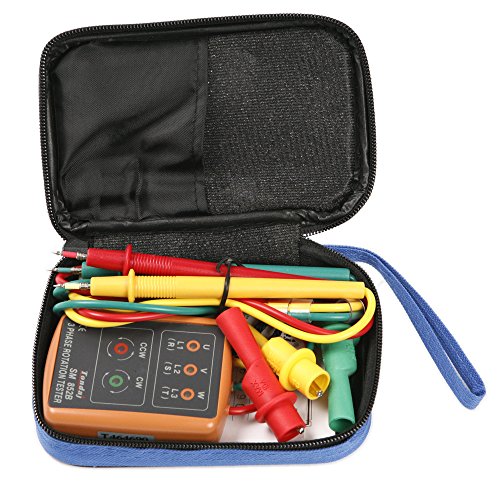
The ATOPLEE model supports 60V–600V with a 2000 V/min limit and an operating frequency range of 20 Hz to 400 Hz. This tester is ideal for quick phase sequence checks in moderate-voltage environments and for users who value an easy-to-read LED/buzzer indicator. It is best for field technicians who need a straightforward presence-detection device on standard distribution lines. A potential limitation is its moderate test lead length (about 1 meter), which may require closer proximity to the test point in larger equipment rooms.
Hioki 3129-10 Phase Detector

Hioki 3129-10 shifts toward higher-end use with a clamp diameter accommodating wires 10–40 mm, and 0.7 m (24 inches) of lead length. It provides a non-contact phase rotation readout with an easy-to-read arrow display and non-metallic contact clips, suitable for testing 70V–1000V lines. This meter is best for electricians who need safe operation on larger motors or heavier cables and desire greater lead reach. Caution: specialty clamps may require careful handling around industrial conduits or crowded panels.
Fluke 9040 3 Phase Rotation Indicator

Fluke’s 9040 provides three-phase indication with a clear LCD display. This option emphasizes dependable phase rotation indication and straightforward use, making it well-suited for technicians who prioritize reliability in critical setups or maintenance where quick confirmation of motor rotation direction matters. A limitation is that it may be heavier or bulkier compared with ultra-compact models, which could affect portability in tight spaces.
Vanlison Non-Contact 3 Phase Rotation Meter

Vanlison offers a professional-grade, non-contact 3-phase meter with 70–600V detection and 20″ clamps. It emphasizes safety by avoiding exposed live conductors and supports live-line verification, open-phase detection, and motor rotation analysis in one device. Best for industrial maintenance crews dealing with energized equipment and high-voltage environments. Limitation: non-contact devices may occasionally be less precise on very small conductors or highly inductive loads compared with contact instruments.
KAISAL Phase Rotation Meter Non-Contact
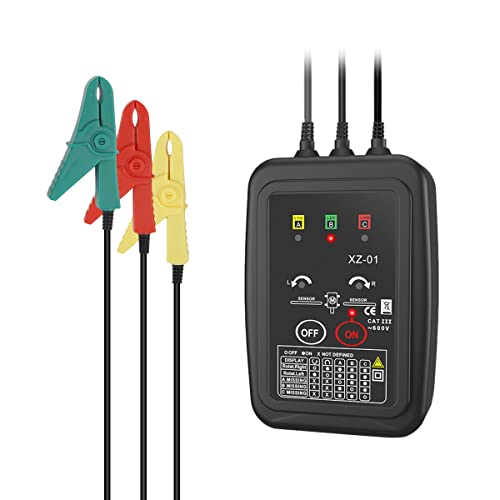
KAISAL’s non-contact phase rotation meter uses three clamps with ultra-high magnetic induction alloy to improve sensitivity for detecting phase rotation without direct wire contact. It supports phase sequence detection, open phase detection, live power checks, and motor rotation checks. Best for technicians who require high sensitivity in tight or high-EMI environments. Limitation: device complexity may require more user familiarity for accurate interpretation in busy panel areas.
IDEAL Electrical 3-Phase Motor Rotation Tester

Ideal Industries’ 3-Phase Motor Rotation Tester combines phase sequence checks, motor rotation indication, and open-phase detection with color-coded alligator clips and a nylon carrying case. It is designed for IEC-1010 compliant work up to 600V, making it a solid general-purpose choice for electricians who require durable, field-ready tools. Caveat: it may be heavier and more feature-rich than needed for purely quick phase checks in small projects.
ETCR ETCR1000D Non-Contact Phase Sequence Tester

ETCR1000D offers a wide test range from 70V to 1000V with a 0.4–1.6 inch wire diameter compatibility. LEDs display phase orientation and live status, with a buzzer for phase confirmation, making it a versatile choice for routine line maintenance and fault location. Best for users who need a broad voltage range and clear audible/visual feedback. Limitation: non-contact design may be less intuitive in environments with heavy electromagnetic interference.
Buying Guide: How to Choose a High Voltage Phase Rotation Meter
- Voltage range needed: Match the device to your typical working voltage. For industrial settings, prioritize models that handle up to 1000V. For simple panel work, 200–600V devices may suffice.
- Safety and non-contact testing: Non-contact meters reduce risk by measuring through insulation. These are preferred in energized systems, but ensure the device’s clamp range fits your cables.
- Lead length and clamps: Longer leads and larger clamp jaws improve reach and compatibility with bigger cables. Consider whether you work with motor leads, bus bars, or compact wires.
- Indication methods: LED indicators, audible buzzers, and LCD readouts affect readability in noisy environments. Choose a method that your team can interpret quickly.
- Safety features and durability: Look for rugged housings, non-metallic contact clips, and certified insulation when working near live equipment.
- Portability versus feature set: Compact meters are easier to carry, while feature-rich models offer more diagnostic capabilities. Balance needs against budget.
- Warranty and support: Reputable brands with clear support channels help with calibration and parts if needed over time.
Frequently Asked Questions
- What is a phase rotation meter used for? It verifies phase sequence, detects open or missing phases, and confirms motor rotation direction to ensure correct wiring and safe operation.
- Can I use a non-contact meter on energized equipment? Yes, non-contact meters are designed for safe operation around live conductors, reducing the need to strip wires.
- What voltage range should I consider for heavy industrial work? Look for meters rated up to 1000V for versatility across various industrial applications.
- Are clamp-type meters safer than contact testers? Clamp-type non-contact devices minimize exposure to live wires, improving operator safety in many scenarios.
- Which feature matters most for motor maintenance? Choose a model with clear phase rotation indication, robust clamps, and sufficient lead length to reach motor terminals without repositioning the device frequently.
- Do I need a dedicated motor rotation tester? If you regularly troubleshoot motors and rely on quick, repeatable phase checks, a purpose-built motor rotation tester can speed up diagnostics.