
Best Generator for RV Trailer: Reliable Power on Every Road Trip
Traveling with an RV or trailer demands dependable power that can handle appliances, chargers, and climate control without waking the whole park. This guide reviews five top-rated RV-ready generators, focusing on inverter technology for clean power, portability for camping life, and features that improve safety and usability. Each option below includes key specs, run times, and what makes it suitable for different kinds of trips—from weekend getaways to extended journeys off-grid. Use the buying guide to compare watts, fuel types, noise, and additional safety features.
| Product | Brand | Surge / Running Watts | Fuel Type | Key Benefit |
|---|---|---|---|---|
| WEN 4800-Watt (56477i) | WEN | 4800 / 4000 | Gas | Quiet, RV-ready, long half-load run time |
| WEN 3600-Watt (56360i) | WEN | 3600 / 2900 | Gas | Ultralight portability for easy towing |
| WEN 5600-Watt (GN5600) | WEN | 5600 / 4500 | Gas | Higher power with wheels and long runtime |
| Champion 4000-Watt Inverter | Champion | 4000 / 3000 | Gas | Low noise, CO Shield safety, lightweight |
| Westinghouse 4650 Peak | Westinghouse | 4650 / 3600 | Gas | RV-ready outlets and lengthy run time |
WEN 4800-Watt Portable Inverter Generator

The WEN 4800-Watt (56477i) combines RV-friendly power with inverter-driven clean energy. Its 224cc engine delivers up to 4800 surge watts and 4000 rated watts, sufficient for air conditioners, microwaves, and charging stations while protecting sensitive devices like smartphones and laptops. The unit is designed for quiet operation and features a compact 1.9-gallon tank that yields up to seven hours of runtime at half load, reducing fuel stops on longer trips. This model is ideal for mid-range RV setups or weekend adventures where stable power without excessive noise matters most.
WEN 3600-Watt Portable Inverter Generator

The WEN 3600-Watt (56360i) is designed for ultralight portability. With a 149cc engine generating up to 3600 surge watts and 2900 running watts, this inverter provides clean power to protect electronics on compact setups. Weighing roughly 46 pounds, it’s easy to transport and store in smaller RVs or trailers. Its efficient design balances wattage and weight for travelers who prioritize ease of setup and fuel economy without sacrificing essential RV power needs.
WEN 5600-Watt Portable Generator

The WEN GN5600 offers greater power with a 224cc engine and a reliable transfer-switch compatibility. It delivers 5600 starting watts and 4500 running watts, with a 4.3-gallon tank that can run roughly 12.5 hours at half load. Wheels and a handle kit facilitate transportation to and from the campsite or storage area, which helps RV owners who use their generator for extended trips or frequent site changes. This model suits larger RVs or groups that require higher load management during outages.
Champion 4000-Watt RV Ready Inverter

Champion Power Equipment’s 4000-Watt inverter is built for RV life with quiet technology and CO Shield safety. Weighing under 49 pounds, it’s one of the lighter 4000-watt options on the market. It produces around 64 dBA at 23 feet, making it suitable for quiet camping environments, tailgating, or powering essential home backups. The unit provides 4000 starting watts and 3000 running watts, offering up to 10 hours of runtime. Optional parallel capability allows pairing with another unit for additional output when needed.
WEN Quiet 6800-Watt Dual Fuel RV-Ready Inverter

The WEN DF680iX offers a robust 6800 surge watts and 5100 running watts from a 224cc dual-fuel engine that can run on gasoline or propane. Dual-fuel capability provides flexibility for longer trips where gas replenishment may be uncertain. This model also includes a bonded-neutral 240V output to support Level 2 EV charging, and a CO Watchdog safety feature that automatically shuts off the unit if dangerous carbon monoxide levels are detected. It’s a strong option for larger RVs or longer excursions needing flexible fuel and advanced safety.
Westinghouse 4650 Peak Watt Portable Generator
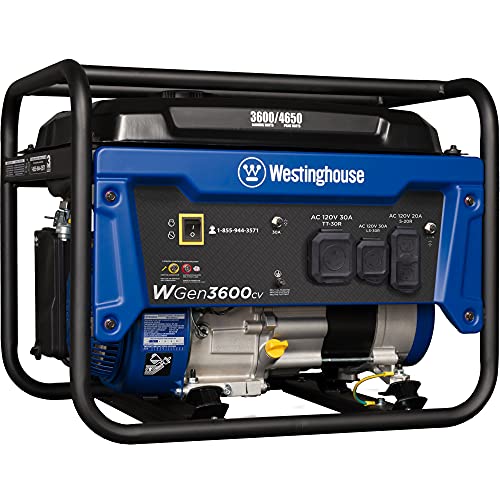
The Westinghouse 4650 Peak Watt model is RV-ready with a 4-gallon fuel tank and a long runtime of up to 14 hours per tank. It provides 3600 running watts and 4650 peak watts, with multiple outlets including RV-Ready TT-30R. Its design emphasizes safety and convenience with rubber-covered outlets and an overall user-friendly setup that suits mid-sized RVs requiring reliable energy for climate control and appliances during camping trips.
Buying Guide: Key Purchase Considerations
- Power needs: Estimate total running watts for essential appliances (air conditioner, refrigerator, microwave) plus charging devices. Choose a unit with a comfortable margin (20–50% higher than your calculated load).
- RV readiness: Look for RV-ready outlets (TT-30R) and transfer-switch compatibility. Inverter technology helps protect sensitive electronics from power surges.
- Fuel and runtime: Gasoline models are common and convenient, while dual-fuel units offer flexibility. Check tank capacity and expected run time at half-load to gauge stopping frequency on trips.
- Portability: Consider weight, wheels, and handles. Lighter models are easier to move into storage or into/out of the RV storage bay, but heavier units often offer higher wattage and longer runtimes.
- Noise level: For campground etiquette, prioritize models labeled as quiet or under a specific decibel rating at a standard distance (e.g., 23 feet).
- Safety features: CO sensors, auto shutoff, and bonded-neutral configurations protect users and equipment. If planning to charge or power EVs, look for models with appropriate electrical configurations.
- Expansion options: Some models support parallel operation with a second unit for additional wattage. This is helpful for larger RV setups or frequent hosts at campsites.
- Maintenance and warranty: Check warranty length, service availability, and whether parts like spark plugs and air filters are readily available near your travel routes.
In choosing the best generator for an RV trailer, consider the balance between power, weight, noise, and safety. The options above cover a spectrum from compact, quiet inverters to more robust, dual-fuel choices that suit extended trips or higher load needs. Always plan for worst-case scenarios at your typical campsite, and verify that your RV’s electrical system can safely handle the selected generator’s output.