
Best Battery Terminal Fuse Blocks for Reliable Power Protection
Choosing the right fuse block for a battery terminal is essential for protecting electrical systems in boats, trucks, RVs, and other vehicles. This guide highlights five top-rated options, explains key features, and helps you compare capabilities like amp rating, voltage, material quality, and weather resistance. All selections are designed to fit standard 5/16″ studs and 58V DC systems while delivering durable performance in demanding environments.
Summary of Selected Products
| Product | Brand | Max Current | Voltage | ||
|---|---|---|---|---|---|
| Joinfworld MRBF Terminal Fuse Block 100A | Joinfworld | 100A | 58V DC | 5/16″ (M8) | Waterproof cap |
| Blue Sea Systems 5191 Fuse Block | Blue Sea Systems | 300A per block | 58V DC | 5/16″-18 (8mm) | Weatherproof |
| Blue Sea Systems 5023 ST Blade Block | Blue Sea Systems | 4 fused circuits | 58V DC | – | Designed for terminal mounting |
| BOJACK MRBF 250A Fuse Block | BOJACK | 250A | 58V DC | 5/16″ (M8) | IP66 waterproof rating |
| Joinfworld MRBF 250A Fuse Block | Joinfworld | 250A | 58V DC | 5/16″ (M8) | Waterproof cap |
Joinfworld MRBF Terminal Fuse Block 100A

The Joinfworld 100A MRBF terminal fuse block is designed for 58V DC systems, making it suitable for marine, automotive, and RV applications. It uses thermoplastic PPS for the main body and stainless steel studs and nuts, which enhances high-temperature performance and electrical conductivity. The unit is compact and easy to install, helping to minimize space in constrained engine bays or battery compartments. Its waterproof cap provides protection against moisture and salt exposure, supporting long-term reliability in rough environments.
Blue Sea Systems 5191 Fuse Block

The Blue Sea Systems 5191 block supports up to 300A per block and is compatible with 58V DC systems. It uses a 5/16″ (8mm) terminal stud and a 3/8″ mounting hole for sturdy installation. This block is compact yet high-capacity, making it a strong choice for demanding main circuit protection on boats, trucks, and off-grid setups. Weatherproof construction ensures durability in open environments.
Blue Sea Systems 5023 ST Blade Fuse Block

The 5023 ST Blade Fuse Block is a four-circuit, easy-to-install solution that mounts on the battery terminal stud. It includes screw terminals for securing wires, offering a straightforward way to protect multiple circuits with ATO/ATC fuses. Its compact form and terminal-focused design make it ideal for installations needing clean wiring and reliable circuit protection in smaller spaces.
BOJACK MRBF 250A Fuse Block
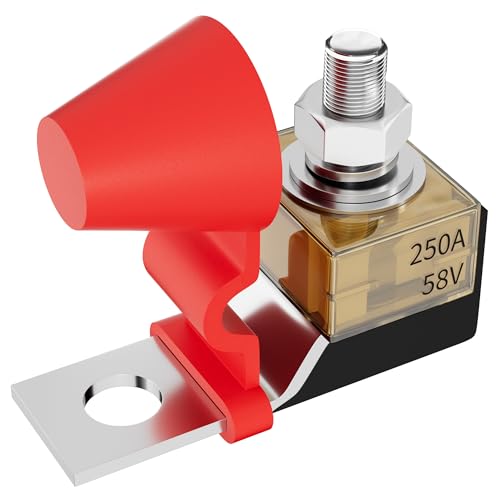
The BOJACK 250A MRBF terminal fuse block is designed for marine and vehicle use, rated at 58V DC with IP66 waterproof capability. The body is constructed from ceramic and PPS UL 94-V0 thermoplastic, with tin-plated terminal surfaces to enhance protection against corrosion. Its rugged build is suited for harsh environments where reliable main circuit protection is critical.
Joinfworld MRBF 250A Fuse Block
The 250A MRBF fuse block from Joinfworld matches the 58V DC rating and uses 5/16″ studs with a 3/8″ mounting hole. It emphasizes easy installation and space efficiency, making it a convenient option for vehicles and boats requiring high-current protection. Stainless steel studs and hardware contribute to stable electrical performance in high-heat conditions.
Buying Guide: Key Considerations For Battery Terminal Fuse Blocks
When choosing a fuse block for battery terminals, consider current and voltage ratings, compatibility with your battery studs, environmental exposure, mounting options, and serviceability. High-current models (100–300A) are essential for main power protection in boats and RVs, while 4-way or multi-circuit blocks help simplify wiring in compact spaces. Weatherproof or IP-rated construction improves durability in open-air installations. Material quality—such as PPS thermoplastic bodies and stainless steel studs—contributes to longevity under heat and vibration. Finally, verify compatibility with your fuse types (ATO/ATC) and ensure the mounting footprint aligns with your battery compartment.
Other perspectives include: evaluating ease of installation and maintenance, ensuring that the block can withstand salt, spray, and humidity in marine apps, and confirming that terminal studs and mounting holes align with existing hardware. For commercial fleets, redundancy and serviceability may trump ultra-compact design, while for DIY enthusiasts, compactness and cost can be decisive factors. Always consult product datasheets to confirm voltage and amperage limits, stud sizes, and mounting requirements before purchase.