As an Amazon Associate I earn from qualifying purchases. These links may earn this site a commission when you buy, at no extra cost to you.
For woodworkers seeking fast, clean, and precise ripping results, an FTG (Flat Top Grind) table saw blade can make a noticeable difference. This article highlights five high-performing FTG blades from trusted brands, detailing their construction, kerf, and optimal applications. Each blade is evaluated for efficiency, durability, and finish quality to help you choose the best option for your saw and materials.
| Product | Brand | Teeth / Kerf | Arbor | Why It Stands Out |
|---|---|---|---|---|
| FOXBC 10-Inch Thin Kerf Ripping Table Saw Blade | FOXBC | 24T FTG, .094″ kerf | 5/8″ | Lightweight kerf, smooth cutting with reduced vibration and noise; durable tungsten carbide |
| Freud LU87R010 Thin Kerf Rip Saw Blade | Freud | 24T, .071-0.126″ kerf options (0.071″ plate) | 5/8″ | Premium TiCo carbide, optimized for low-power saws with clean, precise rips |
| CMT 201.024.10 Industrial Ripping Blade | CMT ORANGE TOOLS | 24T, .0126″ kerf | 5/8″ | Rugged build for rapid, heavy-duty ripping across soft/hardwood |
| CMT 221.060.10 Industrial Cabinetshop Saw Blade | CMT ORANGE TOOLS | 60T, 0.126″ kerf | 5/8″ | Fine finish crosscuts and laminates with PTFE coating for reduced friction |
| CMT P10050 ITK Plus Combination Blade | CMT ORANGE TOOLS | 50T, 0.094″ kerf | 5/8″ | Versatile rip/crosscuts with efficient chip clearance |
Note: All selections are intended for heavy-duty ripping and general-purpose table saw work. Always verify blade compatibility with your specific saw model and arbor size before purchase.
FOXBC 10-Inch Thin Kerf Ripping Blade

The FOXBC blade features a 10-inch diameter with a thin kerf of .094 inches and a 24-tooth FTG grind, optimized for fast, smooth wood ripping. Its 5/8-inch arbor matches common table saws, and the high-density tungsten carbide teeth deliver wear resistance and long blade life. The combination reduces vibration and noise compared to thicker kerfs, contributing to cleaner finishes on both softwoods and hardwoods.
Freud Heavy-Duty Rip Blade With TiCo Carbide

Freud’s LU87R010 is designed for high-performance ripping with a robust TiCo carbide blend. The blade features a flat top grind (FTG) with 24 teeth and a 5/8″ arbor. Its rigid body helps maintain stability during aggressive cuts, delivering a clean glue-line finish on both hardwoods and softwoods. The design is compatible with a range of materials and thicknesses, typically from 3/4″ to 2-3/4″.
CMT 201.024.10 Industrial Ripping Blade

The CMT 201.024.10 is built for fast, heavy-duty ripping with a 24-tooth FTG grind and .0126″ kerf. With a 5/8″ arbor, this blade excels on both softwoods and hardwoods, particularly in machines designed for ripping operations. Technical details emphasize a balance between kerf integrity and aggressive tooth geometry for efficient material removal and steady, consistent performance.
CMT 221.060.10 Cabinetshop Saw Blade

This 10-inch blade with 60 teeth is designed for cabinetmaking and crosscut-focused work, featuring a trapezoidal tooth grind and PTFE coating to reduce friction and heat. The 0.126″ kerf and 0.087″ plate thickness pair with a 5/8″ bore to support accurate, chip-free cuts when trimming laminates and plywood in high-volume shop settings.
CMT ITK Plus P10050 Combination Blade
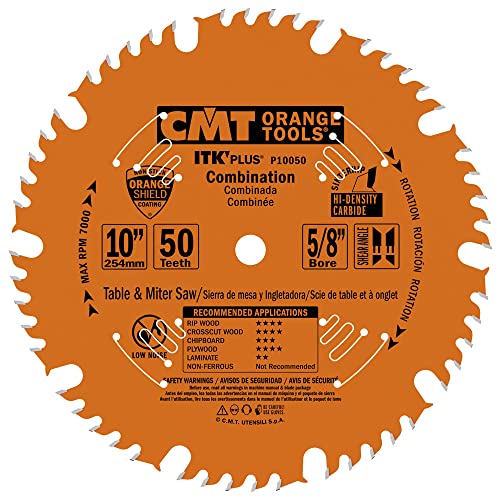
The P10050 ITK Plus combines 50 teeth with a 1FTG+ 4ATB configuration and a 5/8-inch bore for versatile rip and crosscut performance. Its large gullets enable deep chip clearance, supporting rapid cutting of softwoods, hardwoods, and plywood. The blade’s 0.094″ kerf and 0.063″ plate thickness contribute to efficient material removal and a finer finish in mixed-cut applications.
Buying Guide: Key Purchase Considerations
- Cutting task and material type: For clean rips in hardwoods, look for blades with robust carbide and a flat-top grind (FTG). For composite and plywood, consider blades with PTFE coatings to reduce gumming and heat buildup.
- Kerf and power requirements: Thin-kerf blades (.071″–.098″) reduce shear forces and are better for underpowered or smaller saws, while standard kerf blades provide stability on larger saws.
- Tooth count and grind: Higher tooth counts yield smoother finishes on crosscuts, while lower counts (like 24T) emphasize aggressive ripping. FTG designs minimize resistance and chatter during heavy cuts.
- Arbor compatibility and mounting: Ensure a 5/8″ arbor is compatible with your saw. Some specialty blades may offer alternatives; verify bore size and stabilizing features before purchasing.
- Coatings and build quality: PTFE or other coatings reduce friction and heat, extending blade life. TiCo or other high-density carbide blends improve edge retention and cutting performance.
- Maintenance and usage: Regular cleaning of buildup, proper feed rate, and avoiding bogging the saw down help maintain accuracy and finish quality over time.
- Versatility versus specialization: Combination blades offer good all-around performance, while dedicated ripping blades excel at fast, straight cuts through thick stock.