
Best Electrical Insulating Mats for Safe High-Voltage Work Environments
If you work around high-voltage equipment, you need reliable insulating mats to protect against electric shocks. This guide highlights five top options, outlining who each product is best for and why. It’s ideal for electricians, substation technicians, and maintenance teams seeking durable, non-slip insulation mats that fit various workspaces. A quick summary table below compares key details to help you decide faster.
| Product | Best For | Key Benefit |
|---|---|---|
| Viuseo 20″ x 20″ Electrical Safety Mat | Small to medium workbenches; tight spaces | 6000V insulation with portable, cut-to-fit design |
| Yunlake 10 FT Electrical Safety Rubber Mat | Large areas and equipment bases | Large coverage; easy to cut to fit |
| Maasechs 2 Pcs 20″ x 20″ Insulated Mats | Professional electricians; workstations | Two mats with high-visibility orange; 1000V rating |
| KNIPEX Tools Rubber Insulating Mat 40″ x 40″ | Heavy-duty live-work environments | Large surface area; strong insulation at 1000V |
| RENLXFI Red High Voltage Flooring Mat | Distribution rooms; larger installations | Multiple thickness options for varied voltage protection |
Viuseo 20″ x 20″ Electrical Safety Mat

Best for compact spaces and personal workstations, this mat delivers 6000V insulation to block current paths and protect operators in distribution rooms or repair sites. The natural rubber construction offers flexibility, water resistance, oil resistance, and durability against compression and impact. It can be cut to size for a precise fit and rolls up for easy transport. Ideal for technicians who need a portable, reliable mat that can be customized to fit smaller work areas. Caution: cutting may affect edge integrity and insulation performance if not done carefully.
Yunlake 10 FT Electrical Safety Rubber Mat

Best for covering large work zones, this 10 ft by 3.28 ft mat provides substantial area protection. It’s made from natural rubber, offering toughness, water resistance, oil resistance, and compression resilience to prevent deformation over time. It’s also easy to cut to different sizes to fit irregular workspaces. Choose this if you need broad coverage to shield large equipment bases or expansive repair tables. Limitation: very large mats may be heavier to move compared to smaller pieces.
Maasechs 2 Pcs 20″ x 20″ Insulated Mats
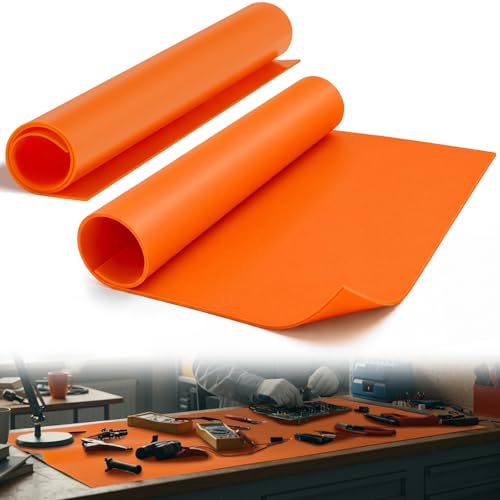
Best for professional electrical workspaces requiring 1000V protection, this pair provides ample coverage for workbenches and equipment bases. The thick industrial rubber with a textured anti-slip surface resists wear and deformation and helps keep tools and hands stable during work. It’s particularly suitable for electricians performing panel maintenance or transformer work. Caution: two mats may be needed to cover larger areas beyond a single workstation.
KNIPEX Rubber Insulating Mat 40″ x 40″

Best for heavy-duty live-work environments, this large 40″ x 40″ insulating mat offers a broad, non-conductive surface with 1000V insulation rating. The generous size reduces the need to reposition frequently and provides a reliable safe zone around critical equipment. Limitation: the product emphasis is on protection when working near live parts, so overly small work areas may require additional mats to achieve full coverage.
RENLXFI Red High Voltage Flooring Mat

Best for distribution rooms and larger installations, this insulating rubber mat comes in multiple thickness options to match varying voltage protection needs. Its rubber construction delivers wear resistance, waterproofing, and oil resistance, while an anti-slip surface reduces the risk of slips in hazardous environments. Choose this if you want scalable protection across different zones and equipment. Caution: verify the exact thickness aligns with your voltage requirements before purchasing.
Buying Guide: Key Purchase Considerations
- Voltage rating: Match the insulation rating (e.g., 6000V, 1000V, up to 35 kV) to the electrical tasks you perform. Higher ratings generally provide greater protection but may come with increased stiffness or weight.
- Size and coverage: Assess workspace dimensions. Large mats reduce seams and gaps but may be heavy; smaller mats offer flexibility for tight spaces.
- Material quality: Look for natural rubber with oil and water resistance, good tear strength, and anti-slip textures. This improves durability and safety in demanding environments.
- Edge and seam considerations: Some mats are designed to be cut to fit; others come in fixed sizes. If cutting, ensure you maintain insulation integrity along cut edges.
- Visibility and safety cues: High-visibility colors (like bright orange) help delineate safe zones and reduce accidental contact with energized equipment.
- Portability and storage: Rollable mats offer easy transport and storage, important for mobile technicians or multi-site work.
Frequently Asked Questions
- What thickness should I choose for a high-voltage mat? – Thicker mats generally provide more cushioning and durability, with thicker options often supporting higher voltage ratings. Choose based on both safety needs and the heaviness of equipment.
- Can these mats be cut to fit irregular spaces? – Some mats are designed to be cut to size; others come fixed. If cutting, follow manufacturer guidance to preserve insulation properties at the edges.
- Do these mats prevent electrical shocks completely? – They reduce the risk by blocking current paths, but they should be used as part of a broader safety protocol, including PPE and proper lockout/tagout procedures.
- Are colored mats better for safety? – Bright colors improve visibility and help establish insulated zones, which can reduce accidental contact with live components.
- Is heavier always better for stability? – Heavier mats tend to stay in place better, but weight should be balanced with handling practicality for transport and setup.
- Which mat is best for small workspaces? – Compact 20″ x 20″ mats like Viuseo are ideal for tight areas, offering easy cutting and portable use.