
Best Electric Roof Heating Cables for Preventing Ice Dams and Heat Loss
Answering your search for reliable roof de-icing solutions, this guide covers top electric roof heating cables suited for American homes. It highlights who each product is best for, compares key specs, and notes practical considerations. This selection focuses on kit-type roof cable systems that are pre-assembled for easier installation and safer operation. Ideal buyers include homeowners dealing with ice dam issues, property managers seeking low-maintenance de-icing, and contractors planning quick, scalable installations.
Summary table of chosen products:
| Product | Length | Wattage | Best For |
|---|---|---|---|
| Frost King RC160 | 160 ft | 800 W | Medium-to-large roofs; DIY installers who want ready-to-install kits |
| Frost King RC100 | 100 ft | 5 W/ft (≈600 W total) | Smaller roof edges; budget-conscious projects |
| Frost King RC200 | 200 ft | 1000 W | Large roofs; extensive guttering protection |
| TOPDURE 160ft | 160 ft | 5 W/ft | Versatile roof and gutter de-icing; certified safety emphasis |
| HEATIT 100ft Self-Regulating | 100 ft | 8 W/ft | Pipe freeze protection and roof de-icing with thermostat |
Frost King RC160 Roof Cable Kit

Overview: Frost King RC160 provides 160 feet of de-icing cable rated at 120V and 800W. The kit is pre-assembled and designed for straightforward installation with easy-to-follow instructions included. Best for medium-sized roof edges and gutters where a single, continuous run is practical.
Who it’s best for: Homeowners tackling moderate ice dam risk on standard to medium roofs who want a ready-to-install, self-contained solution without extra parts. The 160-foot length supports longer roof spans with fewer splices.
Why chosen: The RC160 balances length and wattage to address ice dams efficiently on typical American homes. Its pre-assembled nature reduces installation complexity, making it suitable for DIY projects.
Limitations: As a fixed load solution, ensure the area you cover aligns with the cable length to avoid under- or over-wattage coverage. A larger roof might benefit from a longer kit or multiple runs.
Frost King RC100 Automatic Roof Cable Kit

Overview: The RC100 kit covers 100 feet at 120V with an overall output of 5 watts per foot. It is pre-assembled for quick installation and includes straightforward instructions. This option suits smaller roof sections or tighter gutter lines where a compact solution is preferred.
Who it’s best for: Homeowners with shorter roof spans or limited installation space who still want a reliable de-icing solution you can install without complex wiring.
Why chosen: The RC100’s compact length makes it ideal for constrained projects while still delivering effective ice dam prevention when used on appropriate roof lengths.
Limitations: The shorter length means you may need additional runs for larger roofs, which can complicate installation and require careful planning to avoid gaps in protection.
Frost King RC200 Roof Cable Kit

Overview: The RC200 kit delivers 200 feet of 120V cable with a 1000W capacity. It’s pre-assembled for easy installation and includes simple-to-follow instructions. This option is designed for larger roof areas or extensive gutter protection.
Who it’s best for: Property owners with expansive rooflines or multiple gutters where a longer reach reduces the number of separate wiring runs.
Why chosen: The RC200’s higher wattage and length provide robust de-icing coverage, helping to prevent ice dams across bigger homes or commercial-style roof sections.
Limitations: Longer runs require careful routing to avoid overheating and ensure consistent temperature along the length of the cable. Verify the electrical supply accommodates higher wattage needs.
TOPDURE 160ft Roof And Gutter Cable

Overview: TOPDURE’s 160-foot de-icing cable uses 5 watts per foot and is CSA ETL certified for safety. The kit targets ice dam prevention on roofs, gutters, and downspouts with a focus on reliable safety standards. The cable is designed to be installed along metal or plastic gutters and inclined roof surfaces.
Who it’s best for: Buyers prioritizing comprehensive safety certifications and a longer run for mid-to-large roofs. It’s a solid choice for installers who want verified safety credentials alongside effective de-icing.
Why chosen: The combination of constant wattage and strong safety certifications makes TOPDURE a dependable option for ongoing winter maintenance on varied roof configurations.
Limitations: Fully certified cables require correct installation to maintain safety guarantees. Avoid overlaps and ensure spacing guidelines are followed to prevent overheating.
HEATIT 100ft Self-Regulating Cable
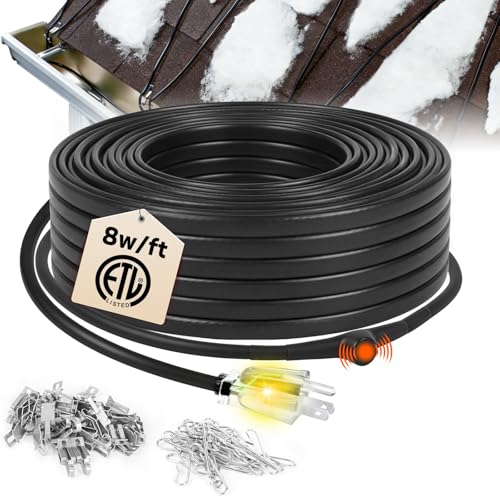
Overview: HEATIT’s 100-foot self-regulating cable uses 8 watts per foot and includes a thermostat with a 10-foot power plug. The entire kit, including the plug, is ETL listed for comprehensive safety. It is suitable for roof de-icing, gutters, and pipe freeze protection, with automatic power adjustment based on temperature.
Who it’s best for: Homeowners seeking a self-regulating solution that adapts power to conditions, ideal for mixed applications like roof edges, gutters, and nearby pipes where temperature variation occurs.
Why chosen: The self-regulating technology reduces overheating risk and simplifies maintenance, making it a safer option for variable winter conditions and installations with uneven heat needs.
Limitations: The 100-foot length may require multiple runs for larger roofs. Always pair with proper insulation and an appropriate power source to maximize efficiency.
Buying Guide: How To Choose The Right Electric Roof Heating Cable
- Roof size and length: Match cable length to roof edge coverage. Longer runs reduce the need for splices but require careful routing and load planning.
- Wattage and heat output: Higher wattage provides faster ice melt but demands more electrical capacity. For large roofs, consider multiple cables or higher-rated kits.
- Self-regulating vs constant wattage: Self-regulating cables automatically adjust heat to prevent overheating, while constant wattage cables deliver steady performance but require precise placement and spacing.
- Certification and safety: Look for ETL and CSA certifications for comprehensive safety assurances across the entire cable system, not just the plug.
- Installation convenience: Pre-assembled kits save time and reduce on-site wiring. Consider included instructions and mounting hardware for your roof type.
- Environment compatibility: Confirm compatibility with your roof materials, gutters, and downspouts. Some cables are better suited to metal gutters or asphalt shingles.
- Maintenance and longevity: Choose cables with durable insulation and protective coatings for winter seasons and freeze-thaw cycles.
FAQ
- What’s the main difference between self-regulating and constant-wattage roof cables?
Self-regulating cables vary heat output based on temperature, reducing overheating risk. Constant-wattage cables maintain uniform heat along their length and may require careful placement to avoid hotspots. - Do I need instructions or professional installation for these cables?
Most kits are designed for DIY installation with included instructions, but verify wiring requirements and local electrical codes before starting. - Can these cables be used on all roof types?
They are generally suitable for many roof types, gutters, and downspouts, but verify compatibility with your roofing material and gutter system in the product details. - How do I determine the right length for my roof?
Measure the roof edge and gutter length you want protected. Choose a kit that covers that distance with some buffer for joints and corners. - Are certifications like ETL and CSA important?
Yes. Complete cable certifications ensure comprehensive safety compliance for the entire system, not just the plug. - What maintenance is required once installed?
Inspect cable runs periodically for wear, secure mounting, and ensure the thermostat or control remains functional if included.