
Best Electric Current Detector Tool Picks for Safe, Efficient Circuit Work
If you need a reliable way to detect live voltage without direct contact, these non-contact voltage testers help identify live wires, outlets, and breakers quickly. This guide highlights five top options ideal for electricians, DIY homeowners, and service professionals who want clear alerts and easy-to-read readings. Each product includes who it’s best for and practical caveats to consider before buying.
| Product | Best For | Key Reason |
|---|---|---|
| Klein Tools NCVT1P | General electrical work | Bright, clear alerts and 50–1000V range |
| KAIWEETS Voltage Tester | Flexible, sensitive testing | Dual range with LCD display and adjustable sensitivity |
| Neoteck Non-Contact Voltage Detector | Quick identification | Simple beeps and LED indicators for live/null wires |
| Saker 3-in-1 Circuit Breaker Finder | Complex panel work | Breaker finder, outlet tester, and GFCI test in one |
| VENLAB Voltage Tester | Versatile range | Dual-range 12V–1000V and 48V–1000V with alarms |
Klein Tools NCVT1P Voltage Tester

The Klein Tools NCVT1P is a non-contact voltage tester with a 50V–1000V AC detection range and audible plus flashing LED alerts. It’s best for electricians and maintenance pros who need quick verification of live circuits without direct contact.
Best for: Routine electrical maintenance and quick spot checks where a compact, non-contact tool is preferred. The green LED confirms operation, while a red flash and audible alert indicate voltage presence.
Limitation: While excellent for general use, it does not provide precise voltage values or detailed readings, which may be needed for in-depth diagnostics.
KAIWEETS Voltage Tester

The KAIWEETS tester provides dual-range AC voltage detection (12V/70V–1000V) with an LCD display and a responsive buzzer. It automatically distinguishes live and neutral wires and offers sensitivity adjustments for precise detection in varied environments.
Best for: Users who need sensitivity control and a clear voltage readout for both low- and high-voltage tasks, such as thermostat wiring or doorbell work.
Limitation: The device has a complex feature set; beginners may require a short learning curve to interpret the LCD bar graph and sensitivity controls effectively.
Neoteck Non Contact Voltage Detector

The Neoteck tester detects 12–1000V AC with audible beeps and LED indicators to distinguish live versus null wires. It includes a flashlight feature for low-light inspections and provides a straightforward indication of voltage presence.
Best for: Quick, simple checks in dim work areas or when a lightweight, inexpensive option is needed for basic circuit verification.
Limitation: It may not support the widest voltage range beyond its stated 12–1000V, and the LED/Beep cues are not as feature-rich as some higher-end models.
Saker 3-in-1 Circuit Breaker Finder

The Saker tool combines circuit-breaker finding, receptacle testing, and GFCI trip testing with an LCD readout showing voltage, frequency, and wiring status. It uses NCV sensing to locate live circuits without penetrating walls and offers auto data hold for after-work review.
Best for: Electrical pros performing remodels, panel inspections, or service calls that require locating breakers and verifying wiring conditions in real time.
Limitation: The feature-rich setup may be more than needed for simple home testing; it’s best when you anticipate multiple testing tasks in one session.
VENLAB Voltage Tester
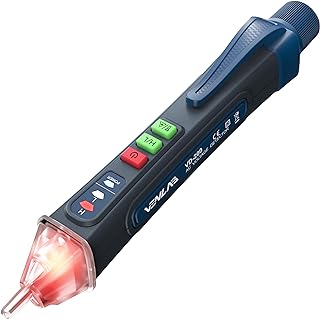
The VENLAB device offers dual-range detection (12V–1000V and 48V–1000V) with both audible and visible alarms and an LCD display. It is designed to adapt to various electrical testing tasks, from residential wiring to broader electrical work.
Best for: Users who need versatility across both standard and lower-voltage scenarios, with a clear LCD readout for quick interpretation.
Caution: When testing very low voltage or nearby live sources, confirm the sensitivity setting to prevent misreads or missed detections.
Buying Guide
- Voltage range needs: Choose a tester that covers the voltage ranges most common in your work. If you often work with 120V-240V systems, ensure the device handles at least 250V or more for safety.
- Reading method: Do you prefer a simple LED/beep indicator, a bar graph, or a full LCD readout with frequency data?
- Non-contact vs. contact: Non-contact models reduce risk of shock, but some tasks benefit from a contact-capable tester to verify continuity or precise measurements.
- Sensitivities and modes: Dual-range testers or adjustable sensitivity help tailor detection for low-voltage devices like thermostats or doorbells.
- Ease of use and form factor: Compact pocket testers suit fieldwork; bulkier tools may offer more features but can be heavier to carry daily.
- Special features: LCD voltage display, auto data hold, GFCI testing, and NCV indicators improve workflow in panels or wall interiors.
FAQ
- What is a non-contact voltage tester? It detects AC voltage without touching conductors, using a sensor near the tip to indicate live circuits.
- When should I use a dual-range tester? Use dual-range testers when switching between low-voltage and high-voltage tasks to ensure sensitivity matches the work.
- Can these testers identify exact voltage values? Some models show approximate readings on an LCD or bar graph, while others emit alert signals without numeric values.
- Are these testers safe for home use? Yes, they’re designed for safe, non-contact detection, but always follow manufacturer instructions and standard electrical safety practices.
- What’s the advantage of an LED and audible alert? Immediate, hands-free indication helps you quickly locate live circuits and reduces guesswork on-site.
- Do testers require calibration? Most consumer testers do not require routine calibration for typical use, but refer to the user manual for maintenance guidelines.