
Best Electric Baseboard Heater Relay Solutions for Easy Thermostat Control
This guide reviews practical, plug-and-play electric baseboard heater relays that work with 24V thermostats or low-voltage controls. It highlights models that offer built‑in transformers, easy installation, and reliable switching for improved temperature control. Best for DIY homeowners and property managers seeking straightforward replacement relays, these options support 24V thermostats and vary by voltage compatibility, installation style, and compatibility with 2- or 3-wire setups.
Summary of selected products:
| Product | Voltage | Built‑in Transformer | Best For |
|---|---|---|---|
| Aube RC840T‑240 On/Off | 240V | Yes | Users needing 24V thermostat control for 240V baseboard heaters |
| OONO F‑1057 | 120V | Yes | Low‑voltage thermostats with 120V loads |
| Aube RC840T‑240 (2 Pack) | 240V | Yes | Bulk replacement or multi‑zone setups |
| Aube RC840T‑120 | 120V | Yes | Standard 24V thermostat integration for 120V systems |
| Honeywell R841C1227/U | Typically 120/240V (line voltage switch) | No built‑in transformer | Older systems or when transformer isn’t needed |
Aube Technologies RC840T-240 On/Off Relay with Built‑in 24V Transformer

This direct replacement relay includes a built‑in 24V transformer for easy installation and is compatible with 24V thermostats using 2-wire (R, W) or 3-wire (R, W, C) connections. Best for homeowners upgrading legacy relays while maintaining 24V control. A potential limitation is the 240V load may require proper wiring to existing junction boxes.
OONO F-1057 120V Relay With Built‑in 24V Transformer

The F‑1057 controls a 120V line voltage resistive load from a low voltage thermostat and includes a built‑in 24V transformer. It supports 3-wire (R, C, W) and 2‑wire (R, W) thermostats, making it versatile for retrofit projects. Choose this if you need quick installation with LED indication and immediate relay action on heat demand. Caution: ensure compatibility with your thermostat type to avoid wiring mismatches.
Aube RC840T-240 On/Off Relay (Two Pack)

This 2‑pack provides dual RC840T‑240 relays with built‑in 24V transformers. Best for multi‑zone baseboard setups or when upgrading multiple rooms. It offers the same direct replacement capability and thermostat compatibility as single units. Limitation: bulk purchase requires adequate panel space and junction box access.
Aube RC840T-120 On/Off Relay With Built‑in Transformer

The RC840T‑120 provides universal replacement for 24V thermostat control of 120V loads with built‑in transformer. Best for standard 120V baseboard heating systems requiring reliable, instantaneous relay activation. Better for projects where 120V is the primary supply and a quick install is desired. Limitation: may not support higher voltage baseboard configurations without additional adapters.
Honeywell R841C1227/U Electric Heater Relay

This Honeywell relay supports line‑voltage control compatible with standard thermostat cycling, handling up to 5,000 W per relay. Best for older or simpler setups that require robust, straightforward switching without a built‑in transformer. Choose this if a direct, no‑frills control path is preferred. Limitation: no built‑in transformer, requiring a separate 24V supply if your thermostat needs one.
Aube Technologies RC840 On/Off Switching Relay
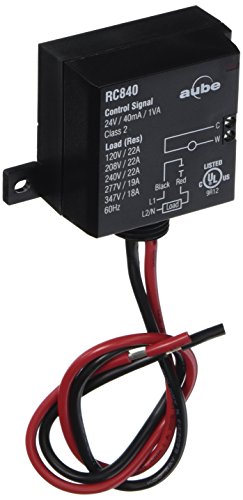
The RC840 is a universal replacement relay compatible with 24V thermostats. Immediate relay activation improves temperature control and comfort. Best for users replacing an older relay without changing thermostat wiring. Limitation: does not include a built‑in transformer, so low‑voltage control may require a separate 24V supply.
Buying Guide
What should I consider when choosing an electric baseboard relay?
- Voltage compatibility: Ensure the relay matches your baseboard heater voltage (120V or 240V).
- Thermostat interface: Check whether 2-wire, 3-wire, or wireless thermostats are supported.
- Built‑in transformer: Decide if you need a built‑in 24V transformer for thermostat control.
- Load rating: Confirm the relay can handle the heater’s wattage and current.
- Installation: Look for “universal replacement” or “easy install” language for DIY setups.
- Physical mounting: Verify panel space and mounting options in your junction box.
Single vs. multiple relays
- Single relays are suitable for one zone or room.
- Two‑pack or multi‑pack options are efficient for multi‑zone baseboard systems or future expansions.
Safety and compatibility notes
- Always power off electrical circuits before wiring.
- Follow thermostat wiring diagrams and ensure proper C‑wire connections if required.
- Verify junction box size and clearance for heat dissipation and wiring access.
FAQ
- What is a baseboard heater relay with a built‑in transformer used for?
It provides low‑voltage 24V control to switch high‑voltage (120V or 240V) baseboard heaters via a thermostat. - Do I need a 24V transformer in my relay?
If your thermostat requires a C wire or uses low voltage, a built‑in transformer simplifies wiring. - Can I replace a 24V thermostat with a new model?
Yes, but ensure compatibility with the relay’s wiring (R, W, C configurations). - Is a higher wattage load always better?
Higher load handling provides headroom for peak heat demand, but must match your heater’s rating. - Are these relays compatible with all baseboard systems?
Most are universal or widely compatible; verify voltage, thermostat type, and wiring with your system.