
Best DC Motor Driver Options for Your Projects
Choosing the right motor driver is essential for reliable control of DC motors in hobbyist and prototype builds. This guide highlights five robust drivers, covering compact modules for small motors and higher-current boards for more demanding applications. Each section details key features, capabilities, and how they suit different use cases, from simple on/off control to precise speed and direction management.
The following summary table lists the selected products and their standout specs to help you compare at a glance.
| Product | Brand | Voltage Range | Current (Per Channel) | Key Benefit |
|---|---|---|---|---|
| PN00218-CYT14 Cytron MDDS30 | Makermotor | 7V–35V | 30A continuous per channel (80A peak) | Two-channel driver with quiet switching (18 kHz) |
| WWZMDiB L298N Module | WWZMDiB | 5V logic; motor voltage varies | Up to dual motor support (2 DC or 1 two-phase stepper) | Simple, versatile dual H-bridge for small projects |
| DROK DC Motor Driver L298 | DROK | 6.5V–27V | 7A per port | Dual H-bridge with optocoupler isolation |
| Cytron MD20A 20A Driver | Makermotor | 6V–30V | Up to 20A | Bi-directional control for a single brushed motor |
| DRV8871 Motor Driver Module | Teyleten Robot | 6.5V–45V | 3.6A peak | Compact high-voltage, high-current performance |
Cytron MDDS30 Dual DC Motor Driver

The Cytron MDDS30 provides two independent channels suitable for driving DC motors with a wide operating range of 7V to 35V. Each channel supports up to 30A continuous current, with peak capability up to 80A for short durations. Onboard MOSFETs operate the outputs at approximately 18 kHz, offering quieter operation and reduced audible noise during motor drive. This module is appropriate for compact robotics or automation projects requiring moderate current per motor and straightforward control. Its dual-channel design allows synchronized or independent control of two motors, making it a practical choice for differential drive robots or dual-axis systems.
WWZMDiB L298N Motor Driver Controller Board
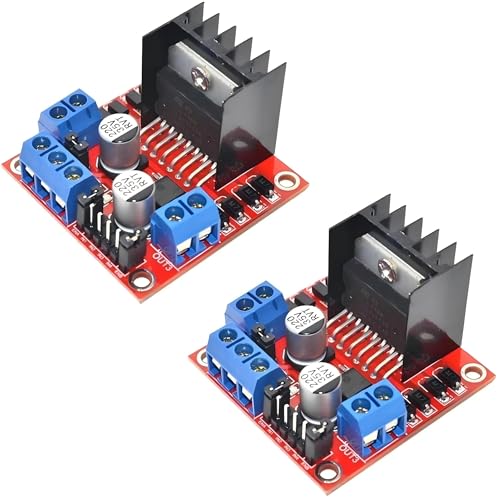
The WWZMDiB L298N module uses the classic L298N driver chip, supporting two DC motors or a single two-phase stepper motor. It operates as a dual H-bridge with logic input at 5V, offering a simple path to motor control for smaller projects or beginners. While not designed for high current, it remains a popular choice for hobbyists due to its low cost and broad compatibility with Arduino and Raspberry Pi platforms. It is best suited for lightweight robotics, educational kits, and projects where space and cost are primary considerations.
DROK DC Motor Driver L298 Dual H-Bridge

The DROK L298 driver features a dual H-bridge design, capable of driving two DC motors in either same or opposite directions. It includes optocoupler isolation and a broad input voltage range of 6.5V to 27V, with a per-port current rating of 7A. This module is well-suited to projects requiring reliable bidirectional motor control, simple wiring, and robust isolation between control logic and motor power. It’s frequently used in educational kits, automation prototypes, and small servo or conveyor systems where straightforward motor control is needed.
Teyleten Robot DRV8871 Motor Driver Module
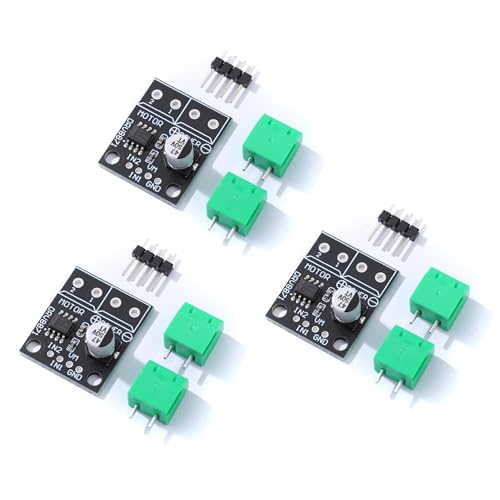
The DRV8871-based module from Teyleten Robot handles voltages from 6.5V up to 45V and supports a peak current of 3.6A. This makes it a compact option for mid-range motors that demand higher voltage flexibility and more robust performance than entry-level L298-based solutions. The DRV8871 architecture supports smooth PWM-based speed control, enabling more nuanced motor speed adjustments for robotics, CNC experiments, or automated tooling where precise torque and speed profiles matter. It also benefits from a smaller footprint suitable for space-constrained builds.
Cytron MD20A Bi-Directional DC Motor Driver

The MD20A from Cytron offers bi-directional control for a single brushed DC motor, supporting a DC operating range of 6V to 30V and up to 20A continuous current. It is a compact, single-channel driver ideal for projects where one motor requires reliable control with a simple input interface. The MD20A is suitable for small robotics, conveyor systems, or hobbyist projects that need straightforward direction and speed management without the complexity of dual-channel controllers.
Buying Guide: Key Considerations For Selecting a DC Motor Driver
- Voltage and current requirements: Match the driver’s voltage range and continuous current rating to your motor’s specifications. Exceeding current ratings can overheat and reduce motor life.
- Number of channels: Choose a single-channel vs. dual-channel driver based on how many motors you need to control and whether you require synchronized operation.
- Control interface: Determine whether you need simple PWM speed control, DIR/Step signals, or more advanced features like micro-stepping, current limiting, or isolation.
- Protection features: Overcurrent protection, current limiting, thermal shutdown, and optocoupler isolation help protect both motor and controller in demanding environments.
- Physical form factor and wiring: Consider footprint, connector types, and ease of wiring in your enclosure or project box.
- Noise and thermal performance: Higher-frequency switching and robust heat sinking improve reliability in quiet or space-constrained installations.
For project planning, map motor power needs, control precision, and environmental conditions. Dual-channel options can simplify robot drivetrains, while compact single-channel drivers are often sufficient for small automation tasks. If you anticipate future upgrades, a modular approach with a scalable driver platform may save time and effort down the line.