
Best DIN Rail Terminal Block Jumpers for Smooth Electrical Bridging
Answering the need for quick, reliable bridging on DIN rail terminal blocks, these jumper solutions are ideal for electricians, technicians, and DIY enthusiasts working with control panels, automation, or industrial wiring. The top picks below are chosen for durability, compatibility, and ease of use. Best for: consistent, high-visibility bridging on 2.5 mm terminal blocks; mid-range projects requiring robust copper conductors; and applications where quick insertion and removal are valuable.
| Product | Best For | Key Feature |
|---|---|---|
| E-outstanding 5pcs 6 Sides Rail Terminal Block Press-Fit Jumper EB10-6 DIN | Heavy-duty industrial use | Copper core with nickel plating for durability |
| 10Pcs Fixed Bridge Jumper FBI-10-6 | High-current or dense terminal blocks | Brass, high conductivity, compatible with UK5N |
| Dinkle DSS2.5N-02P DIN Rail Terminal Block Jumpers | Two-wire daisy-chaining | Two jumper ports per block; finger-safe |
| Dinkle Assembly Kit DK10N Red/Black | Solar or power distribution assemblies | UL rated, assembled in USA |
| UFB FBS DIN Rail Jumpers (2–10 Pole Sets) | Multiple-pole configurations | Varied pole counts; tin-plated conductor |
E-outstanding 5pcs 6 Sides Rail Terminal Block Jumpers
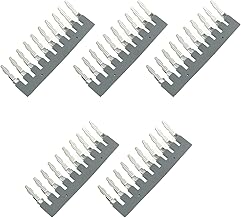
Reference features show a copper core with nickel electroplating for durability. The design supports press-fit connections on DIN rails, making it suitable for compact, high-density panels. Best for: rugged industrial environments where corrosion resistance and reliable electrical contact are crucial. Better for: assemblies requiring durable nickel-plated copper. Caution: ensure compatibility with your specific block profile to avoid loose fits.
10Pcs Fixed Bridge Jumper FBI-10-6

Made from brass with high electrical conductivity and corrosion resistance. This set provides bridging across 10 poles and is compatible with UK2.5B and UK5N blocks. Best for: high-current or dense terminal configurations needing stable, low-resistance connections. Better for: long-term reliability under frequent insertion/removal. Caution: check screw count (100 screws included) may be overkill for small projects.
Dinkle DSS2.5N-02P DIN Rail Terminal Block Jumpers

Two jumper ports per block enable clean daisy-chaining and efficient power distribution. Finger-safe design reduces the risk of accidental contact. Best for: modular panels where fast, repeated jumper changes are needed. Better for: clean, organized wiring in multi-block installations. Caution: two ports per block may limit configurations in larger systems; plan your layout accordingly.
Dinkle Assembly Kit DK10N Red/Black 10 Gang

Package designed for solar combiners or power distribution with UL 600V rating. It’s built for USA-made assemblies, offering a straightforward path to complete DIN rail configurations. Best for: engineers assembling solar or utility-grade power distribution blocks. Better for: standardized UL-rated workflows. Caution: verify voltage and current limits for your application to avoid overstress.
UFB FBS DIN Rail Terminal Block Jumpers

The FBS series offers 2-, 3-, 4-, 5-, and 10-pole sets with tin-plated phosphor copper conductors and PA66 red shells for easy handling. Best for: varied pole configurations in a single project. Better for: rapid provisioning across different block sizes. Caution: ensure the shell color and size match your panel’s labeling and clearance requirements.
Buying Guide
What should you consider before buying DIN rail jumper jumpers?
- Conductor material and plating: Copper with nickel plating resists corrosion and maintains good contact over time. Tin-plated copper is another option for low contact resistance.
- Pole count and compatibility: Ensure the jumper matches the terminal block pitch and the number of poles you need to bridge.
- Mechanical fit: Look for press-fit or slide-in designs that suit your DIN rail and block profile to avoid loose connections.
- Current and voltage ratings: Select jumpers that meet or exceed the system’s electrical demands to prevent overheating or failure.
- Accessibility and handling: Finger-safe designs and color-coded parts help reduce installation errors in tight panels.
- Ease of installation: Some kits include screws or pre-wired segments; others require separate tools for insertion.
FAQ
- What is a DIN rail jumper used for?
It bridges electrical connections across adjacent terminal blocks on a DIN rail to simplify wiring and enable shared circuits.
- Which material is best for jumpers?
Copper with nickel or tin plating offers good conductivity and corrosion resistance; choose plating based on environmental conditions.
- Are these jumpers compatible with all DIN rail blocks?
Most jumpers target common 2.5 mm terminal blocks, but always verify block compatibility with your specific model.
- Can jumpers handle high current?
Some sets are designed for higher current; check current ratings and the system’s load requirements before use.
- How many poles should I buy?
Plan for the maximum number of bridged connections in a single panel; consider future expansion to reduce restocking.
- What installation pitfalls should I avoid?
Avoid forcing incompatible jumpers into blocks; ensure secure insertion and clean, organized routing to prevent shorts.