
Best Dc Disconnect Switches for Solar Systems
Selecting a reliable DC disconnect switch is essential for safe solar system maintenance, quick isolation during work, and protecting components from overloads. This guide highlights five top options, covering ratings from 500V to 1200V, various IP ratings for outdoor use, and practical features like plug‑and‑play wiring and tamper‑resistant handles. Each product is evaluated on isolation capability, weather resistance, installation ease, and compatibility with common solar configurations.
| Product | Voltage Rating | Current | Enclosure | Key Benefit |
|---|---|---|---|---|
| CNLonQcom Solar Panel Disconnect Switch | 500V DC / 90–500V AC | 32A | IP65 | Plug‑and‑play wiring with solar extensions |
| CNLonQcom DC1200V Isolator Switch | 1200V DC | 32A | IP66 | Rugged outdoor reliability |
| CNLonQcom Isolator 1/2 String | 1200V DC | 32A | IP66 | DIY wiring with dual‑port connectors |
| Wlinflatable IP66 Quick Disconnect | 1000V DC | 64A total (two circuits) | IP66 | Two independent circuits, tamper‑resistant |
| HCOVTXR 32A 1000V DC Isolator | 1000V DC | 32A | IP66 | Durable PC+ABS enclosure, lockable OFF |
Note: All products listed are designed for solar installations and offer weather‑resistant enclosures, easy wiring options, and clear disconnection capability essential for safe maintenance and service work.
CNLonQcom Solar Panel Disconnect Switch

The CNLonQcom Solar Panel Disconnect Switch is built for robust isolation with 1 input and 1 output, supporting DC 12–500V and AC 90–500V systems. The PA flame‑retardant enclosure enhances safety during maintenance, while the included four 30 cm solar extension cables simplify quick wiring. This unit emphasizes over‑voltage and overload protection to protect both equipment and personnel, making it suitable for outdoor PV installations or mixed AC/DC configurations. The non‑polar design accommodates either +/- or -/+ poles on DC circuits, and L/N wires on AC circuits.
Key features include a plug‑and‑play design for faster installation, solid isolation, and a compact footprint suitable for roof edges or electrical closets. The combination of a heat‑resistant housing and a quick wiring harness helps minimize field errors during setup and servicing, contributing to improved system uptime.
CNLonQcom DC1200V Isolator Switch

This DC isolator switch is engineered for complete system power disconnection during maintenance or emergencies, rated at 1200V DC and 32A. Its IP66 enclosure provides dustproofing and resistance to powerful water jets, making it suitable for rooftop, marine, or dusty industrial environments. The unit supports plug‑and‑play installation with universal solar connectors and pre‑drilled mounting holes for straightforward wall mounting, reducing field wiring time and error potential.
Designed to safeguard equipment and personnel, this disconnect offers reliable overload protection and a clear isolation point in outdoor solar arrays. Its rugged construction is intended for long‑term outdoor exposure, with weatherproof performance in rain, snow, or sun exposure.
CNLonQcom Solar Isolator Disconnect Switch
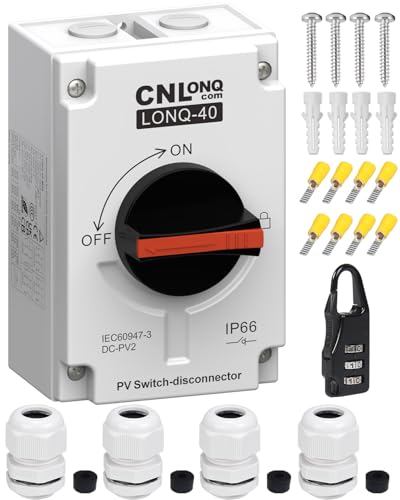
The Solar Isolator Disconnect Switch from CNLonQcom offers complete isolation with 1200V DC and 32A capacity, designed for 1 or 2 string configurations. The IP66 weatherproof enclosure protects against dust and water ingress, enabling reliable operation in outdoor roof installations or portable solar setups for boats or RVs. Built for DIY wiring, it includes PGM20 dual‑port connectors and built‑in four‑pole isolators, allowing flexible wiring layouts and easy top/bottom mounting.
This model supports customizable wiring while maintaining robust safety standards. Its rugged design aims to minimize maintenance downtime, with clear, straightforward installation steps and sealed connections that resist corrosion in exposed environments.
Waterproof IP66 Solar Disconnect Switch
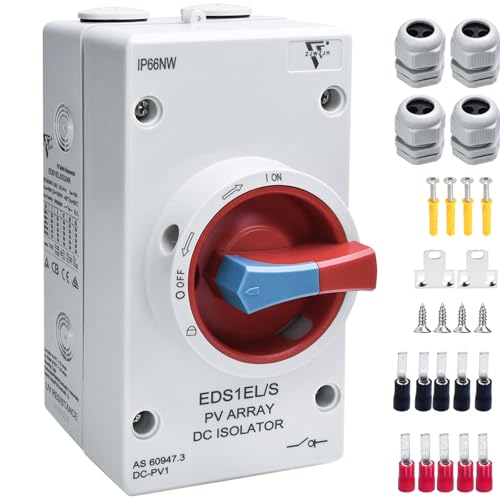
This 4‑pole DC disconnect switch handles up to 32A per circuit with a total of 64A when used as two circuits. The IP66 enclosure supports outdoor use, with a padlockable handle that locks in the closed position to prevent tampering. The unit complies with IEC 60947‑1 and 60947‑3 standards, making it a reliable option for rooftop solar, RV setups, and marine installations. The design emphasizes quick, safe disconnection and durable construction for long‑term outdoor operation.
The included wiring connections accommodate 6–8 mm conductors, and the transparent cover allows users to verify the switch state at a glance. This model is particularly suitable when two circuits must be independently controlled, such as separate roof arrays or string configurations on larger systems.
DIHOOL Solar Panel Disconnect Switch

The DIHOOL panel disconnect features a non‑polarized 2‑pole DC circuit breaker suitable for 12V–400V systems. It includes an IP65 weatherproof enclosure suitable for outdoor installations, such as solar arrays or battery charging posts. The built‑in arc squelching magnet provides improved arc extinguishing, and the enclosure is flame‑retardant. Included solar extension cables with pre‑wired connectors facilitate plug‑and‑play wiring for faster, safer installations, reducing field wiring errors and improving site safety.
Designed for durability, the DIHOOL switch balances protection and accessibility. Its robust contacts and copper windings help ensure reliable operation in fluctuating solar conditions and allow straightforward maintenance access without disassembling major components.
Buying Guide: Key Purchase Considerations
When choosing a DC disconnect switch for solar applications, consider these factors to ensure a proper match with your system and environment:
- Voltage and current ratings: Match the switch to your array’s maximum voltage (DC) and the current on each string. Higher voltage ratings enable larger system designs and more headroom for future expansion.
- IP/Ingress protection: Outdoor installations benefit from IP66 or higher enclosures to resist dust and water jets. IP65 is adequate for sheltered placements but may require additional shielding in heavy rain or spray zones.
- Number of poles and circuits: Determine whether your setup needs a single‑string disconnect or dual‑string capability. Independent circuits provide flexibility for maintenance on one string while the other remains live.
- Mounting and enclosure: Look for pre‑drilled mounting holes and sturdy housings (PC/ABS, flame‑retardant plastics) designed for external temperatures and UV exposure.
- Connectors and wiring: Universal solar connectors and quick‑connect accessories simplify installation. Ensure cable gauge compatibility with DC conductors used in your system.
- Lockout and tamper resistance: A padlockable handle reduces the risk of accidental re‑energization during service, enhancing personnel safety.
- Arcing and safety features: DC arc extinguishing and robust switching mechanisms minimize arcing during disconnection, protecting both the equipment and technicians.
- Compatibility with system components: Verify compatibility with inverters, charge controllers, combiner boxes, and battery banks to ensure seamless integration.
- Regulatory compliance: Choose products that meet applicable standards (IEC 60947, IP ratings) to ensure safety and reliability in your locale.
- Ease of installation: Plug‑and‑play options, included cables, and clear labeling can reduce installation time and error risk, especially in complex rooftop installations.
In practice, a balanced choice considers rating margins (opting for a switch with higher voltage/current than the current system requires), durable outdoor enclosures, and practical wiring options. For portable or marine applications, rugged IP66 housings and corrosion‑resistant connectors are particularly valuable. Always follow manufacturer installation instructions and, when in doubt, consult a licensed solar electrician to ensure safe, code‑compliant operation.