
Best DC Amp Meter Shunt Solutions for Reliable Battery Monitoring
Answering your search for accurate DC amp meter shunt options, this guide highlights five models suited for 12V–48V systems, including automotive, solar, and RV setups. Each pick targets specific use cases: everyday battery monitoring, high-current workloads, or compact panels where space matters. The top picks balance shunt accuracy, display clarity, installation ease, and ruggedness. Use the buying guide below to compare features and decide which meter best fits your needs.
Quick comparison at a glance
| Product | Voltage Range | Current Range | Display | Best For |
|---|---|---|---|---|
| DROK Digital Multimeter DC 8-100V 20A | 8–100V | 0–20A | LCD | General purpose DC monitoring |
| DROK 4.5-100V DC Voltmeter Ammeter | 4.5–100V | 0–50A | LED | Compact automotive/rail applications |
| Baomain DH-670 30A Analog | 0–30A | 0–30A | Analog Dial | Simple current readout |
| MORNING GROUP 0-200V 0-300A 9-in-1 | 0–200V | 0–300A | LCD Backlit | All-in-one battery health monitoring |
| Aobao 2x 0-100V 50A 2-in-1 | 0–100V | 0–50A | LED | Dual-display compact kits |
Note: All products include shunt components or rely on integrated shunts. Read installation notes to ensure compatibility with your system voltage and current requirements. This guide uses objective comparisons to help you pick the right meter for your setup without assuming any particular brand loyalty.
DROK Digital Multimeter DC 8-100V 20A with Built-In Shunt
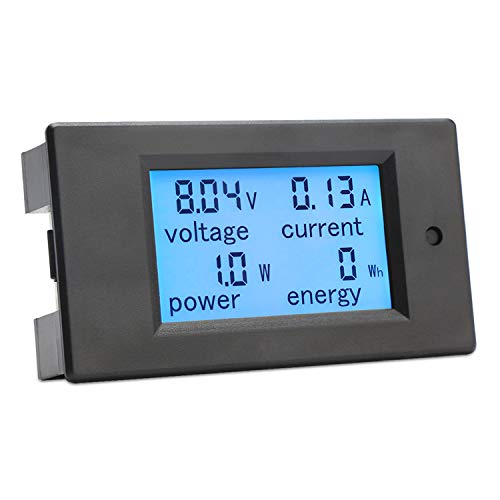
This meter measures voltage, current, power, and energy on a single LCD display. It supports DC 8–100V and 0–20A, making it suitable for standard 12V and some 24V systems. It includes a built-in shunt for direct current measurement and energy tracking. Best for: hobbyists and small installations needing an all-in-one readout. Limitation: may require careful wiring to ensure accurate voltage measurement when used in high-noise environments.
DROK DC 4.5-100V Volt/Meter with 0-50A

This compact panel meter covers 4.5–100V and 0–50A, with a crisp LED display that highlights voltage and current. Best for: compact automotive, RV, and battery setups where space is limited. Better for: monitoring multiple small loads or solar panels with moderate current. Caution: Not designed for extremely high current surges beyond its 50A range.
Baomain DH-670 30A Analog Amp Panel Meter

Analog amp meters provide a straightforward current readout from 0–30A with a 75mV shunt. Best for: installations where a simple, no-fuss current gauge is preferred. Better for: older panels or dashboards that rely on analog indicators. Limitation: analog scales may be harder to read precisely at a glance compared to digital displays.
MORNING GROUP 9-in-1 Battery Monitor with Shunt
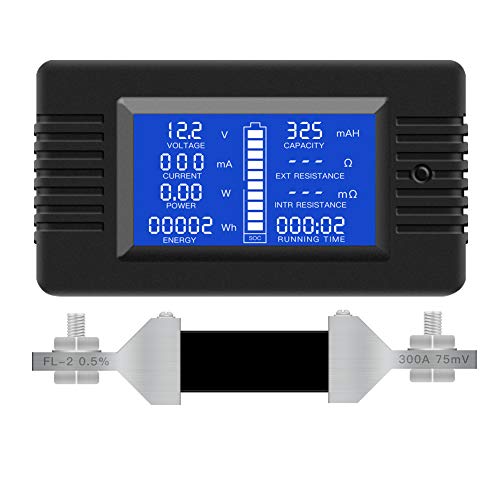
This 9-in-1 monitor tracks voltage, current, power, impedance, internal resistance, capacity, SOC, energy, and running time. Best for: full battery health insights for RVs, solar systems, and off-grid setups. Better for: users who want an integrated view of battery status. Caution: installation note mentions interior use and readability may vary in bright sunlight; plan mounting away from direct sun for best visibility.
CGELE 0-200V 0-500A Monitors with Shunt

This model presents nine measurements including voltage, current, power, impedance, internal resistance, capacity, SOC, energy, and running time. Best for: larger 12V/24V/48V systems needing higher current coverage. Better for: users seeking a bright, backlit LCD with 360° viewing. Limitation: includes a 500A/50mV shunt in some configurations; verify current rating before purchasing for your system.
CGELE 0-200V 0-300A Panel Monitor With Shunt

9-parameter display with backlit LCD and 360° viewing, plus easy wire installation with a screw-free design. Best for: versatile installation in solar, RV, or automotive systems requiring higher current. Better for: users who want a comprehensive set of readings in a single panel. Caution: verify that the included shunt’s rating matches your intended current load to avoid undersized protection.
Baomain DH-670 100A Analog Amp Panel Meter

Analog DC current reading with a 75mV shunt provides a straightforward 0–100A scale. Best for: simple dashboards or retrofits where analog gauges are preferred. Better for: quick current checks without digital interpretation. Limitation: lacks digital readout and may be harder to read precisely in dim lighting.
Buying Guide
- Confirm your system voltage (12V, 24V, 48V) and peak current. Choose a meter with a shunt rating that exceeds your maximum expected current to avoid clipping.
- Digital LCD/LED backlit displays offer precise values; analog meters provide quick glance readings but less precision. Consider visibility in daylight or night conditions.
- The shunt is the heart of current measurement. Ensure it matches the current range and fits your enclosure or wiring path.
- Some models use screw-free terminals or backplate mounting. Factor in your panel size and wiring complexity.
- If you need more than current, look for meters that track voltage, power, energy, impedance, capacity, and SOC for battery health insights.
FAQ
- What is a shunt in a DC amp meter? A shunt is a low-resistance conductor that generates a measurable voltage proportional to current, allowing the meter to calculate current flow.
- Can I use these meters with solar power systems? Yes, many models support 12V–48V systems and monitor solar panels, batteries, and loads.
- Are digital meters more accurate than analog? Generally, digital meters provide precise numeric readings, while analog meters offer quick proportional visualization but may be less precise.
- Is it important to match shunt rating to load? Yes. An undersized shunt can saturate or distort readings; match current expectations to the shunt rating.
- Do these meters require calibration? The provided data does not specify calibration requirements; follow installation instructions to ensure correct wiring and readings.
- Can I install these in a vehicle? Many are suitable for automotive use, but check the installation note for interior placement and exposure to vibrations and temperature.