
Best Class D Amp Modules for DIY Audio Projects
Direct answer: If you’re building a compact, efficient audio system or upgrading a DIY speaker setup, Class D amplifier modules offer high efficiency, compact size, and strong output. This guide highlights five versatile options suited to home theater, car audio, or bare-bone DIY builds. Best for hobbyists seeking compact power, best for car stereo projects, and best for subwoofer and multi-channel needs are covered below. The table summarizes core specs to compare at a glance.
| Product | Channel | Power (Approx.) | Voltage | Best For |
|---|---|---|---|---|
| Yaregelun K12A | 2 | 1000W peak (active system) | DC 12V | Home theater and active sub/satellite setups |
| Clyxgs TPA3116D2 | 2 | High efficiency, ~100W mono (typical) | DC 12–26V | Car audio and DIY speaker builds |
| DROK 12V PAM8620 | 2 | 15W per channel | DC 8–26V | Compact stereo systems and rooms with limited space |
| WAudio 350W Subwoofer Plate | 1 | 350W RMS at 4Ω | DC 24V | Powered subwoofer builds |
| 2PCS TW100U 100W Mono | 1 | Up to 100W mono | DC 12–24V | Wireless stereo bridges and modular builds |
Yaregelun K12A Professional Digital Power Amplifier Module
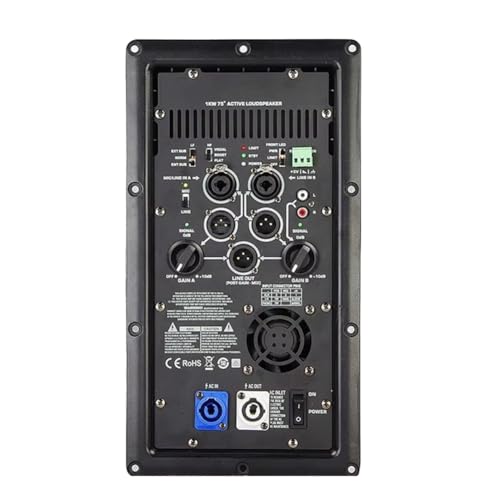
The Yaregelun K12A is a robust Class D power amplifier module designed for high-power home theater installations. Best for enthusiasts building mains-powered loudspeaker arrays or a compact theater system that requires substantial bass and dynamic headroom. The module features deep excursion limiting to preserve signal integrity during low-frequency transients and an onboard mixer that accepts multiple inputs. It provides direct outputs and a balanced sum, making it adaptable for integrated or modular setups.
Who it’s best for: users seeking a strong, integrated front-end with multiple input sources and broad LF/HF coverage for a balanced listening space. Why chosen: its control over low-frequency transients helps maintain clarity at high outputs, reducing distortion in dynamic scenes. Caution: the device units require careful heat management in enclosed spaces due to high-power operation.
Clyxgs TPA3116D2 Dual Channel Class D Amplifier Board

The Clyxgs board concentrates on high-efficiency class D amplification with protective features and a compact footprint. This module is well-suited for car audio upgrades, DIY speaker builds, or small-form desktop systems. It touts an efficient power stage, simplified components, and protective circuitry against overvoltage, undervoltage, overheating, and shorts.
Who it’s best for: builders needing a straightforward, reliable two-channel amp with good efficiency for low-heat operation. Why chosen: the integrated protections reduce risk during DIY projects. Caution: performance can vary with load impedance; ensure speakers match the rated impedance for best results.
DROK 12V Dual-Channel PAM8620 Class D Amplifier Board

The DROK PAM8620-based module delivers dual-channel stereo power with high efficiency above 90 percent. It uses a black immersion gold PCB, premium components, and large-capacity filter capacitors for clean audio. It’s a solid pick for compact stereo systems or DIY sound installations where space is limited and heat dissipation is a concern.
Who it’s best for: hobbyists seeking a reliable dual-channel board for 8–24V projects with high efficiency. Why chosen: low harmonic distortion and compact design. Caution: keep within recommended supply voltage and impedance ranges to avoid clipping or thermal stress.
WAudio 350W Class-D Subwoofer Plate Amplifier

The WAudio plate amplifier is a high-output subwoofer solution designed to deliver 350W RMS at 4Ω. It focuses on efficiency and bass integration with phase switching to align woofer response with room acoustics. This module is ideal for active sub builds in compact setups where strong, controlled bass is required without excessive heat.
Who it’s best for: users aiming to power a dedicated subwoofer with minimal extra circuitry. Why chosen: phase adjustment helps achieve seamless bass integration. Caution: best performance with a suitable sub enclosure and correct impedance matching.
2Pcs TW100U 100W Mono Amplifier Board

The TW100U module pair offers True Wireless Stereo pairing with built-in step-up circuitry and Bluetooth 5.3 for wireless linking. This solution is suitable for quick, modular speaker builds or portable sound projects where wireless pairing simplifies setup. It leverages the TPA3116D2 core for efficient amplification and supports 19–24V operation in a compact package.
Who it’s best for: builders seeking wireless stereo expansion or easy add-ons to passive speakers. Why chosen: TWS pairing enables simple multi-room or multi-speaker setups. Caution: wireless range and stability can vary with environment; consider a wired backup if reliability is critical.
Buying Guide: Key Considerations for Class D Amplifier Modules
- Power needs and impedance: Match the module’s rated power with your speaker impedance to avoid clipping and overheating.
- Voltage range: Ensure the supply voltage you plan to use (common ranges include 5V, 12V, 24V) matches the module’s specifications.
- Thermal management: Higher power outputs generate heat; plan for adequate ventilation or heatsinking, especially in enclosed enclosures.
- Inputs and outputs: Look for flexible input options (XLR, RCA, USB, Bluetooth) and the ability to route multiple inputs or combine channels as needed.
- Protection features: Overvoltage, undervoltage, thermal cutoffs, and short-circuit protection can prevent damage to both amp and speakers.
- Application fit: For subwoofers, prioritize plate amps with phase control and high-current capability. For multi-room or wireless setups, consider modules with TWS or Bluetooth features.
- Size and integration: Plate-style devices suit built-in compartments; compact boards are easier to embed in DIY speaker projects or car audio.
- Sound goals and accuracy: While Class D focuses on efficiency, some modules include features like directivity matching or excursion limiting to preserve audio integrity at higher outputs.
FAQs
- What is Class D amplification best used for? Answer: High-efficiency, compact power suitable for home theater, subwoofers, car audio, and portable speaker builds.
- Do these modules require external heat sinks? Answer: Many do, especially at higher power; check the device’s thermal recommendations and mount in well-ventilated spaces.
- Can I run multiple Class D modules in one system? Answer: Yes, but ensure power supply capacity, proper grounding, and safe wiring to prevent noise or interference.
- Is Bluetooth or wireless pairing reliable for hi-fi setups? Answer: Bluetooth and TWS can add convenience but may introduce latency or interference; use wired links for critical listening when possible.
- Will these modules work with 4Ω and 8Ω speakers? Answer: Most do; verify the rated impedance for each module and avoid pushing it beyond its design limits.
- What factors influence sound quality the most? Answer: Power supply stability, effective heat dissipation, correct impedance matching, and proper enclosure design.