As an Amazon Associate I earn from qualifying purchases. These links may earn this site a commission when you buy, at no extra cost to you.
When cutting hardwood, the blade choice can mean the difference between splintering edges and precise, clean finishes. This guide highlights top circular saw blades designed to handle dense woods with minimal tear-out, long life, and stable performance. Each blade is evaluated on durability, cut quality, and compatibility with common 7-1/4 and 10 inch saws. Read on to compare features and select the best blade for hardwood projects, from framing to fine finish work.
Summary of chosen products
- COMOWARE 7-1/4″ 40T ATB Carbide-Tipped — 5/8″ arbor; anti-vibration; ideal for general hardwood framing and plywood cuts.
- Diablo Ultra Finish 60T ATB — 7-1/4″; 5/8″ arbor; high-density carbide with non-stick coating for ultra-finish edges.
- COMOWARE 7-1/4″ 60T ATB — 5/8″ arbor; optimized for clean, fast hardwood cuts and reduced chip-out.
- FOXBC 7-1/4″ 60-Tooth ATB Ultra Fine Finish — 5/8″ arbor; wear-resistant carbide for smooth finishes in hardwoods.
- DEWALT 6-1/2″ 40T Framing — patent-pending design for accurate tracking and reduced vibration; suitable for rough hardwood framing tasks.
COMOWARE 40T ATB Circular Saw Blade For Hardwood

The COMOWARE 40T ATB blade targets clean, controlled cuts in hardwood with an alternating top bevel tooth design. The carbide-tipped teeth resist heat buildup and wear, supporting longer life under heavy-cut conditions. A 5/8″ arbor ensures compatibility with most standard circular saws, and the anti-vibration construction minimizes chatter, contributing to smoother finishes on dense woods. This blade is well-suited for framing and plywood work where edge quality matters and speed is important.
COMOWARE 60T ATB Circular Saw Blade For Hardwood
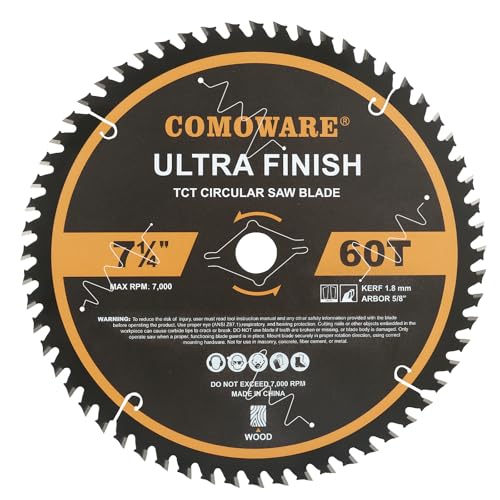
The 60-tooth ATB blade from COMOWARE is designed for finer finishes in hardwood projects. The higher tooth count reduces chip-out and leaves smoother edges on end grains, while the tungsten carbide teeth resist heat and wear. Its 5/8″ arbor is a common fit for many miter and table saws. The blade’s anti-vibration features help maintain stability during long cuts, making it a solid choice for precision work like cabinet doors or moldings in hardwoods.
Diablo Ultra Finish 60ATB Saw Blade For Wood

Diablo’s 60-tooth ATB blade emphasizes ultra-finish performance while cutting hardwood. Its Hi-Density carbide teeth are engineered for durability across dense woods, and the Perma-Shield non-stick coating protects against heat and gumming. The kerf is laser-cut for precision, contributing to fast, clean crosscuts and rips in hardwood without leaving rough edges. This blade is particularly effective for finish carpentry where visible faces demand a pristine edge.
FOXBC 7-1/4″ 60-Tooth ATB Ultra Fine Finish
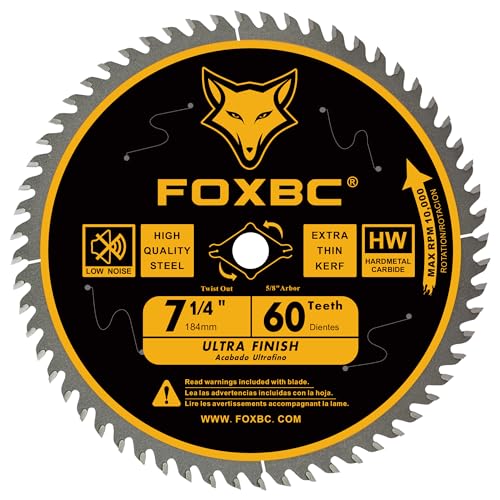
The FOXBC blade uses a high-density tungsten carbide formula and a fine 60-tooth ATB arrangement to deliver ultra-fine finishes on hardwoods. Its 5/8″ arbor matches common saws, and the coating reduces resin buildup, helping maintain sharpness over multiple passes. The blade’s cut quality is well-suited for finished carpentry, cabinetry, and cabinetry-grade hardwoods where edge smoothness is critical.
DEWALT 6-1/2-Inch Framing Circular Saw Blade

DEWALT’s 40T framing blade focuses on dependable tracking and reduced vibration for consistent performance across hardwood framing tasks. Its high-density carbide delivers long life under demanding cuts, while body slots help minimize blade wobble. This blade is a practical option for rough-cut work in hardwoods and framing projects where speed and durability are prioritized over ultra-smooth finishes.
Buying Guide: Key Purchase Considerations
- Tooth count and edge geometry: Higher tooth counts (e.g., 60T) yield smoother finishes on hardwood but cut more slowly; lower counts (e.g., 40T) cut faster but may show more tear-out. ATB (Alternating Top Bevel) teeth reduce splintering on both faces and edges of hardwood.
- Arbor size and compatibility: Most 7-1/4″ blades use a 5/8″ arbor. Always verify arbor compatibility with your saw model (some older saws use 1/2″ or 3/4″ arbors).
- Coatings and coatings wear: Perma-Shield or similar non-stick coatings help resist heat buildup and gum, extending blade life in hardwoods with resins.
- Kerf and vibration: Thinner kerfs reduce material waste and require less power, but they can be trickier to control on older or less-stable saws. Anti-vibration features improve precision in longer cuts.
- Finish vs. speed balance: For cabinetmaking and fine trim, opt for blades designed for finish cuts with clean edges. For framing or rough cuts, focus on durability and speed.
- Material suitability: While some blades are marketed as “for wood,” many perform best on hardwood with dense grain. Look for blades labeled specifically for hardwood or with high-density carbide teeth.
- Maintenance and care: Keep blades clean, free of resin buildup, and stored dry to maximize life. A lightweight blade guard and proper alignment contribute to safer, straighter cuts.
In summary, the best circular saw blade for hardwood depends on the project—whether you prioritize ultra-smooth finishes, long-term durability, or a blend of speed and precision. The blades listed here represent a range of performance characteristics across common 7-1/4″ and related sizes, suitable for different hardwood applications from framing to fine cabinetry.