
Best Charge Controller and Inverter Combos for Home Solar Systems
The following handpicked inverter-charger and solar controller combos offer reliable all-in-one power solutions for off-grid and grid-tied setups. Each option blends AC inverters with MPPT or PWM charge controllers, supporting battery-optional configurations and various battery chemistries. The selections cover different power needs, from compact systems for RVs to larger home energy setups.
| Product | Brand | Key Benefit |
|---|---|---|
| Sumry Solar Inverter Charger, 3600W | SRGFTS | All-in-one inverter charger with 120A MPPT, 60-500V PV input, pure sine wave |
| Sumry Hybrid Solar Inverter, 4000W | SRGFTS | Glass top LCD, 140A MPPT, high efficiency and battery-less capability |
| 1200W Power Inverter with 20A Solar Charge Controller | Giandel | Compact, dual USB, suitable for small solar setups and direct panel charging |
| 30A PWM Solar Charge Controller | Rolokit | LCD readout, auto 12/24V, safe battery protection |
| Renogy Wanderer 10A PWM Controller | Renogy | 4-stage charging, negative ground, compact RV/marine-friendly |
Sumry Solar Inverter Charger, 3600W

The Sumry 3600W inverter charger combines a pure sine wave inverter with a built-in 120A MPPT solar charge controller and a 100A AC battery charger. Its PV input voltage range spans 60V to 500V, and it supports maximum PV input power of 4200W (18A). It delivers stable 110V/120VAC output suitable for general household devices and many sensitive electronics. The unit can operate with a variety of 24V batteries, including AGM, Gel, Lead-acid, and LiFePO4. It also offers a no-battery operation mode when PV power is sufficient to run connected loads, provided PV input voltage exceeds 120V. This flexibility makes it a strong option for off-grid or hybrid home energy systems.
Sumry Hybrid Solar Inverter, 4000W

This 4000W hybrid inverter features a robust 140A MPPT charge controller, a large LCD display, and a tempered glass top cover. It supports battery-less operation while offering an MPPT-driven charging path for PV arrays up to 5600W (350VDC). The inverter outputs pure sine wave power with up to 98% conversion efficiency, ensuring compatibility with sensitive devices. The built-in LCD provides real-time data on input, output, and battery status. It is well-suited for off-grid homes, cabins, or backup power systems that rely on solar energy.
1200W Power Inverter With Solar Controller

The Giandel setup provides a 1200W inverter with two AC outlets and a 2.4A USB port, plus a 20A solar charge controller. It’s designed for RVs, boats, camping, and small off-grid applications. This model includes a remote controller and cables, offering straightforward monitoring and control. It’s suited for charging SLA or GEL batteries from a small solar panel array and powering a compact set of devices like TVs, laptops, and lights. The system is convenient for portable energy needs where space and weight matter.
30A PWM Solar Charge Controller

The Rolokit 30A PWM solar charge controller supports 12V or 24V battery systems, with compatibility limited to lead-acid types (OPEN, AGM, GEL). It features an LCD screen, adjustable battery float and reconnect settings, and over-discharge protection. It provides dual USB outputs (5V/3A) for charging small devices and is suitable for home, industrial, or small off-grid projects. The controller memorizes parameters to simplify operation when the battery runs low, helping prevent accidental reconfiguration.
Renogy Wanderer 10A PWM Controller
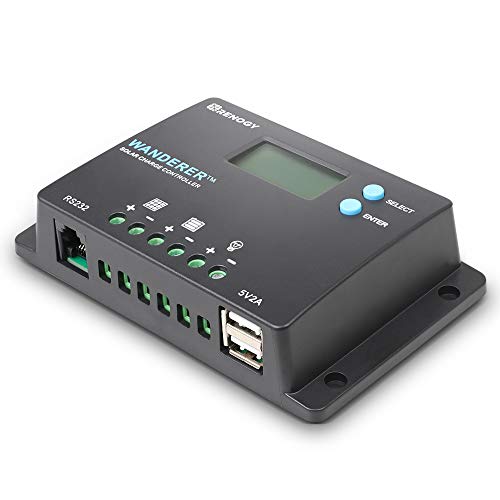
Renogy’s Wanderer 10A PWM charge controller is designed for 12V/24V systems and is compatible with AGM, Gel, Flooded, and Lithium batteries. The four-stage charging profile (Bulk/Boost/Float/Equalization) prioritizes battery longevity and efficiency. The device includes an LCD readout, negative-ground design, and a compact footprint ideal for RVs and small marine installations. It’s a reliable choice for straightforward solar charging with enhanced battery protection.
Buying Guide
- Power needs: Match inverter wattage (continuous and surge) to your anticipated loads. Include future expansion when choosing an inverter-charger combo.
- Battery compatibility: Confirm supported chemistries (lead-acid, AGM, Gel, LiFePO4, lithium) and whether a battery is required for operation.
- MPPT vs PWM: MPPT controllers maximize energy harvest, especially with higher PV voltages and larger arrays, while PWM controllers are simpler and cost-effective for smaller setups.
- PV input range: Check voltage and current limits, as well as maximum PV input power. Ensure PV array matches the controller’s capabilities for optimal performance.
- Battery protection features: Look for over-charge, over-discharge, short-circuit, and reverse polarity protections, plus temperature compensation if available.
- Ease of monitoring: LCD displays, mobile app integration, and clear status indicators help manage charging and load behavior.
- System configuration: Consider whether you need battery-less operation, grid-tied backup, or full off-grid autonomy, and verify compatibility with your existing solar panels and battery bank.
- Size and installation: Pay attention to enclosure type, cooling, and mounting space. Ensure the device supports your installation environment (indoor/outdoor, IP rating).
- Expandability: If you foresee adding more panels or batteries, choose an inverter-charger and controller with scalable options or parallel operation.
These product selections provide a range of inverters with integrated MPPT or PWM controllers, suitable for various American homes, RVs, and small businesses seeking reliable solar power management. Always verify compatibility with your specific PV array, battery type, and local electrical codes before installation.