
Best Car Battery Charge Controllers for 12V Systems: Top 5 Picks
The best car battery charge controllers for 12V systems optimize solar power, protect battery life, and fit RV, marine, or outdoor setups. This guide highlights five compatible options, explaining who should choose each controller and why. Use this to match your battery type (AGM, Gel, Flooded, or Li‑Ion/LiFePO4) with charging modes, protection features, and installation needs. The top picks balance efficiency, safety, and ease of use for DIY and off‑grid enthusiasts.
| Product | Type | Best For | Key Benefit |
|---|---|---|---|
| Renogy Wanderer 10A | PWM | Small RV or Marine Installations | 4‑stage charging and negative ground design |
| SOLPERK 8A 12V | PWM | Outdoor, Waterproof Needs | IP67 waterproof; robust safety protections |
| AeternaSol 20A PWM | PWM | Higher Amp Off‑Grid Systems | Upgraded 20A PWM with LCD and clear indicators |
| SUNER POWER MPPT 12W | MPPT | Smart Trickle Charging and High Efficiency | Ultra‑Smart MPPT with high efficiency |
| Depvko 30A PWM | PWM | Lead‑Acid Systems (12V/24V) | Dual USB and auto‑memory for settings |
Renogy Wanderer 10A PWM Controller
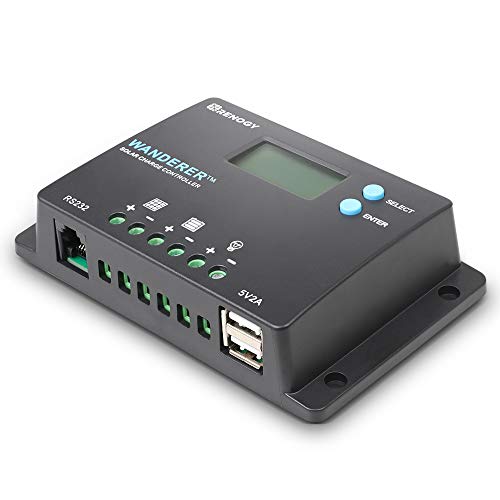
The Renogy Wanderer 10A PWM controller is designed for 12V/24V systems and supports AGM, Gel, Flooded, and Lithium batteries. It uses a 4‑stage charging process (Bulk/Boost/Float/Equalization) to maximize battery life and solar efficiency. The negative ground design makes it a solid choice for RV and marine environments where grounding considerations matter. It includes an LCD for monitoring and supports multiple load control modes for direct DC loads. Best for compact setups with limited space and where ground polarity considerations are important. Caution: ensure proper wiring to avoid short circuits, and verify battery type compatibility before use.
Who it’s best for: Small RVs, sailboats, or off‑grid cabins needing a simple, reliable PWM controller with clear status monitoring.
Selected for its balance of compact design (5.2 × 3.1 inches), negative ground safety, and integrated LCD display. The Wanderer is a practical entry‑level choice when space and straightforward battery protection are priorities.
Limitations: It is a PWM controller, not an MPPT, so it may be less efficient in certain high‑voltage panel setups or low‑sun conditions compared with MPPT models.
SOLPERK 8A 12V Solar Charge Controller

SOLPERK’s 8A PWM controller is rated for 12V systems and is designed for rugged outdoor use with IP67 waterproofing. It provides essential safety protections to prevent reverse current, overheating, short circuits, overcharging, over‑voltage, and reverse polarity. An integrated intelligant LED display shows charging status and system parameters. Best for outdoor installs where weather resistance is a priority and where visibility of status indicators matters. Consider this when you need a compact, weatherproof unit that is easy to install in exposed locations.
Who it’s best for: Outdoor enthusiasts, boaters, and off‑grid users needing weatherproof protection and straightforward monitoring.
Limitation: Being PWM, it may offer less efficiency under certain conditions than higher‑capacity MPPT controllers, especially with higher panel voltages.
AeternaSol PWM Solar Charge Controller 20A
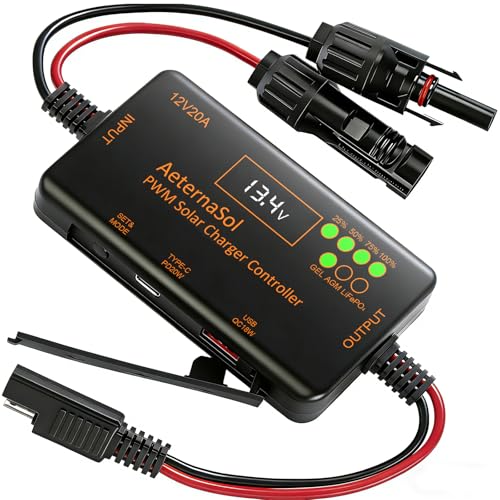
The AeternaSol 20A PWM controller targets 12V systems and is compatible with panels below 300W. It features upgraded 20A charging capability, precise charging algorithms, and a clear LCD for real‑time monitoring. It emphasizes safe operation with explicit notes on polarity and installation to avoid damage. Best for mid‑range off‑grid projects where more charging capacity is helpful without moving to MPPT complexity. Choose this if you want a higher current PWM option in a tighter budget.
Who it’s best for: Users with moderate solar arrays and lead‑acid or Li‑based batteries seeking straightforward PWM control with a readable display.
Caution: No polarity converter is included, and incorrect wiring can damage equipment.
Depvko 30A PWM Solar Controller
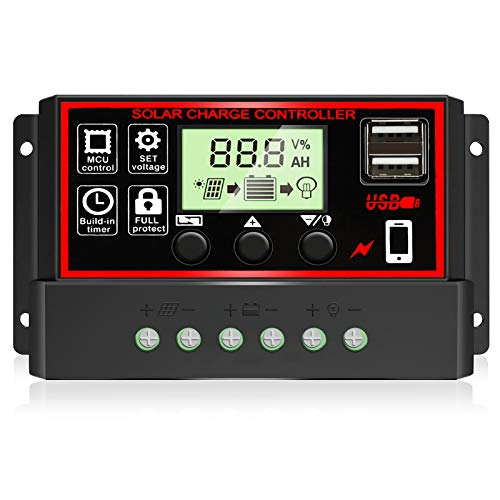
The Depvko 30A PWM controller supports 12V/24V systems and aims to improve overall solar system efficiency with automatic parameter memorization. It offers three‑stage PWM charging and is designed for lead‑acid batteries (OPEN, AGM, GEL). It includes dual USB outputs and built‑in protection features to reduce battery stress and extend life. Best for larger PWM installations where a higher current count is beneficial but a full MPPT is not required. Choose this if you need USB charging alongside solar management. Caution: Not compatible with non‑lead‑acid battery chemistries.
Buying Guide
What should you consider when selecting a car battery charge controller?
- Battery type compatibility: Confirm AGM, Gel, Flooded, or Li‑ion support to avoid charging errors.
- Voltage and current rating: Ensure the controller matches your system voltage (12V vs 24V) and panel amperage needs.
- PWM vs MPPT: MPPT controllers offer higher efficiency, especially in low‑sun or higher panel voltage scenarios; PWM controllers are simpler and adequate for smaller setups.
- Protection features: Look for overcharge, overdischarge, short‑circuit, reverse polarity, and temperature compensation protections.
- Monitoring interface: LCD or LED indicators help track voltage, charge mode, and charging state for proactive maintenance.
- Install environment: If exposed to rain or spray, prioritize IP ratings (IP67 or IP32) and weatherproof enclosures.
- Load control: Some models include direct DC load control for pumps, lights, or other devices; consider if this suits your setup.
- Wiring and polarity: Ensure correct positive/negative connections; some models require attention to polarity to avoid damage.
Practical comparison questions
- Is MPPT worth the extra cost for a small 12V system? Yes, when panel voltage is high or sun exposure is inconsistent.
- Do I need a battery type switch? Yes, matching your battery chemistry to the controller’s charging profile reduces wear and extends life.
- Can I mix controllers with different battery banks? It’s best to use one controller per battery bank to avoid communication and protection issues.
- Are waterproof controllers necessary for RVs and boats? Outdoors and exposed environments benefit from IP-rated units to protect electronics.
FAQ
- What is the main difference between PWM and MPPT controllers? PWM controllers regulate charging by connecting panels directly to the battery, while MPPT controllers optimize voltage and current to maximize power transfer, often increasing efficiency in challenging conditions.
- Can a 12V solar controller charge a 24V battery? No, most controllers are rated for specific voltages; use a 24V model for 24V batteries.
- Do PWM controllers require exact panel compatibility? They work with a wide range of panels but are less forgiving of high panel voltage differences than MPPT controllers.
- What happens if I oversize a controller for my battery bank? It’s generally safe, but you won’t gain efficiency; match controller current to your system’s charging needs.
- Do I need to perform maintenance on these controllers? Not typically; check connections and ensure ventilation if mounted in enclosed spaces.
- Are these controllers suitable for LiFePO4 batteries? Some support Li‑ion chemistries; verify the product’s listed compatibility for your specific LiFePO4 pack.