
Best Battery Box Solutions for Solar Systems: Quick Picks for Off-Grid Power
Answering the question, these battery boxes are compact, portable power hubs designed to work with solar setups. They’re best for campers, boaters, RV travelers, and small off-grid users who want safe, organized 12V/24V power with built-in protections. The top picks below emphasize versatility, safety features, and easy portability to keep solar systems running smoothly when you’re away from outlets.
Summary table of selected products
| Product | Best For | Key Benefit | Notes |
|---|---|---|---|
| SUNAPEX Smart Battery Box (No Battery) | Mariners, RVers, and solar users needing a safe portable box | Integrated lighting, 16A protection, multiple ports | Battery not included |
| SUNAPEX Smart Battery Box Pro (Battery Not Included) | High-demand 12V/24V devices | Two 30A Anderson plugs with fuses, PD & QC ports | Better for high-current loads |
| DR.PREPARE Trolling Motor Smart Battery Box | Marine and RV users with 12V/24V gear | All-in-one box with USB, Anderson ports, and protection | Battery not included |
| TXL Portable Battery Box (Group 24) | Outdoor enthusiasts needing replaceable battery design | Replaceable battery saves maintenance costs | Weighs ~10.6 lbs |
| POWO Carlife Portable Smart Battery Box | Compact power hub for trolling motors and camping | USB-C, USB-A QC3.0, 30A Anderson ports | Battery not included |
SUNAPEX Smart Battery Box 12V/24V (No Battery)

This battery box offers a 16A overload switch, a 12V cigarette lighter, two USB ports, and a digital voltmeter. It includes integrated lighting for low-light use and ergonomic handles for easy transport. This model is ideal for boaters and RV users who need a compact, protected power hub for 12V/24V systems without installing a full enclosure.
Best for: boaters, RV travelers, and mobile solar users who want a safe, lightweight power center with straightforward protection against overloads and shorts.
Caution: Does not include a built-in high-current charging port beyond the USB and cigarette lighter outputs; ensure your battery and devices fall within the 16A protection limit.
SUNAPEX Smart Battery Box Pro (Battery Not Included)

This pro model adds two 30A Anderson plugs with fused ports and keeps the other protections. It’s designed for higher-current needs, making it well suited for running refrigerators, ovens, and other 12V/24V high-demand devices from a single box. A built-in overload switch helps prevent device damage.
Best for: users who need robust power delivery for higher-demand devices in solar or off-grid setups.
Caution: Requires careful wiring to stay within fuse ratings; ensure devices don’t exceed the combined 50A on the two 30A connectors.
DR.PREPARE Trolling Motor Smart Battery Box
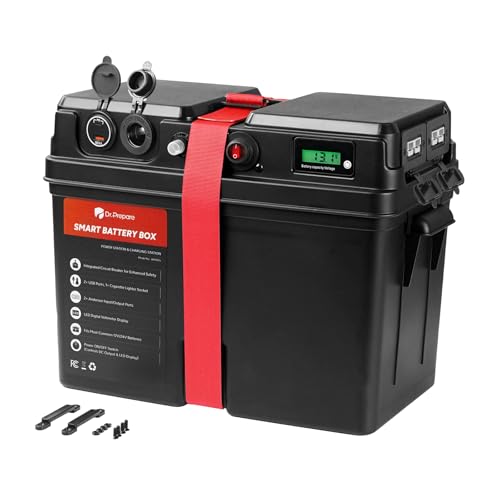
This all-in-one marine battery box supports Group 24/27/31 batteries and adds USB, USB-C PD, QC 3.0, dual Anderson ports, and a 10A resettable breaker. An LED screen shows real-time voltage and alerts for low voltage. It’s a practical choice for boats, RVs, and off-grid camping where a toggle-safe power hub is needed.
Best for: boaters and RV operators who want an intelligent, protected box that can operate multiple ports with real-time monitoring.
Caution: Battery inside must fit the box and ports; verify battery dimensions before purchase.
TXL Portable Battery Box (Group 24)

This battery box supports a replaceable Group 24 battery and provides a 50A Anderson connector, cigarette lighter, dual QC3.0 ports, and a Type-C port. A 100A main switch adds safe transport and power control. It’s ideal for short trips where portability and easy battery replacement matter most.
Best for: outdoor users who want a portable, easy-to-maintain power box and the option to swap batteries without buying a new unit.
Caution: Replacing to a new battery is necessary if the current one fails; ensure battery compatibility with the Group 24 standard.
POWO Carlife Portable Smart Battery Box

This compact hub includes Type-C PD, USB-C, USB-A QC3.0, and two 30A Anderson ports, along with a digital voltmeter. It’s designed for quick deployment for trolling motors, camping, and off-grid scenarios. The product emphasizes ease of use and multi-port flexibility in a small form factor.
Best for: users who need a small, versatile power center with fast charging options for on-the-go solar setups.
Caution: Small size may limit overall continuous high-current usage; plan loads and battery size accordingly.
Buying Guide: Key Considerations For Battery Boxes In Solar Setups
- Power needs and ports: Identify essential loads (refrigeration, lighting, USB devices, motor controllers) and ensure the box provides sufficient ports and current capacity with appropriate protection.
- Voltage compatibility: Most boxes support 12V/24V systems. Confirm your solar battery configuration aligns with the box’s supported voltage range.
- Battery compatibility and replacement: Some models use integrated batteries, while others accept Group 24 or other common battery formats. Consider maintenance costs and replacement options.
- Protection and safety features: Look for overload protection, short-circuit protection, fuses, circuit breakers, and real-time voltage monitoring to safeguard devices and batteries.
- Port options and efficiency: USB-C PD, QC, and Type-C outputs enable modern devices to charge efficiently. Higher-current Anderson plugs are beneficial for refrigerators or tools.
- Portability and build: If you travel often, ergonomic handles, weather-resistance, and a compact footprint improve usability in boats, RVs, and campsites.
- Future expansion: If you anticipate expanding your solar array or battery bank, choose a box that can accommodate higher-power loads or exchangeable batteries.
Frequently Asked Questions
- What is a battery box and why use one with a solar system?
It is a portable power hub that houses a battery (or accepts one) with multiple outputs for 12V/24V devices, enabling organized, safer off-grid operation alongside solar charging. - Do these boxes require professional installation?
Most are designed for DIY use. Check your system’s voltage, port ratings, and fuse protection. Always follow manufacturer instructions. - Can I use a battery box with LiFePO4 cells?
Yes, many models support LiFePO4 chemistries; verify compatibility with the specific box and BMS features for safe operation. - What should I consider when choosing between 12V and 24V options?
24V systems deliver higher efficiency for larger loads, but require compatible batteries and devices. 12V is common for portable devices and small loads. - Are there limitations to using USB-C PD or QC ports on battery boxes?
PD/QC ports support fast charging but have wattage limits. Plan power needs to avoid exceeding port ratings. - Is a replaceable battery design advantageous?
Yes, it reduces long-term costs by allowing you to swap batteries without replacing the entire box, especially for Group 24-type configurations.