As an Amazon Associate I earn from qualifying purchases. These links may earn this site a commission when you buy, at no extra cost to you.
Choosing the right air flow meter for ducting is essential for accurate HVAC installation, duct balancing, and performance testing. The following hand-held devices cover a range of needs—from simple wind speed and temperature readings to in-duct airflow measurements and data logging via Bluetooth or USB. The list focuses on reliability, ease of use, and applicability to duct work and ducted systems in residential, commercial, and field settings.
| Product | Brand | Key Capabilities | Notes |
|---|---|---|---|
| BTMETER BT-100 Handheld Anemometer | BTMETER | Wind speed, wind temp, wind chill; CFM estimation; 5 units; tripod mounting | Compact, dual temp sensors, good for duct testing and drone applications |
| BTMETER BT-816B | BTMETER | Wind speed, temperature; multi-mode; backlit display; Max/Avg/Current | Versatile for HVAC and field use |
| TopTes TS-301 | TOPTES | 2.26″ backlit LCD; 6 units; humidity and wind temperature | Good for outdoor activities and indoor airflow checks |
| Testo 405i | Testo | In-duct airflow, velocity; Bluetooth/app; portable | High relevance for duct testing and in-duct measurements |
| Elitech ANE-200W | Elitech | Bluetooth app control; USB data export; multi-parameter (CFM/CMM, temp) | Professional HVAC and environmental testing support |
Note: Each selected product offers capabilities relevant to ducting and duct-work testing, such as in-duct airflow measurement, CFM calculation, and data logging or export for professional records. The list emphasizes devices with reliable sensors, user-friendly interfaces, and broad unit options to suit different duct diameters and installation scenarios.
BTMETER BT-100 Handheld Anemometer

The BT-100 is a multifunction anemometer designed for HVAC and ducting work. It measures wind speed with accuracy across multiple units (m/s, km/h, ft/min, knots, mph) and provides wind temperature in Celsius or Fahrenheit. Its wind chill feature helps assess operating conditions in duct environments. A notable feature is its 2% reading accuracy for wind speed and a temperature range of -10 to 60°C, enabling practical use in a variety of duct testing scenarios. The device supports a calculated CFM estimate (Q = V × A) for duct cross-sectional area, useful during duct balancing and airflow verification. A metal threaded tripod mount allows fixed positioning for continuous measurements, beneficial when testing long duct runs or during drone-based airflow assessments. The backlit display enhances readability in dim work areas.
BTMETER Anemometer Handheld Wind Speed Meter BT-816B

The BT-816B offers high accuracy with a sensitive temperature sensor and a 7-blade fan shaft for smooth readings. It supports multiple units for wind speed and temperature (m/s, ft/min, knots, km/h, mph; ℃/℉), and provides Max/Avg/Current readings for quick trend assessment. A low battery indicator and auto/manual power-off help manage field use. The device is suitable for a range of applications, including HVAC testing, sailing, drone operations, and electrical equipment testing, making it a versatile option for ductwork verification and airflow checks in various environments.
TopTes TS-301 Digital Anemometer
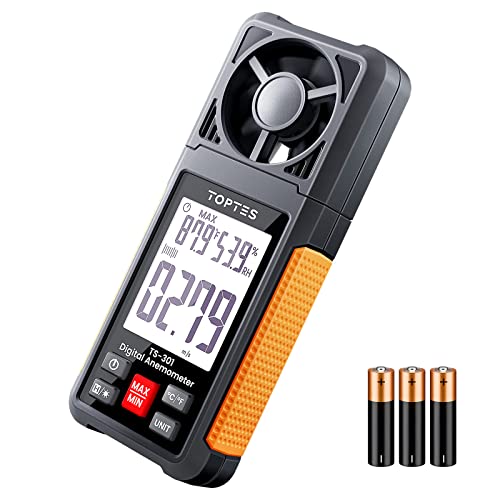
The TS-301 features a large 2.26-inch backlit LCD screen for easy readings in various lighting conditions. It measures wind velocity in six units, including ft/m, ft/s, mph, knots, km/h, and m/s. The device also includes wind humidity and wind temperature sensors, enabling environmental context for duct air flow assessment. Its humidity range is 0.0% to 99.9% RH, and temperature readings span a wide range, helpful in adapting to different ducting conditions. While primarily designed for outdoor activities like sailing and drone work, its ability to measure multiple units and environmental parameters makes it suitable for preliminary duct airflow checks and indoor air-flow evaluations within HVAC settings.
Testo 405i – In-Duct Anemometer with Bluetooth

The Testo 405i is designed for in-duct airflow testing with reliable air velocity measurements and the capability to measure in-duct temperature. It supports Bluetooth and app operation for remote monitoring and data logging, which is beneficial for duct balancing and HVAC commissioning tasks. The device is described as reliable and practical, featuring a hinged, telescopic shaft extendable up to 15 inches, enabling measurements in hard-to-reach duct areas. It is portable and time-saving, making it suitable for both field service and professional HVAC work where duct access is limited.
Elitech ANE-200W Bluetooth Anemometer
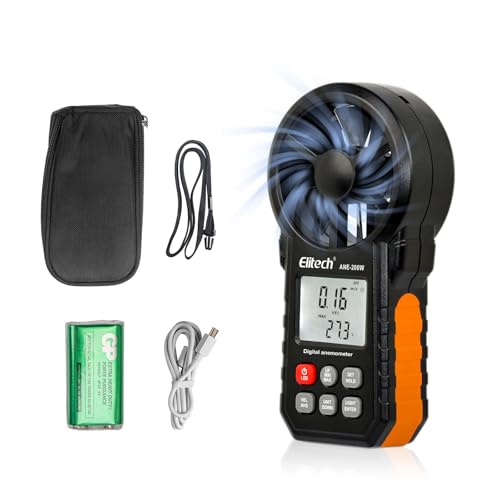
The Elitech ANE-200W integrates Bluetooth app control for real-time wind speed, temperature, and airflow monitoring. It supports data logging, graph views, and CSV export, which is advantageous for professional HVAC and environmental testing workflows. In addition to wind speed, the device measures air volume in CFM/CMM and temperature, with multiple wind units available (m/s, km/h, mph, knots, ft/min, Beaufort). USB data export provides an option for desktop analysis and long-term recording, making it a strong choice for ducting projects requiring detailed data capture and reporting.
Buying Guide: Key Considerations For Ducting And Airflow Measurement
- In-Duct Capability: For ductwork, prefer meters with direct in-duct measurement support or accessible shaft extensions to reach ducts and registers without disassembly.
- Unit Versatility: Look for multiple wind speed units (m/s, ft/min, mph, knots, km/h) and compatible temperature scales (°C/°F) to fit regional standards and specific duct configurations.
- CFM Calculation: Devices that provide or support quick CFM estimates help with duct balancing and system performance checks. A clear method for calculating Q = V × A improves repeatability.
- Temperature And Humidity: Humidity and temperature sensing can contextualize airflow readings, especially in environments with condensation, humidity control, or thermal loads.
- Data Logging And Export: Bluetooth-enabled meters with mobile apps or USB export enable long-term data collection for commissioning reports and trend analysis.
- Display And Usability: A bright backlit or high-contrast display improves readability in dim duct spaces. Auto-off and battery indicators extend field usability.
- Mounting And Accessibility: Tripod mounting or extendable shafts can free hands for climbing, drone flights, or lengthy measurements along ducts or plenums.
- Durability And Battery Life: For field use, rugged housings and efficient power management reduce downtime during inspections and testing.
- Support And Documentation: Look for devices with clear manuals and customer support to resolve calibration questions and unit conversions critical for duct testing.
- Cost Vs. Performance: Match features to the necessary precision for your ducting tasks—simple velocity checks may not require advanced data logging, while commissioning projects benefit from comprehensive data capture.