
Best 60 Watt Solar Panel Kit for Reliable Off-Grid Power
Answering your search for a compact 60 watt solar panel kit, this guide compares five solid options that fit 60W–ish needs and common 12V systems. These kits are best for weekend campers, small off-grid setups, and vehicle or RV charging. Each product below is evaluated for portability, durability, ease of use, and suitability for different users such as hobbyists, travelers, or DIY installers. The brief summary table helps you compare at a glance before diving into details.
| Product | Brand | Power (Nominal) | Best For |
|---|---|---|---|
| SOLPERK 50W/12V Solar Panel Kit | SOLPERK | 50W | Casual campers and small battery maintainers |
| SOLPERK 100W Solar Battery Kit | SOLPERK | 100W | Extended off-grid sessions and larger battery banks |
| Solar Panel Kit 50W with 10A Controller | LEPITERY | 50W | Budget-friendly 12V charging and simple setups |
| SOKIOVOLA 60W Portable Foldable Panel | SOKIOVOLA | 60W | Travel and outdoor use with portable foldable design |
| ECO-WORTHY 200W Kit with PWM Controller | ECO-WORTHY | 200W | Medium off-grid systems and RVs needing higher power |
SOLPERK 50W/12V Solar Panel Kit

The SOLPERK 50W kit uses a high-efficiency monocrystalline panel and a waterproof 12V charge controller. It is designed to charge and maintain a variety of 12V batteries, including LiFePO4 and AGM, making it versatile for trailers, motorcycles, boats, RVs, and outdoor equipment. Best for light-duty charging and trickle maintenance in modest solar setups. A key advantage is its IP65-rated controller with clear status indicators. A limitation is its 50W power output, which may require larger batteries or longer sun exposure for substantial charging.
Who it’s best for: Weekend campers, boat owners, and vehicle owners seeking a compact, weather-sealed solution for maintaining small 12V battery banks.
SOLPERK 100W Solar Battery Kit

This kit features a 100W solar panel paired with a robust MPPT controller. It is designed to maximize power harvest in varied sunlight, delivering higher daily output than a 60W setup under ideal conditions. It’s a solid choice for RVs, boats, sheds, and caravans that require more aggressive charging. Best for users who want faster recharge cycles and better performance in intermittent sun. A caveat is that the higher power system may require more mounting space and wiring planning than smaller kits.
Who it’s best for: RV owners, boaters, and hobbyists with larger battery banks or demanding charging needs who can accommodate a bigger system.
LEPITERY 50W Solar Panel Kit With 10A Controller

The LEPITERY 50W kit includes a PWM charge controller with 10A capacity and a corrosion-resistant frame. It is designed for 12V battery charging and supports simple installations on RVs, cars, and rooftops. Best for budget-minded buyers who need straightforward, maintenance-friendly solar charging. A limitation is the lower efficiency and power compared to higher-end MPPT systems, which can limit performance in less-than-ideal conditions.
Who it’s best for: Newer solar users, small vehicles, and DIY installers seeking an affordable entry into solar charging with basic protection features.
SOKIOVOLA 60W Portable Foldable Panel

This foldable 60W panel is designed for travel and outdoor use. It features multiple output options, including USB-C and USB-A ports, plus a DC output. The ETFE lamination and waterproof construction enhance durability in harsh weather. Best for campers and outdoor enthusiasts who value portability and multi-port charging. Caution: real-world output can vary with light conditions and panel angle, especially when using USB-C ports for higher draw devices.
Who it’s best for: Backpackers, campers, and vehicle travelers needing a compact, transport-friendly charging option with flexible outputs.
ECO-WORTHY 200W Kit With PWM Controller
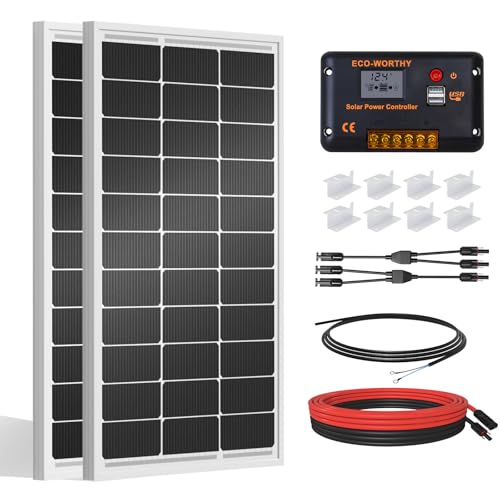
The ECO-WORTHY 200W kit offers a higher-output solution with a PWM controller designed for 12V systems. It is intended for RVs, campers, and other off-grid applications that require more power. Best for users who need a scalable 12V charging setup and have space for a larger panel array. A limitation is the PWM controller’s efficiency relative to MPPT in bright sun and complex shading scenarios.
Who it’s best for: Off-grid enthusiasts who want more charging capacity and a modular approach to expanding power in stages.
Buying Guide
What to consider when choosing a 60 watt solar panel kit:
- Power needs: If you run frequent small loads or maintain a single battery, a 50–60W kit is usually enough. For larger battery banks or faster charging, consider 100W or higher.
- Controller type: MPPT controllers optimize power under varied conditions but cost more. PWM controllers are simpler and cheaper but less efficient in marginal sun.
- Portability vs. fixed installation: Foldable or compact panels excel for travel. Fixed installations suit RVs and boats with stable mounting.
- Durability: Look for tempered glass, corrosion-resistant frames, and IP ratings if exposure to weather is common.
- Output options: USB ports are convenient for charging devices directly. Ensure the system’s voltage and connectors match your battery or inverter.
- Expansion potential: If you anticipate growing your setup, choose a kit with additional mounting or expansion compatibility.
FAQ
- What is the practical difference between MPPT and PWM controllers?
MPPT extracts more power, especially in cooler weather and lower light, while PWM is simpler and cheaper. - Can a 60W kit charge a 12V battery efficiently?
Yes, for small loads or trickle maintenance; charging speed depends on sunlight and battery capacity. - Are foldable panels durable for outdoor travel?
Generally yes, with proper handling, but protect edges and avoid extreme curvature. - Is higher wattage always better?
Higher wattage provides faster charging and more headroom, but requires more space and wiring planning. - Do these kits work in shaded conditions?
Output drops significantly in shade; position panels to maximize direct sun where possible. - Do I need professional installation?
Simple setups can be DIY, but consider professional help for mounting and wiring in RVs or boats.