
Best 6 Position Rotary Selector Switches for DIY Projects and Electronics
Looking for a reliable 6-position rotary selector switch for hobby projects, radios, or control panels? This guide highlights five practical options, showing who each is best for and why. These switches vary in pole count, deck layers, and mounting fit, so the right pick depends on your circuit complexity and mounting space. The top selections span compact 1-pole models to larger 3-pole designs, with easy plug-in installations in many cases. Below is a quick table to compare key details at a glance.
| Product | Pole Count | Positions | |||
|---|---|---|---|---|---|
| uxcell 1P6T 1 Deck | 1 | 6 | 1 | 0.38 in / 9.7 mm mounting | Compact projects, space-limited panels |
| FOCMKEAS RS25 2P6T | 2 | 6 | 1 | 220V, 0.3A | Medium-duty switching, TV/radio boards |
| Taiss LW26-20-5/3 | 3 | 5 | 12 terminals | Ui 550V, Ith 20A | Higher-power switching with more terminals |
| uxcell 2P6T 1Deck | 2 | 6 | 1 | 9 mm hole | Dual-pole, compact multi-switching |
| KEYMOO SZW26-20/0-5.3 | 3 | 5 | 12 | Ui 660V, Ith 20A | Professional-grade 5/6-position control |
uxcell 1P6T 1 Pole 6 Position Rotary Switch

Best for ultra-compact panels where space is at a premium. This 1-pole, 6-position switch keeps circuitry simple and helps conserve panel real estate. It features a single deck and seven pins for mounting, suitable for straightforward tone, selection, or channel-switching tasks. Best for simple audio or control line applications where a compact footprint matters.
Who it’s best for: hobbyists building compact radios or small control panels; beginners needing a straightforward, easy-to-wire switch.
Caution: limited to a single deck and lower current handling; avoid high-load, multi-pole applications.
FOCMKEAS RS25 Rotary Band Switch 2P6T
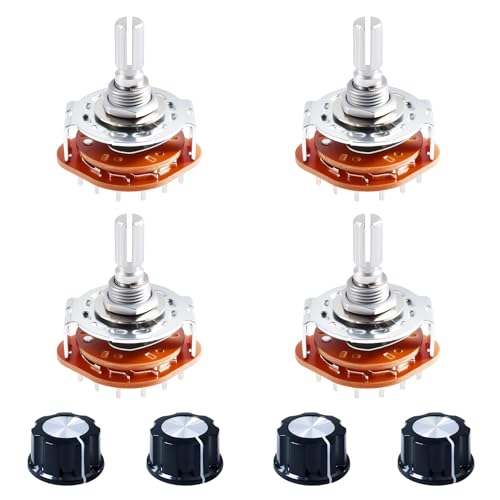
Best for two-pole circuits needing six discrete positions, on a compact form factor. This RS25 variant uses a 1-deck design with a 6-position channel. It’s suitable for quick replacement in TV or radio boards where a plug-in setup simplifies service. The metal-plastic build offers wear resistance for moderate-duty use.
Who it’s best for: technicians and hobbyists integrating a second pole into a small selector scheme; projects where plug-in design speeds maintenance.
Caution: rated current of 0.3A at 220V; avoid high-current or high-load applications.
Taiss LW26-20 5/3 Rotary Changeover Switch

This 5-position, 3-pole switch offers a higher terminal count for more complex configurations. With a latching action and 12 terminals, it supports multi-circuit routing and more flexible wiring. It is suitable for control panels that require multiple independent paths or routing signals through different channels.
Who it’s best for: more advanced builders needing a larger, programmable switch with greater terminal density; where a stable, latched action is important.
Caution: larger footprint; ensure there is enough panel depth for the 3D space and potential wiring clearance.
KEYMOO 20A Rotary Changeover Switch

Best for higher-current, multiple-circuit needs. The SZW26-20/0-5.3 provides 5-way operation across 12 terminals with a 660V rating and 20A current capacity. This makes it a solid choice for professional equipment panels, industrial controls, or any project requiring robust switching across several paths.
Who it’s best for: professionals and serious hobbyists handling higher voltages or currents in multi-path switching scenarios.
Caution: larger size and higher voltage rating require careful wiring practices and appropriate insulation on panel fronts.
FOCMKEAS 2pcs RS26 Rotary Band Switch
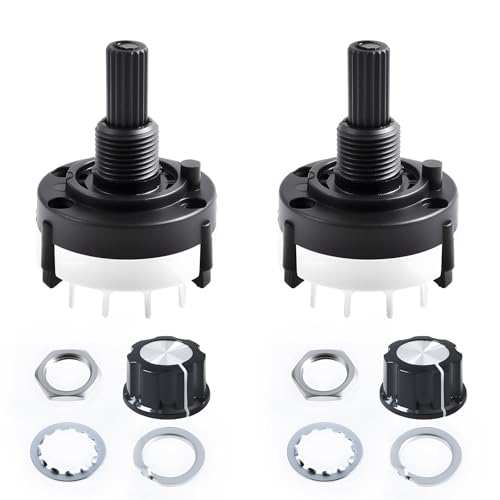
Best for multi-pole, 6-position switching in a compact but slightly larger footprint than RS25. This 2-pole design provides extended control channels and a 1-deck layout, suitable for small control panels with moderate power needs. It uses a plug-in design for easy installation and maintenance.
Who it’s best for: builders who need an additional pole without expanding the panel significantly; projects that benefit from a simple plug-in approach.
Caution: ensure space for the slightly larger diameter (28.6mm / 1.13in) and ensure the wiring adheres to the 220V rating.
Buying Guide: How To Choose A 6 Position Rotary Switch
- Pole count and deck: Determine how many independent circuits you need to route. A 1P switch handles a single circuit; 2P or 3P designs support more complex wiring. Consider whether you need one or multiple decks for stacked switching.
- Positions and wiring: Six positions are common, but verify the exact number and whether you require center-off or latching action. Check terminal counts to ensure you have enough wiring space.
- Voltage and current ratings: Match Ui and Ith to your project’s supply and load. Higher ratings provide headroom but may require more panel depth.
- Mounting footprint: Measure mounting hole diameter and overall size to fit your panel cutout. Compact models suit small enclosures; larger models fit rugged panels or industrial equipment.
- Plug-in vs welded/through-hole: Plug-in designs simplify assembly and replacement. Through-hole or welding variants offer robust connections in high-stress environments but require more skill and time.
- Durability and materials: Metal, ceramic, or high-strength plastics impact heat resistance and longevity. For high-temperature or RF applications, choose materials designed for those conditions.
- Application fit: For radios and hobby projects, compact 1-Deck units are often sufficient. For control panels with multiple routing paths, consider 2P or 3P units with extra terminals.
Frequently Asked Questions
- What is a 6-position rotary switch used for? It selects one of six electrical paths or settings in a single circuit, common in radios, audio equipment, and control panels.
- What is the difference between 1P6T and 2P6T? 1P6T has one pole and six positions; 2P6T has two poles, allowing two independent circuits to be switched simultaneously.
- Do these switches require soldering? Some models are plug-in designs that avoid soldering, while others use pins that may require soldering for permanent boards.
- Can these switches handle high-current loads? Many are rated for 0.3A to 20A depending on the model; verify Ui and Ith to ensure suitability for your load.
- Are these switches suitable for high-voltage applications? Some models are rated up to 660V or 550V; choose a switch that matches your voltage and insulation requirements.
- What should I check before buying? Check pole count, deck count, positions, mounting hole size, and the panel depth to ensure a proper fit.