
Best 4-20mA Signal Splitter Solutions for Industrial Signals
Choosing the right 4-20mA signal splitter helps maintain signal integrity in industrial environments. This guide highlights five reliable options, suitable for engineers, technicians, and plant managers seeking isolation, accuracy, and compact DIN-rail mounting. Each product is evaluated for who benefits most, potential limits, and how it compares to similar models. Use the buying guide and FAQ to refine your selection and ensure the chosen device matches your system’s isolation needs, voltage, and output configuration.
| Product | Best For | Key Benefit |
|---|---|---|
| General 4-20mA networks | One-in, two-out with isolation | |
| Signal Isolator DC 24V (nodehawk) | Dense installations | Ultra-thin, isolated, two outputs |
| ASI451145 4-20mA Analog Splitter | Precise calibration | Three-way isolation, dual output |
| Automation Systems Interconnect (1 In, 2 Out) | DIN rail systems | Zero/span adjust, dual outputs |
| Lelukee Analog Isolator Transmitter | Integrated signal conditioning | Single channel, dual output, DIN rail |
ANGGREK Splitter: 4-20mA Isolator Transmitter

The ANGGREK device provides a one-in, two-out 4-20mA signal path with galvanic isolation. It uses high-quality electronic components for precision and supports multi-channel input and output in a slim profile. Best for general-purpose signal distribution in control panels and PLC loops. A potential limitation is that specifications emphasize simplicity over advanced calibration beyond basic isolation.
Signal Isolator DC 24V (nodehawk)

This ultra-thin isolator offers 1 input to 2 outputs, designed for dense installations with guide-rail compatibility. It ensures signal integrity by providing isolation and noise suppression. Best for compact panels and systems where space is at a premium. Limitation: wiring and grounding must be carefully managed to maintain isolation performance.
ASI451145 4-20mA Analog Splitter

ASI451145 provides three-way isolation with dual outputs and precise calibration via zero and span controls. It suits applications needing robust interference protection and accurate signal distribution across multiple receivers. Choose this if you require adjustable calibration for consistent readings. Limitation: more complex setup than single-output devices.
Automation Systems Interconnect: 1 In, 2 Out DIN Rail
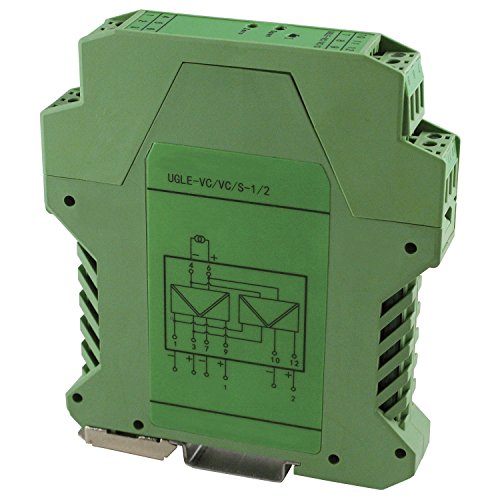
Widely used in DIN rail installations, this unit provides a single input with two isolated outputs and offers zero and span adjustments for precise calibration. Best for industrial control cabinets needing compact, easily replaceable modules. Caution: ensure the power supply remains within specified range to maintain stability.
Lelukee Analog Isolator Transmitter
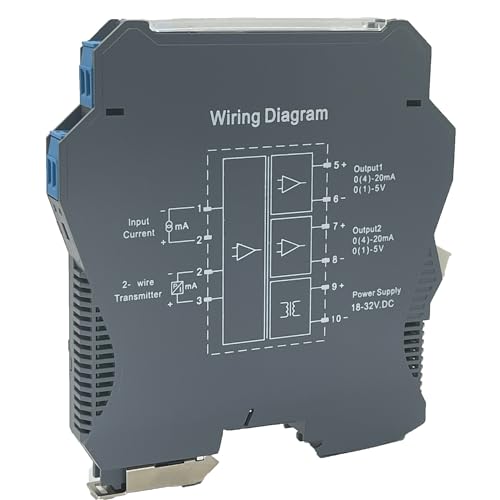
The Lelukee transmitter combines signal isolation with a dual-output arrangement in a single-channel design, suitable for broader industrial networks. It supports DIN-rail mounting and is positioned as a versatile isolator/transmitter. Limitation: one channel may require careful planning when expanding to larger networks.
Buying decisions should balance isolation level, output count, mounting style, and calibration needs. The selected models cover common configurations: single input with dual outputs, dual-output solutions, and compact DIN-rail modules designed for crowded electrical panels.
Buying Guide
What to consider when choosing a 4-20mA signal splitter
- Isolation: Determine if galvanic isolation is needed to protect sensitive equipment from ground loops and noise.
- Output configuration: Decide between 1-in/2-out or 2-in/2-out layouts based on your network topology.
- Power supply: Check voltage compatibility (commonly 24V DC) and ensure the unit’s power draw fits your PSU capacity.
- Calibration: Look for zero and span adjustments if precise transmitter calibration is critical for your process.
- DIN rail mounting: Verify whether the product is designed for reliable mounting in control panels and cabinets.
- Interference resistance: Assess dielectric strength and response time to ensure resilience in harsh environments.
- Space considerations: Consider ultra-thin or compact modules for dense installations and crowded panels.
Practical buying questions
- Do I need three-way or two-way isolation for my signals?
- Will a single sender feed two receivers without degrading accuracy?
- Is DIN-rail mounting required for quick replacement in the field?
- Will I calibrate with zero/span, or rely on fixed output settings?
Recommended scenarios
- Best for compact control panels: nodehawk and Lelukee units with slim profiles.
- Best for precise, calibrated signals: ASI451145 with adjustable zero/span.
- Best for standard DIN rail deployments: Automation Systems Interconnect units.
- Best for general distribution: ANGGREK with straightforward one-in, two-out wiring.
FAQ
- What does signal isolation achieve? It reduces noise and prevents interference between devices.
- Can a 4-20mA splitter be used with multiple PLCs? Yes, if the outputs are compatible and within spec.
- Do all splitters require external calibration? Some provide zero/span adjustments; others are fixed.
- Is DIN-rail mounting essential? It’s common for panel installations but not mandatory for all designs.
- What amperage range do these devices support? They generally operate around 4-20mA signaling with DC power inputs like 24V.
- Will the devices protect against high-frequency interference? Many models offer shielding and isolation to minimize noise.