
Best 380 Watt Solar Panel Guide for Off-Grid Power and RVs
Finding a reliable 380 watt solar panel setup for off-grid charging, RVs, boats, or sheds means comparing efficiency, compatibility, and expansion options. This guide highlights five high-performing panels near the 380W mark and explains how to pair them with controllers, inverters, and battery systems. You’ll learn about parallel vs. series configurations, shading tolerance, and durability features to help optimize energy capture in American weather and usage patterns.
| Product | Brand | Wattage (per unit) | Key Benefit |
|---|---|---|---|
| DOKIO 800W (2×400W) Panels | DOKIO Store | 800W (two 400W panels) | High capacity for yard, shed, or greenhouse charging |
| N-Type 16BB 400W Panel (2 Pack) | Callsun Store | 200W per panel; 400W total | Bifacial, anti-shade design; higher efficiency |
| JJN 100W Solar Panel | JJN Brand | 100W | Compact, high-efficiency for mobile setups |
| 400W Solar Panel, 4 Pcs 100W | Callsun or similar | 400W total (4×100W) | Good for modular rooftop or RV installations |
| 400W Portable Solar Panel (Foldable) | Unspecified | 400W | Lightweight, outdoor-ready for quick setups |
Note: The listed panels range from 100W modules to dual-400W configurations. When planning a 380W-focused system, consider how many panels you need to meet or exceed your daily energy requirements, the charge controller’s amperage and voltage ratings, and how you’ll route cables for safety and ease of use.
DOKIO 800W Two 400W Panels Overview

The DOKIO system combines two 400W panels to deliver up to 800W under standard test conditions. This arrangement is ideal for powering 12V or 24V devices with a compatible MPPT controller. Users should plan for the higher current when sizing inverters and cables. The product emphasizes parallel configuration on 12V to balance voltage and safety, while offering sequential options if the controller supports higher input voltage. Each panel includes a 3 m MC4 lead per panel, reducing the need for long extensions and simplifying installations.
Callsun 200W Panels With Bifacial Tech

This 400W total package comprises two 200W panels, leveraging N-type 16BB cells and bifacial design. The bifacial backsheet captures light from the rear, potentially increasing total output by up to 30% under favorable conditions. The dual-module parallel architecture enhances shading tolerance, so if one portion is shaded, the other half can continue generating. Expect higher efficiency and improved longevity due to reduced hotspots, making these panels well-suited for RVs, boats, or off-grid homes with variable sun exposure.
JJN 100W Solar Panel

The JJN 100W panel is a compact, high-efficiency module designed for boats, caravans, and small off-grid rigs. It uses N-Type 16BB cells to improve efficiency and reduce typical degradation, aiming for a 25% conversion rate. While smaller in wattage, its light footprint and robust construction make it a strong companion for modular systems where space or weight matters. It’s well-suited for stacking with other panels to approach your daily energy target and for travelers needing dependable, low-profile solar input.
Callsun 400W Monocrystalline
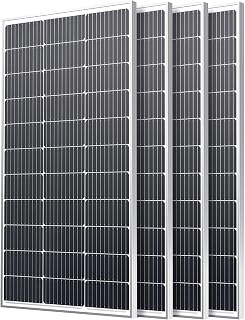
Callsun’s 400W module option showcases high-efficiency monocrystalline panels with anti-shade and twin-cell design. This setup aims to sustain performance in partially shaded environments by dividing the panel into two independent halves. The bifacial and anti-hot-spot technologies contribute to reliability and longer life, making it suitable for off-grid homes, RVs, and marine applications where sun exposure shifts during the day. This modular approach supports scalable configurations, whether you need to expand later or complement a larger system.
400W Portable Foldable Panel
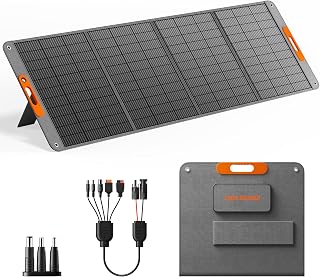
This foldable 400W portable panel is designed for quick deployment in outdoor settings, such as camping trips, EV charging on the road, or emergency power scenarios. Its lightweight ETFE construction enhances durability and weather resistance, while MC4 output provides compatibility with common off-grid systems. The IP65 waterproof rating supports use in rain or humidity. While not the largest single-panel option, it shines in portability and fast setup, making it a practical adjunct to larger fixed installations or as a supplemental charge source for power stations and small solar generators.
Buying Guide: Key Purchase Considerations For 380W-Class Solar Panels
When choosing a 380W-class solar setup, consider the following factors to ensure you select a system that meets your energy needs and environment:
- System voltage and controller: Confirm the panel’s voltage and the maximum input rating of your charge controller or MPPT inverter. Parallel connections on 12V systems demand higher current, while series connections raise voltage but reduce current. Ensure your components tolerate the configured current and voltage.
- Shading tolerance: Anti-shade or bifacial designs help maintain output under partial shading. Twin-cell architectures or split-module layouts provide resilience against trees or structure shadows.
- Durability and weather rating: Look for panels with robust frames, weatherproof seals, and ETFE or tempered glass construction for long life in varying climates. Foldable or portable units should still offer solid UV resistance and weather sealing.
- Physical footprint and installation style: Fixed rooftop or shed installations require larger, rigid panels, while portable or foldable panels suit temporary setups. Ensure mounting hardware and cable routing meet your space constraints.
- Wiring and cable length: Longer cables introduce voltage drop, especially on high-current 12V systems. Preferring panels with longer pre-attached leads can simplify installations, but verify lead ratings and connector compatibility.
- Longevity and warranty: Panels with warranties that cover output degradation and workmanship provide confidence for long-term off-grid use. Check the expected degradation rate (e.g., 0.5%–1% per year).
Performance planning tips:
- Estimate daily energy needs (in watt-hours) to determine how many panels are required to meet your load.
- Match panel configurations to your battery bank capacity and inverter size to avoid exceeding charge controller limits.
- Consider local sun exposure patterns and seasonal variations to optimize panel orientation and tilt for maximum daily yield.
Across these options, you’ll find panels optimized for different use cases—from stationary yard or greenhouse power to mobile RV and boat setups. By aligning your choice with your voltage, shading context, and expandability goals, you can build a reliable solar solution around a 380W-class footprint.