
Best 3 Phase Overload Relay Solutions for Industrial Motors and HVAC
The following guide highlights top 3 phase overload relay options suitable for protecting 3-phase motors in HVAC systems, compressors, pumps, and industrial machinery. These devices help prevent motor damage from overloads, phase loss, and unbalance. Below you will find concise product profiles, key features, and a buying guide to help you choose the right relay for your application.
| Product | Brand | Key Use | Voltage Range |
|---|---|---|---|
| Schneider Electric DPER07 | Schneider Electric | HVAC motors, compressors, pumps | 0-4000 Hz network; 600V insulation / 690V IEC |
| Walfront NR2-93 | Walfront | 3-phase motor overload protection | Up to 690V |
| Walfront NR2-36 | Walfront | 3-phase motor protection with phase break | 690V insulation; 35mm rail compatible |
| Schneider Electric DPER03 | Schneider Electric | HVAC motors, compressors | 0-4000 Hz; 600V / 690V |
| LR2 D13 JR28-25 | Generic | Motor protection in 3-phase circuits | 1NO 1NC configuration |
Schneider Electric DPER07 Easy TeSys Thermal Overload Relay

The DPER07 is designed for protecting 3-phase motors in HVAC, elevators, pumps, and compressors. It features a compact, modular design suitable for space-constrained installations and supports quick configuration to fit specific applications. The relay operates within a network frequency of 0-4000 Hz and offers a rated insulation of 600V cUL / 690V IEC with a Class 10 trip rating. This makes it a reliable, cost-effective option for guarding against overloads, phase failures, and phase unbalances, while maintaining durability in dusty or harsh environments.
Schneider Electric DPER03 Easy TeSys Thermal Overload Relay

The DPER03 model mirrors the DPER07’s design and operational philosophy, offering manual/automatic reset options for three-phase motor protection. It is suitable for HVAC equipment, air conditioners, heat pumps, and other AC-driven machinery. With a 0-4000 Hz network frequency capability and 600V cUL / 690V IEC insulation rating, this relay provides robust protection against overloads, phase failures, and unbalances while maintaining a compact, modular footprint ideal for retrofit or new installations.
Walfront NR2-93 3 Phase Thermal Overload Relay
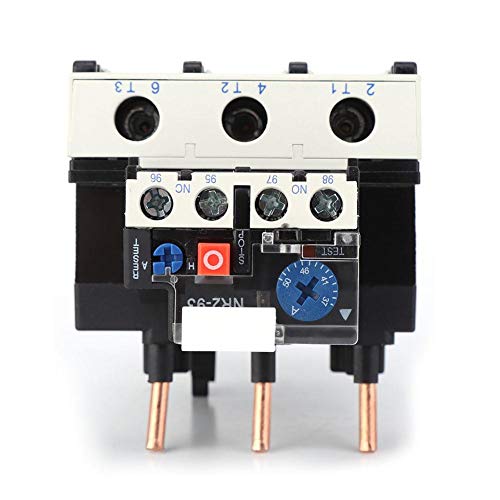
The NR2-93 automatic overload relay is designed for 3-phase systems with a 40A rating and both 1NO 1NC contact arrangements. It supports voltages up to 690V and is suitable for protecting motors in power systems operating at 50-60 Hz. The device helps prevent motor damage by interrupting current during overload conditions and can be used as a protective element for phase balance in a variety of electrical installations.
Walfront NR2-36 23-32A Thermal Overload Relay (2-Pack)

This Walfront NR2-36 2-pack provides durable, reliable protection for 3-phase motors with a 23-32A rating. It features automatic and manual reset options, precise temperature compensation, and multiple safety mechanisms to safeguard against phase breaks and overloads. With a 690V insulation rating and 35mm rail compatibility, it suits panel builders and field installations seeking modular, scalable motor protection solutions.
LR2 D13 JR28-25 2.5A 3-Phase Thermal Overload Relay

The LR2 D13 JR28-25 combines 2.5A load current handling with a 3-phase, 1NO 1NC configuration. It offers reliable motor protection against overloads and phase imbalances, suitable for compact control panels or equipment requiring dependable thermal protection. While generic in branding, its high-quality construction aims to deliver consistent performance across industrial applications.
Buying Guide: Key Considerations And Comparisons
When selecting a 3 phase overload relay, consider the following factors to ensure optimal performance and protection for your motor systems.
- Current rating and voltage compatibility: Match the relay’s current rating (e.g., 20A, 40A, 23-32A, 1NO 1NC) to the motor’s full-load current and the system’s voltage (up to 690V in many models). Choose a device that comfortably covers startup surges.
- Reset mechanism: Decide between manual and automatic reset based on safety and operational workflow. Automatic reset offers quick recovery, while manual reset may prevent unintended restarts in sensitive environments.
- Protection features: Look for protection against overloads, phase loss, and phase unbalance. Some models also provide trip indication, reset buttons, and test functions for easier diagnostics.
- Mounting and footprint: Modular, compact designs save space in control panels. Consider DIN rail compatibility (35mm) and the ease of integration with existing wiring.
- Environment and durability: If installed in dusty or harsh environments, choose units with dust-resistant enclosures and robust insulation ratings (600V cUL / 690V IEC).
- Brand and support: Reputable brands (like Schneider Electric) typically offer broader compatibility with other motor protection devices and reliable customer support, which can simplify maintenance.
- Maintenance and diagnostics: Features such as trip indicators, lockable test/stop buttons, and clear wiring diagrams help reduce downtime during servicing.
- System compatibility: Ensure the relay supports your motor type (AC motors common in HVAC), and that it can handle your control scheme (manual vs automatic reset, single-phase vs three-phase configurations).
- Cost vs lifetime value: While initial cost matters, evaluate long-term reliability, ease of replacement parts, and availability of spare relays when planning a retrofit or new installation.
Across these options, the Schneider Electric DPER07 and DPER03 stand out for HVAC-oriented protection with robust protocols and modular design. Walfront NR2-93 and NR2-36 provide economical, scalable protection for 3-phase motors, including protection against phase breaks. The LR2 JR28-25 variant offers a more compact, generic solution for smaller installations. When choosing, align the device’s rating with your motor’s FLA, ensure voltage compatibility, and prioritize features that support quick diagnostics and reliable protection in your specific environment.