
Best 250 to 240 Volt Adapters for Welding, RV, and Generators
If you need to bridge 250V outlets to 240V welding or power tools, these adapters are designed for reliability and safe operation. This guide highlights five top options, clarifying who benefits most from each and pointing out simple limitations to consider in real-world setups.
Buyer summary table:
| Product | Best For | |
|---|---|---|
| NEMA 10-50P to 6-50R Welding Adapter – STW 6 AWG | Heavy gauge wiring, ETL certified, outdoor STW jacket, 100% copper | High-demand welding tasks and compatible 250V outlets |
| EXCELFU NEMA L14-30P to 6-50R – 30A to 50A Adapter | 10 AWG copper, 4-prong to 3-prong, rugged outdoor use | Generator-to-welder connections and portable power |
| Welder Adapter Cord NEMA 14-50P to 6-50R – ETL Listed | 8 AWG copper, 600V STW jacket, ETL Listed | Welding gear from NEMA 14-50 outlets to 6-50R welders |
| Tekit White NEMA 6-20P Universal Plug Adapter – 110-250V | 15A, 250V rated, universal world-to-NEMA 6-20R compatibility | Temporary adaptation for 240V outlets in North America |
| NEMA N6-30P 30A to 6-20R – EV, Dryer, Welder | 30A 240V, 6-30P to 6-20R compatibility | Industrial 240V equipment needing 6-20R receptacle |
Note: The table reflects general compatibility and intended use. Always verify outlet and receptacle ratings for your exact configuration before connecting equipment.
Product Highlights
NEMA 10-50P To 6-50R Heavy-Duty Welding Adapter

- Best for: High-demand welding tasks where a 250V outlet must power a 6-50R welder receptacle.
- Why chosen: This adapter uses a heavy 6 AWG*3C core for reduced heat and robust conductivity, with an ergonomic design for frequent use.
- Limitation: Not suitable for low-current equipment; ensure welding power needs align with a 50A circuit.
EXCELFU NEMA L14-30P To 6-50R Adapter Cord

- Best for: Connecting a 30A generator to a 6-50R welder outlet when you need portable power.
- Why chosen: It pairs a locking L14-30P with a 6-50R receptacle, offering sturdy 10 AWG copper conductors and outdoor-grade STW insulation.
- Limitation: Runs at up to 30A only; won’t support higher-current welders without checking outlet ratings.
Welder Adapter Cord NEMA 14-50P To 6-50R
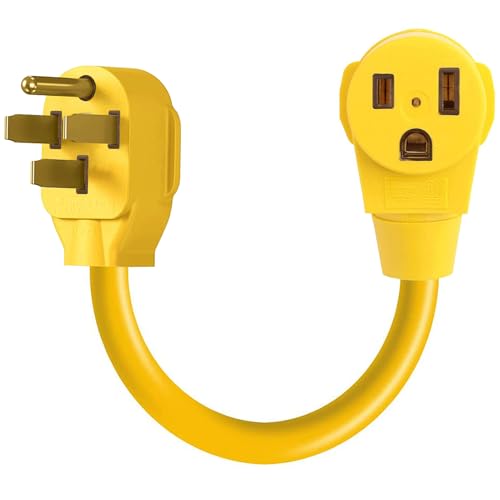
- Best for: Welding setups that rely on a NEMA 14-50P outlet and need a 6-50R receptacle.
- Why chosen: ETL listed with 8 AWG copper wires and a 600V STW jacket ensures stable power delivery and protection in demanding environments.
- Limitation: Designed for 250V systems; check compatibility with non-250V circuits before use.
Tekit White NEMA 6-20P Universal Plug Adapter

- Best for: Quick, portable compatibility with European, UK, and other international plugs on 240V North American outlets.
- Why chosen: Simple, universal approach to 6-20R outlets with a clear warning that it does not convert voltage.
- Limitation: Not a voltage converter; use only with devices designed for 240V operation in North America.
NEMA N6-30P To 6-20R Power Cord Adapter
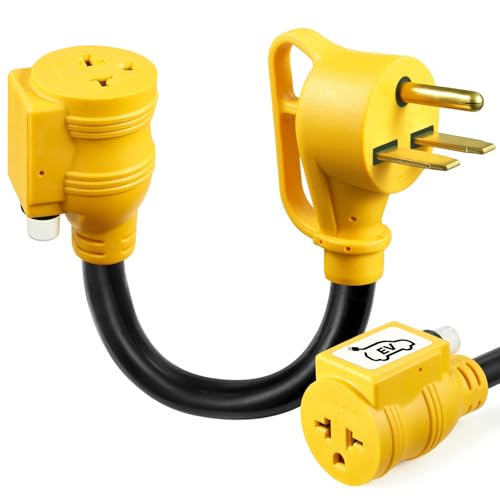
- Best for: Converting a 30A 240V dryer or welder outlet to a 6-20R receptacle for compatible equipment.
- Why chosen: 30A 240V capability with a direct 6-30P male to 6-20R female connection to simplify high-current scenarios.
- Limitation: Only suitable for 240V 15/20A loads; not a universal solution for all 240V devices.
Buying Guide
What to consider when choosing a 250V to 240V adapter
Determine the current rating you need. Adapters supporting 30–50A are common for welding and heavy equipment, while lighter jobs may only require 15–20A. Check the outlet type you have (NEMA 10-50, NEMA L14-30, NEMA 14-50, etc.) and ensure the adapter provides a proper match to avoid misfits and overheating.
Wiring gauge, insulation, and safety
Look for adapters with thick copper conductors (6 AWG or 8 AWG) and durable insulation (STW or equivalent) for outdoor use and high-temperature environments. ETL or UL certification signals compliance with safety standards and reduces risk during heavy-duty use.
Voltage and current suitability
Adapters do not change voltage. They simply connect the correct receptacle to the appropriate plug. Confirm that your equipment is designed to operate at 240V and that the outlet can safely supply the needed current.
Application-specific notes
For welders and generators, choose adapters explicitly designed for those loads to ensure reliable arc stability and power delivery. If you need portable or temporary setups, prioritize locking connectors and weather-resistant jackets to withstand outdoor work sites.
Durability versus portability
Heavy-gauge cables are less flexible but offer longer service life under outdoor or workshop conditions. If you move the setup frequently, consider a lighter option with sturdy strain relief and secure connection points.
FAQ
- Do these adapters convert voltage? No. They only adapt plug shapes and receptacle types. Use devices that are designed for 240V in North America.
- Are these adapters safe for outdoor use? Many models feature outdoor-rated jackets and ETL certifications; verify the jacket rating and weather resistance before outdoor deployment.
- Can I rely on these adapters for continuous welding jobs? Choose a high-current, heavy-gauge option with proper insulation and certifications to minimize heating and maximize durability.
- Will an adapter affect weld quality? Not directly. The key is the adapter’s ability to deliver steady current without significant voltage drop; select models with robust copper conductors and appropriate gauge.
- What is the best adapter for generator-to-welder setups? A locking, multi-prong adapter that matches both your generator outlet and welder receptacle—such as L14-30P to 6-50R styles—offers secure connections and reliable power transfer.
- Do I need safety certifications? Yes. Look for ETL or UL listings to ensure adherence to safety standards in high-power applications.