
Best 240V Generator Options for Welding: Reliable Power for Your Shop and Onsite Jobs
Welding often demands stable, 240V power, especially for use with larger arc welders and plasma cutters. The following selections focus on dual‑fuel or 240V capability, transfer-switch readiness, and accessories that simplify connecting welders to generator power. All choices are designed to give you consistent performance, safer operation, and practical features for American job sites and home workshops.
| Product | Brand | Power (Surge / Running) | Fuel Options | Notable Feature |
|---|---|---|---|---|
| WEN 4,750‑Watt 120V/240V DF475T | WEN | 4750 / 3800 W | Gasoline / Propane | Electric start; 120V/240V transfer-ready |
| WEN 14,500‑Watt TF1450 | WEN | 14500 / 11500 W | Gasoline / Propane / Natural Gas | Tri‑fuel; transfer-switch ready; electric start |
| WEN 14,500‑Watt TF1450X | WEN | 14500 / 11500 W | Gasoline / Propane / Natural Gas | CO shutdown sensor; 120V/240V |
| WEN 11,000‑Watt DF1100T | WEN | 11000 / 8300 W | Gasoline / Propane | Electric start; 120V/240V; wheel kit |
| MECMO L14‑30P to 6‑50R Welder Adapter | MECMO | — | — | Adapter for welder outlets; 30A to 50A conversion |
WEN 4,750-Watt DF475T Dual Fuel Generator

The DF475T offers dual fuel operation with a 224cc engine, switching between gasoline and propane with a simple dial. It provides 4750 surge watts (3800 running) on gasoline and 4350 surge (3500 running) on propane, and it easily toggles to 120V or 240V. This makes it suitable for small to mid‑sized welders and for transfer switches in backup power scenarios. Electric start simplifies startup, while the wheel kit adds mobility for workshop or jobsite use. This model targets portability without sacrificing the 240V capability required for many welders.
WEN 14,500-Watt TF1450 Tri‑Fuel Generator

The TF1450 delivers robust tri‑fuel versatility (gasoline, propane, natural gas) with high surge and running watts, ideal for farm garages or larger welding setups that may require long runtimes. It supports 120V and 240V operations and is transfer-switch ready, making it a strong choice for serious welders who need dependable power for continuous work. An electric start streamlines ignition, and the generator is designed for demanding environments, though its higher power output means larger footprint and weight to manage.
WEN 14,500‑Watt TF1450X with CO Watchdog

The TF1450X adds a CO shutdown sensor to the base TF1450 platform, offering automatic shutdown if carbon monoxide is detected. This feature is especially important for enclosed spaces or long operating sessions where ventilation might be limited. It maintains 120V/240V operation and tri‑fuel capability, providing flexibility and added safety for welding projects that require extended power—whether on a job site or in a workshop setting.
WEN 11,000‑Watt DF1100T Dual Fuel
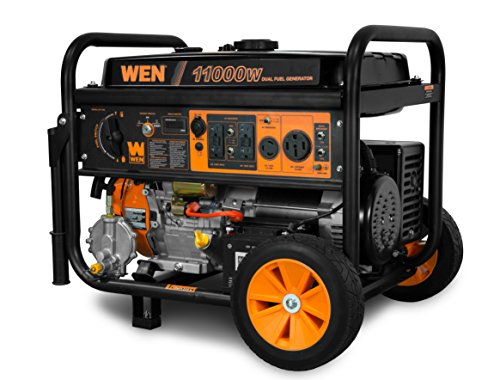
The DF1100T focuses on a balance between power and portability, with 11,000 surge watts and 8,300 running watts on gasoline, plus propane operation. The 457cc OHV engine supports both 120V and 240V outputs and includes an electric start. A wheel kit is included for easier relocation around a shop or site. This model is well suited for welding machines that demand steady power without the footprint of larger commercial units, delivering reliability where space is a concern.
MECMO L14-30P To 6-50R Welder Adapter

This adapter converts a 30A locking generator outlet (NEMA L14-30P) to a 50A welder outlet (NEMA 6‑50R). It provides a practical connection path for welding power cords and welders that require a 50A receptacle, including common 6‑50R plugs from Hobart, Lincoln, and Miller brands. The adapter supports typical welding loads and helps maintain a secure connection when used with generators that meet 240V welding requirements. It’s a useful companion when pairing smaller generators with larger welders.
10FT Welder Adapter Extension Cord
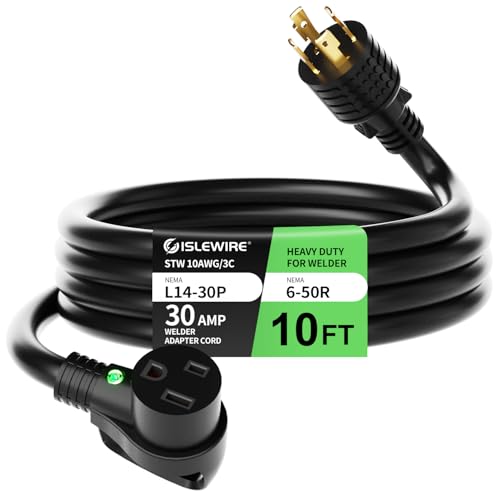
This heavy-duty 10‑foot extension cord converts a generator’s L14‑30P outlet to a 6‑50R welder receptacle and supports 30A at 250V. Built with 10 AWG copper conductors and an STW jacket, it’s designed for welding stick, MIG, or TIG setups, providing a practical reach and secure locking connection. The rugged build withstands shop environments and mobile welding projects, ensuring consistent current delivery with minimal voltage drop over the cord length.
Buying 240V welding power involves balancing wattage capacity, fuel flexibility, and safety features. In line with transfer-switch compatibility, tri‑fuel options offer extended runtimes during long welding sessions away from sources of power. Safety features such as CO monitors and robust winch-friendly wheels aid operation in cramped workshops. An adapter and a dedicated welder cord can streamline connections from generator outlets to welding machines, reducing setup time and improving reliability on the job.
Buying Guide: Key Purchase Considerations
- Power requirements: Identify your welder’s peak wattage and surge needs. A generator with 240V output and above a 8,000–11,000 watt running rating covers most mid‑sized welders and plasma cutters, while larger machines may require 14,000+ watts.
- Fuel flexibility: Dual‑fuel or tri‑fuel generators extend runtime and reduce downtime when one fuel source is scarce. Consider propane compatibility if you need quick, safer storage for fuel on job sites.
- Transfer switches: For home backup or shop automation, select models with transfer‑switch readiness to minimize power interruptions and protect sensitive equipment.
- Safety features: CO shutdown sensors and low‑oil shutdowns add protection for confined spaces and extended operation. Look for models with voltage stability to protect welding electronics and sensors.
- Mobility and ease of use: Wheel kits, electric start, and compact footprints matter for frequent repositioning in a shop or at a job site.
- Accessories compatibility: Ensure available adapters and extension cords match your welder’s plug type (L14‑30P, 6‑50R, etc.) to avoid scrambling for connectors mid‑project.
- Runtime and maintenance: Consider tanks’ capacity and expected run time at a reasonable load. Regular maintenance intervals help sustain performance and extend generator life.
These options provide a spectrum of power output, fuel types, and safety features to support a range of welding setups in American workshops and field environments. When selecting a generator for welding, prioritize robust 240V capability, reliable ignition, and compatible accessory options to ensure smooth, uninterrupted operation during critical tasks.