
Best 240V AC Voltage Stabilizers for Reliable Home Power
When you need steady 240V output for sensitive home appliances, a dedicated 240V voltage stabilizer is essential. These units regulate fluctuating mains voltage to protect devices like refrigerators, air conditioners, and computers. This guide highlights five dependable options and explains who each one is best for, plus practical buying tips to help you choose.
The products below are selected for compatibility with 240V ranges and high-volume needs. The table summarizes key points at a glance.
| Product | Best For | Max Power | Notes |
|---|---|---|---|
| QUGURLID Automatic Voltage Stabilizer (20,000W) | Heavy-duty households with multiple high-wattage appliances | 20,000 W | Wall-mounted, fast response, LCD display |
| Nippon America ATVR-5000 | Mid-sized homes needing CPU-controlled protection | 5,000 W | Delay function for motors |
| CELYYPU 2000 Watt Voltage Converter | Hard-wired setups needing versatile sockets | 2,000 W | LCD display, multiple sockets |
| VCT AR8000 – 8,000 Watt Regulator | Higher-load applications or whole-room protection | 8,000 W | Built-in voltage transformer |
| Simran AR-20000 Voltage Regulator | Large single-phase loads with 110/240V needs | 20,000 W | Built-in transformer, broad conversion range |
QUGURLID Automatic Voltage Stabilizer 20000W

The QUGURLID model supports a wide input range of 120-280V with a 220V output tolerance of ±5%, making it suitable for homes with unstable mains and multiple high-wattage devices. It emphasizes efficient operation (≥95%) and minimal waveform distortion, with a 8-second delay and robust protection chips for safety. The unit is designed for long, continuous operation and includes a wall-mount option and a modern LCD display for quick status checks.
Best for: Large households or workshops that run fans, air conditioners, TVs, refrigerators, and computers simultaneously. It provides robust protection against overvoltage, short circuits, and temperature swings. Consider this if you need a single, high-capacity device to stabilize several appliances at once.
Limitation: This is a high-capacity unit and may be bulkier than smaller stabilizers; ensure secure wall-mounting and a compatible installation space.
Key takeaway: Choose this when you require uninterrupted, high-wampage stabilization across a broad set of devices with precise 220V±5% output.
Nippon America ATVR-5000 Automatic Voltage Regulator

This unit brings up to 5000 watts of capacity and employs a CPU control circuit that actively monitors input voltage. If voltage exceeds 279V, it automatically disconnects to protect connected devices. When voltage returns to a safe range, it reactivates. A built-in delay function (about three minutes) helps protect motors and compressors from rapid on/off cycling, extending the life of appliances like air conditioners and refrigerators.
Best for: Homes with a mix of heavy and moderate loads that need strong, automated protection against voltage spikes. Choose this if you want computer-like monitoring with a straightforward, dependable cutoff mechanism.
Limitation: The CPU-based protection is robust, but reliability depends on proper sizing for your total load; avoid overloading beyond 5000 W capacity.
Key takeaway: This is a strong middle-ground option for households needing smart, protective voltage regulation without going to the highest wattage models.
CELYYPU 2000 Watt Voltage Converter
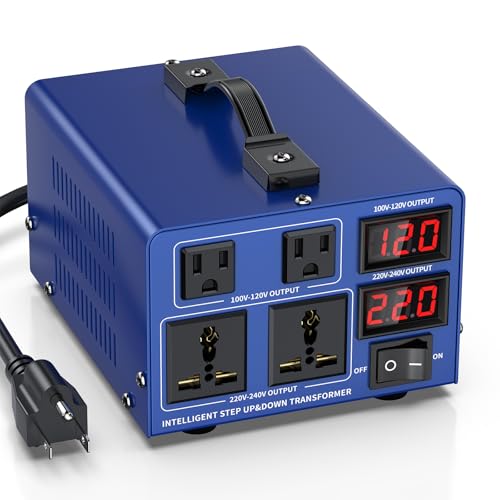
The CELYYPU unit is a 2000W voltage transformer designed to step up 110-120V to 220-240V or step down 220-240V to 110-120V. It claims about 90% efficiency with a stable 230V±5% output when fed 110V input and vice versa. It features multiple sockets (three American, three universal) and a hard-wired power cord, with an LCD display to show input voltage and fault codes for troubleshooting.
Best for: Travelers or households with mixed international devices that operate on 110/120V or 220/240V. It’s a good fit when you need straightforward voltage conversion for heavier appliances in a compact unit.
Limitation: 2000W limit means this model is not ideal for very high-wattage devices or whole-house stabilization; plan loads accordingly.
Key takeaway: Choose this if you need flexible voltage conversion for a handful of devices, especially with a variety of plug types.
QUGURLID 6800W Automatic Voltage Stabilizer

This 6800W variant by QUGURLID emphasizes compact design while delivering strong protection and fast stabilization for 220V single-phase systems. It includes six protection chips and an LCD display, maintaining a stable output that suits refrigerators, TVs, and other high-demand devices. Its 220V output with safeguards helps to prevent overheating in longer running cycles.
Best for: Homes needing robust 220V stabilization for multiple devices without stepping up to the top-end 20kW models. It’s a solid fit where 6800W is enough to cover essential large appliances.
Limitation: While powerful, it may still fall short for households with several high-wattage machines running simultaneously compared with higher-wattage units.
Key takeaway: Select this when you require a balance of capacity, protection, and compact form for mid-to-large loads.
Simran AR-20000 Voltage Regulator

The Simran AR-20000 is a 20,000W regulator with a built-in voltage transformer capable of converting between 110/120V and 220/240V. It supports single-phase operation and is suitable for converting unstable voltage into a stable output across a broad range. It’s designed for large loads and can cope with significant fluctuations while indicating output voltage via its built-in meter.
Best for: Large properties or heavy single appliances that require reliable stabilization and the flexibility to switch between 110/120V and 220/240V. Use this when you need substantial capacity and a built-in transformer for broad compatibility.
Limitation: Such high capacity means larger size and potential installation considerations; ensure adequate space and proper wiring.
Key takeaway: Choose this for maximum capacity and broad voltage compatibility when stability across large, demanding loads is essential.
Buying Guide: Choosing The Right 240V Voltage Stabilizer
How much power do you need? Start by listing the biggest loads you’ll run simultaneously and add them up. Choose a stabilizer with a wattage rating that comfortably exceeds that total to avoid overloading during peak use.
What type of protection matters most? Look for units offering multiple protections: overvoltage, undervoltage, overcurrent, high/low temperature, and lightning protection. A device with a built-in delay is helpful for motors and compressors.
Do you need conversion or stabilization? If you primarily operate equipment that runs on 240V, a stabilizer is ideal. For international devices or mixed voltage environments, a transformer-based converter may be needed in addition to stabilization capabilities.
Installation considerations: Wall-mountable models save space and reduce clutter in living areas. For heavy-duty units, confirm that the mounting hardware or dedicated space can support the weight and heat output.
Smart features: LCD displays, fault-code reporting, and automatic cutoffs improve reliability and troubleshooting. Consider units with clear voltage readouts to monitor performance at a glance.
Bottom line: A higher-wattage stabilizer is better when you run multiple large appliances; a smaller, well-protected unit is suitable for single heavy devices or lighter mixed loads. Always match the device’s input voltage tolerance and the unit’s output range to your local mains characteristics.
Frequently Asked Questions
- What is a 240V voltage stabilizer used for? It stabilizes fluctuating mains voltage to protect and extend the life of 240V appliances like air conditioners, refrigerators, and TVs.
- Can a voltage transformer replace a stabilizer? A transformer changes voltage levels but may not protect against surges or sags; a stabilizer provides automatic regulation and protection features.
- What does wattage tell me? Wattage indicates maximum load capacity. Choose a unit rated higher than your combined appliance wattage needs.
- Is wall mounting necessary? Not necessary, but wall mounting saves space and can improve heat management in busy households.
- Do I need a separate device for international devices? If you have devices that require 110/120V, a converter or transformer may be needed in addition to stabilization for 240V devices.
- How do I size a stabilizer for my home? Add up the wattage of the devices you plan to run at once and select a stabilizer with a rating above that total, plus a margin for startup surges.