
Best 240 Volt Water Heaters for Home Efficiency and Space Saving
Choosing a 240 volt water heater involves balancing space, capacity, and on-demand hot water needs. The following selections cover compact models, tank and tankless options, and gas-powered alternatives to fit various homes and installation constraints. This guide highlights features such as adjustable thermostats, energy efficiency, and quick installation to help buyers compare performance across common use cases.
| Product | Brand | Type | Key Features |
|---|---|---|---|
| GE 18 Gallon Versatile Electric Water Heater | GE Store | Small Tank / Point of Use | Lowboy design, adjustable thermostat, easy connect |
| Rheem 6.5kW Point of Use Tankless | Rheem Store | Tankless / Point of Use | Endless hot water, compact, precise temperature control |
| EcoSmart ECO 11 Electric Tankless | EcoSmart Store | Tankless | Self-modulating, energy efficient, wall-mount capable |
| MIZUDO Natural Gas Tankless | MIZUDO Store | Gas Tankless | Indoor venting, CSA certified, multiple safety features |
| Rheem 11kW Tankless Electric | Rheem Store | Tankless | Digital temperature display, self-modulating, compact |
This overview centers on 240 volt options primarily for residential use, emphasizing compact form factors, energy efficiency, and reliable performance. Readers should consider home electrical capacity, existing plumbing, and the intended hot-water demand profile when choosing between a small tank, a point-of-use model, or a full-house tankless system.
GE 18 Gallon Versatile Electric Water Heater
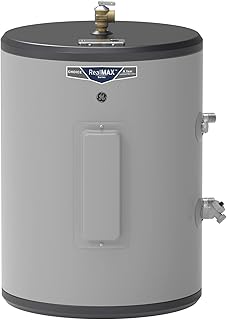
The GE 18 Gallon Versatile Electric Water Heater is designed for tight spaces and applications where height is a concern. With a compact lowboy footprint, it fits under cabinets or in closets while supplying hot water for a small household of one to two people. The unit features an adjustable thermostat for temperature control and a drain valve for straightforward maintenance. Quick installation is possible by using standard water and electrical connections, making it a practical upgrade from older models in apartments or compact homes.
Rheem 6.5kW Point of Use Tankless Electric Water Heater

The Rheem 6.5kW point-of-use tankless heater provides on-demand hot water without storing it, ensuring an endless supply at the point of use. Its continuous temperature monitoring and controlled flow rates help maintain water temperature within about one degree of the selected setting, promoting efficiency and consistent performance. Its compact size supports installation in small utility closets or under sinks, making it a strong option for extra bathroom or kitchen fixtures requiring dedicated hot water without a full-house heater.
EcoSmart ECO 11 Electric Tankless Water Heater

The EcoSmart ECO 11 is a compact electric tankless heater rated at 13 kW at 240 volts, featuring patented self-modulating technology. It delivers endless hot water and maintains temperature with precise flow control, typically within one degree of the setpoint. Its small dimensions and 90% space-saving profile make it suitable for wall mounting or point-of-use installations. Its energy-saving design activates only when hot water is needed, reducing standby losses and overall consumption for small households or supplementary fixtures.
MIZUDO Natural Gas Tankless Water Heater

The MIZUDO indoor direct-vent gas tankless model offers up to 7.9 GPM, suitable for residential whole-house use. Its sealed combustion system draws external air, preserving indoor air quality. CSA-certified protection features include freeze prevention, a dry-fire safeguard, auto-relight, flue obstruction detection, and emergency shutoff. This unit is designed for homes seeking reliable gas-powered on-demand hot water with enhanced safety and continuous performance across multiple usage points, though installation requires venting and gas supply considerations.
Rheem 11kW Tankless Electric Water Heater

The Rheem 11kW tankless electric model uses an on/off dial with an adjustable digital temperature display to help users dial in precise heat. Its self-modulating power control optimizes energy use by matching output to demand, and the unit supports flow rates up to 2.68 GPM. This makes it a practical option for single-point hot water needs or supplementary hot water at a secondary faucet or bathroom, with relatively simple electrical requirements compared to larger whole-house systems.
Buying Guide: Key Purchase Considerations
- Hot water demand: Assess the number of fixtures and daily usage. Tank-style units offer ready storage, while tankless models provide on-demand efficiency at the cost of higher installation complexity in some cases.
- Electrical and gas requirements: Confirm home electrical capacity for high-wrequency demand devices (especially 240V, 11kW+, or higher). Gas units require venting, gas line readiness, and appropriate clearance per code.
- Space and installation constraints: For tight spaces, lowboy tanks, wall-mounted tankless units, or point-of-use heaters can minimize footprint while meeting needs.
- Energy efficiency: Self-modulating or demand-based heaters reduce standby losses. Tankless models generally save energy when hot water usage is intermittent, but initial costs and payback periods vary by model and usage.
- Maintenance and safety features: Look for easy thermostat access, drain valves, anti-scaling features, dry-fire protection, freeze protection, and automatic relight systems in gas models for reliability in diverse climates.
- Durability and warranty: Compare tank liners, corrosion resistance, and the warranty terms for both parts and tanks. Regular flushes can extend life and efficiency.
- Installation complexity vs. future needs: Point-of-use heaters are ideal for localized hot water boosts, while whole-house systems suit larger households. Consider potential future renovations or expansions when selecting capacity.
- Cost of ownership: While initial price matters, factor in energy costs, maintenance, and potential retrofits (electrical panel upgrades or venting) when evaluating total cost of ownership.
When selecting among the listed options, users should also compare installation guidance from the manufacturer, local building codes, and any required permits. For households prioritizing space efficiency and quick modernization, a compact electric tank or tankless solution that supports future expansion can offer the best balance between upfront complexity and long-term reliability.