
Best 24 Volt Wind Generator Options for Off-Grid Power
Answering the question: these 24V wind generators are designed for off-grid setups, DIY energy projects, and remote locations. They’re best for builders seeking scalable wind energy, battery storage, and compatibility with 24V systems. The top picks below cover high-capacity kits, mid-range turbines, and compact options for versatile off-grid needs. Use the buying guide to compare integration, durability, and wind performance across models.
Summary table of chosen products
| Product | Best for | Key Feature | Limitations |
|---|---|---|---|
| Lbxlhr 10000W/12000W Upgraded Wind Vertical Axis Turbine | High-capacity setups | Vertical axis, MPPT, wide wind adaptation | Higher initial cost |
| 3000W Wind Turbine Generator Kit, 12V/24V | Mid-range efficiency | Three-phase PMG, low torque | Smaller rotor diameter |
| Automaxx 1500W 24V Wind Turbine Kit | Residential and small farms | MPPT controller, dual braking | Moderate power ceiling |
| Maixhae 2000W 24V Wind Turbine Kit | Off-grid homes | 8 blades, 1m/s start, robust build | Noise not specified |
| Pikasola 400W 24V Wind Turbine Kit | Compact systems | 5 blades, nylon carbon blades | Lower output capacity |
Lbxlhr 10000W/12000W Upgraded Wind Turbine

Best for high-capacity wind sites, this vertical-axis turbine supports 12V, 24V, 48V, and 220V configurations with an MPPT controller. The spiral, FRP-blend blades minimize start wind and maximize stable output. The Maglev generator reduces start torque and extends service life, with a designed lifespan of 10–15 years and RPM protection capped at 300 RPM. Choose this if you need large-scale off-grid power and compact turbine movement in variable winds.
Who it’s best for: Developers building hybrid wind-solar systems or remote installations needing substantial 24V- or higher-voltage power. Caution: larger system complexity may require professional installation and wiring expertise.
3000W Wind Turbine Generator Kit, 12V/24V

Best for mid-range off-grid projects, this kit uses a three-phase PMG and low-torque startup to boost 24V output and annual energy capture. The design emphasizes reliability and quiet operation, with a rotor diameter of 0.6 m and a 10–20 year service life. Choose this when you want steady power for small homes, barns, or RV setups without aiming for max capacity.
Best for: Small to medium off-grid homes and farms. Caution: Rotor size and power ceiling limit very large energy demands.
Automaxx 1500W 24V Wind Turbine Kit
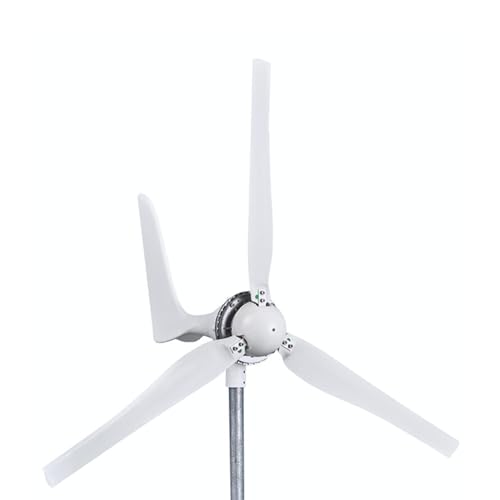
Best for reliable energy in gentle breezes, this kit delivers up to 1500W and uses a digital MPPT controller to optimize performance while protecting against over-RPM, over-voltage, and other risks. Dual braking and app-based control add safety and convenience. It’s well-suited for residential off-grid systems and remote storage setups.
Best for: Homes and farms needing dependable 24V power with strong safety features. Limitation: Not designed for the highest wind zones; may be overpowered in extreme gusts.
Maixhae 2000W Wind Turbine Kit 24V

Best for off-grid homes with higher energy needs, this turbine features an 8-blade nylon glassfiber design for better wind capture and a low-start wind speed around 1 m/s. A three-phase PMG ensures efficient power generation and stable DC output. Choose this if you want a robust 24V solution with scalable storage.
Best for: Households expanding solar storage or remote cabins. Caution: Larger blades and higher output may require sturdier mounting and wind-site assessment.
Pikasola 400W Wind Turbine Kit 24V

Best for compact, entry-level systems, this 400W, 24V kit uses 5 blades and a three-phase synchronous PM generator. It’s a practical option for boats, RVs, or small off-grid setups where space is limited but wind is available. The longer blade length supports more power in moderate winds.
Best for: Travelers and small cabins needing a lightweight 24V wind solution. Caution: Lower wattage means smaller energy footprint and less redundancy in high-demand applications.
Buying Guide: Key Considerations for 24V Wind Generators
System compatibility: Ensure the turbine voltage aligns with your battery bank (24V), MPPT controller, and wiring plan. Consider future upgrades to higher voltages or additional solar to form a hybrid system.
Wind site assessment: Start-up wind speed, cut-in speeds, and rated wind speed determine daily energy. Turbines with low cut-in speeds perform better in gentle breezes.
Durability and mounting: Look for weather-resistant housings, corrosion-resistant materials, and secure mounting for your climate. Vertical-axis turbines can offer simpler yaw-free operation in some sites.
Safety features: MPPT controllers, over-RPM protection, braking systems, and surge protection help prevent equipment damage during storms or gusts.
Maintenance and lifespan: Consider blade material, bearings, and expected service life. Longer lifespans reduce total cost of ownership, especially in remote locations.
System sizing guidance: If you have solar, storage, and loads, balance turbine capacity with battery storage and energy consumption to avoid under- or over-sizing.
Frequently Asked Questions
- What is a 24V wind generator best used for? – It powers 24V battery banks for off-grid homes, boats, RVs, and remote cabins, often in hybrid solar-wind installations.
- Do I need MPPT with these turbines? – MPPT controllers optimize charging efficiency and help protect batteries during wind variability.
- What affects wind turbine start-up speed? – Blade design, generator type, and rotor size influence the minimum wind necessary to begin generating power.
- Are vertical-axis wind turbines better for homes? – They can be simpler to install in some sites, but output depends on wind availability and design.
- Can I mix wind turbines with solar panels? – Yes, but ensure proper charge control and battery management to balance charging sources.
- What maintenance is required? – Regular inspections of blades, bearing wear, wiring, and controller settings help maintain performance.