
Best 220 Volt Plug-in Timers for Heavy-Duty and Home Use
Answering the need for reliable 220V plug-in timers, this guide highlights five 240V-compatible options ideal for air conditioners, heaters, grow lights, and other high-demand devices. The selections balance mechanical and digital designs, to fit different setups and reliability preferences. Best for powerful appliances, grow tents, and controlled environments, these timers keep schedules consistent without constant unplugging.
| Product | Type | Voltage | Best For |
|---|---|---|---|
| Intermatic HB114 Heavy-Duty Plug-in Air Conditioner and Appliance 240 VAC Timer | Mechanical, Dual On/Off | 240 VAC | High-load units; hard-wired schedules |
| Grow1 240V Outlet Digital Timer | Digital, Single Outlet | 240 VAC | Grow lights, hydroponics, aquarium timers |
| Intermatic HB114C Timer, 240V | Mechanical, 2 On/2 Off | 240 VAC | Versatile daily cycling; extra trippers possible |
| Generic 240V Mechanical Timer, Dual Outlet | Mechanical, Dual Outlet | 240 VAC | Multi-outlet control for grow rooms |
| Grow1 Single Outlet Mechanical Timer 24 Hour, 240V | Mechanical, Single Outlet | 240 VAC | Simple, reliable daily cycling |
Intermatic HB114 Heavy-Duty 240 VAC Timer

This heavy-duty, grounded plug-in timer controls 220 or 240 Volt air conditioners, heaters, heavy-duty appliances, and lamps. It supports two ON/OFF settings per day with movable trippers and uses a three-prong, grounded plug. Best for users who need robust, simple on/off control for high-wattage devices. A limitation is that it relies on mechanical tripping, which may require manual adjustment for seasonal changes.
Grow1 240V Outlet Digital Timer
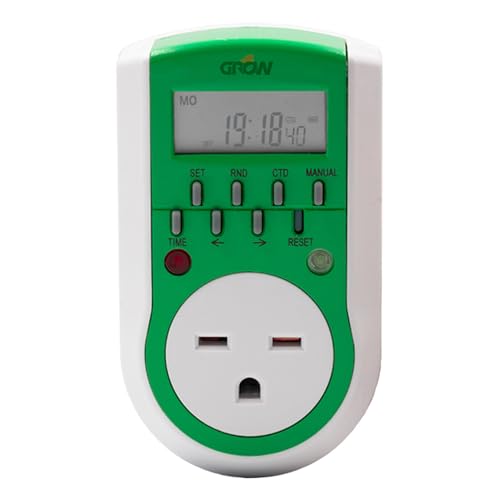
This digital timer offers precise control over a single 240V outlet, making it ideal for grow lights, hydroponics equipment, and aquarium gear. It supports 7-day scheduling and can automate lights or pumps without manual intervention. Choose this if you want programmable on/off cycles with clear digital visibility; limitation is it’s a single-outlet unit, so you’ll need more units for multi-device setups.
Intermatic HB114C 240V Timer

The HB114C adds more on/off events with removable trippers, making it flexible for daily cycles. It’s designed for 240V operation with two on and two off settings per day, and you can add extra trippers for additional cycles. Best for those who need more frequent cycling without stepping up to a digital timer. A potential limitation is the need to manage trippers for each schedule change.
Generic 240V Mechanical Timer with Dual Outlet

This dual-outlet timer provides 15-minute on/off increments and a 24-hour timer mode, designed for indoor use. It’s suited for growing tents, tools, and home appliances where two devices need synchronized control. Best for simultaneous control of two loads; caution is needed to verify that the combined load stays within a safe range for the unit.
Grow1 Single Outlet Mechanical Timer 240V

A reliable, plug-in mechanical timer for a single 240V outlet. It supports 24-hour control with a simple dial, ideal for grow lights or fans in a home garden or grow tent. Best for users who prefer a straightforward, no-frills timer. Limitation: fewer advanced scheduling options than digital models.
Buying Guide: Key Purchase Considerations
What types of 240V timers are available? Mechanical timers offer rugged reliability and simple on/off control, often with multiple trippers for more cycles. Digital timers provide precise scheduling, countdown options, and easy programming. Consider whether you need a single outlet or dual outlets, as this impacts how you power multiple devices.
How to choose by load and safety? Check the load rating (watts or amps) and ensure it matches or exceeds your device’s draw. For high-wattage appliances, use a heavy-duty, grounded timer designed for 240V. Look for UL listing or equivalent safety certifications when possible, especially for grow tent and aquarium setups.
What about scheduling needs? If you need multiple daily on/off events, a timer that supports extra trippers or more daily cycles is beneficial. For straightforward duty cycling, a digital timer with a weekly schedule reduces manual adjustments over seasons.
Where should you place and wire these timers? Position timers in a dry, accessible location away from moisture and heat sources. Ensure the outlet or power strip can handle the combined load and that cords are neatly managed to avoid tripping hazards. Always follow manufacturer wiring instructions and safety notes.
What to consider for Growing and Aquariums
Grow environments benefit from timers with 24/7 reliability and repeatable cycles. Digital timers are advantageous for complex schedules, while mechanical timers excel in straightforward 24-hour or 48-hour cycles. Ensure the timer is rated for 240V and is UL listed for indoor use when installing in grow rooms or aquariums.
Compatibility and Expansion
If you need to control multiple devices, select models with dual outlets or plan to deploy several timers in close proximity. For expansion, verify whether extra trippers can be added or if a digital timer ecosystem is required for synchronized schedules across devices.
Maintenance And Longevity
Mechanical timers typically require less maintenance but may need tripper adjustments over time. Digital timers offer long-term scheduling stability but rely on power to maintain settings. Periodically test timers to confirm they switch devices on and off as intended.
Frequently Asked Questions
- What is a 240V timer best for? Best for high-wattage devices such as air conditioners, heaters, grow lights, and heavy appliances that require scheduled operation.
- Are digital timers more reliable than mechanical ones? Digital timers offer precise programming and fewer mechanical parts but require power to maintain settings; mechanical timers are rugged but offer fewer scheduling options.
- Can I use a 240V timer in a 125V outlet? No. A timer rated for 240V is not suitable for 125V outlets and can be unsafe or ineffective.
- How many on/off cycles can a timer provide? This depends on the model. Some timers offer 2 on/2 off settings, while digital units may provide weekly or more complex schedules.
- Is a timer suitable for aquarium equipment? Yes, provided the timer is rated for the device’s load and is designed for indoor use. Ensure water exposure risk is minimized and the timer is in a dry location.
- Do timers improve energy efficiency? They can by automating devices to run only when needed, reducing idle power draw and extending equipment life when used appropriately.