
Best 12V DC Air Conditioners for RVs, Trucks, and Off-Grid Living
Exploring 12V DC air conditioners helps vehicle owners stay cool without idling engines. These units run off a vehicle’s battery, making them ideal for RVs, campers, trucks, and trailers. This guide highlights five top 12V models, summarizes their core specs, and offers practical buying tips to compare performance, energy use, installation, and noise levels. All selections are designed for off-grid comfort, efficient cooling, and reliable operation during long trips or stationary stays.
Summary of chosen products:
| Product | Approx. Cooling | Power & Current | Noise Level | Installation Notes |
|---|---|---|---|---|
| 12V DC air conditioner, truck split 9000 BTU | 9000 BTU | 850W, 60–70A | Low (quiet operation) | Designed for RVs, trucks, vans |
| 12V RV air conditioner, split type 9000 BTU | 9000 BTU | 800W, 75A start | Moderate | Solid shell, good heat dissipation |
| 12V Rooftop Air Conditioner for RV 10000 BTU | 10000 BTU (cooling) | 960W, 30–50A | Ultra-quiet | Roof-mount, requires skylight fit |
| 12V RV Air Conditioner 8530 BTU Non-Ducted | 8530 BTU | Not stated here | 45 dB | Non-ducted, compact |
| RV Air Conditioner 10000 BTU, Battery Powered | 10000 BTU | 12V system with large battery support | Low | Off-grid ready, durable |
12V DC Air Conditioner, Truck Split 9000 BTU

This 12V split air conditioner is designed for RVs, trucks, construction vehicles, campers, vans, trailers, and other mobile spaces. It operates directly from a vehicle battery, eliminating engine starts for cooling while parked. Typical current draw is about 60A per hour, with a recommendation for battery capacity above 200Ah. The indoor unit’s noise level can be as low as 40 decibels, ensuring quiet operation during nighttime rest. Five rotatable air outlets allow even air distribution inside the vehicle.
Key specifications include a 12V DC input, 850W power consumption, 9000 BTU cooling capacity, and a refrigerant type of R134a (approximately 600g, exclude refrigerant). This unit prioritizes silent, comfortable cooling with a focus on off-grid usability.
12V RV Air Conditioner, Split Type 9000 BTU

This 12V air conditioner is powered by a DC vehicle battery and can operate for more than six hours with a sufficiently large battery capacity. The unit features a high-quality thick shell that resists deformation and rust, with hollow side and back panels to improve heat dissipation. Voltage runs at 12V with a power draw of 800W and a cooling capacity of 9000 BTU. Refrigerant is R134a (about 600g). A starting current around 75A and an air volume of 450 m³/h support effective cooling for various mobile living spaces.
12V Rooftop Air Conditioner for RV 10000 BTU
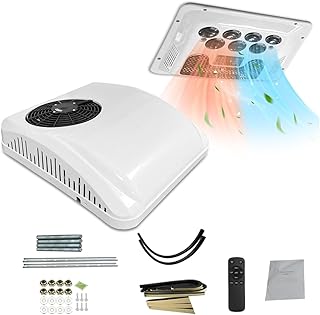
Hiberry Store’s 12V rooftop unit delivers 10000 BTU of cooling, plus heating, designed for trucks, campers, caravans, trailers, and motorhomes. It emphasizes energy efficiency to minimize power use while maintaining strong performance. Installation is rooftop-based, compatible with standard roof layouts, and the unit emphasizes weatherproof ABS construction for UV and impact resistance. Cooling air volume is approximately 2300 W; heating volume is around 1000W, with a rated current of 30–50A. Note that refrigerant is not pre-filled in transit; a refill with R134a (around 380g) is required before operation.
RV Air Conditioner, 12V 10000 BTU Rooftop Unit
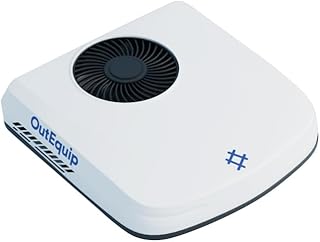
OutEquipPro’s 12V rooftop AC offers 10000 BTU of cooling with a battery-powered setup for off-grid use. It claims 8 hours of cooling on a 12V 480Ah battery and up to 10 hours with a 12V 600Ah battery when parked. The unit emphasizes durability with UV-stabilized ABS housing, EPDM foam gasket, and a zinc-coated condenser to withstand harsh weather. It targets RVs, trucks, vans, campers, and motorhomes seeking reliable off-grid comfort with a low-usage, battery-friendly profile.
Buying Guide: Key Purchase Considerations For 12V DC A/C Units
- Power demand and battery compatibility: Check current draw (A) and total wattage. Ensure your battery bank and alternator or solar setup can support extended cooling without draining critically.
- Cooling capacity vs. vehicle size: BTU ratings indicate maximum cooling. Match BTU to your space size, insulation, and climate. Over-sizing wastes energy; under-sizing won’t keep up during peak heat.
- Installation type: Roof-top units offer space efficiency but require proper mounting and skylight compatibility. Split systems separate indoor and outdoor units; ensure venting and service access fit your vehicle.
- Noise levels: Look for units with decibel ratings around 40–50 dB for comfortable sleep and daily living inside the cabin or camper shell.
- Durability and materials: ABS housings, heat-dissipation features, and rust-resistant components extend life in harsh travel conditions and varying climates.
- Refrigerant and maintenance: Most units use R134a; confirm refrigerant amount and service requirements. Some units ship without refrigerant and require a refill before first use.
- Off-grid capabilities: Battery-powered operation, run times, and compatibility with high-capacity packs affect how long cooling lasts without engine idling or shore power.
- Compatibility with vehicle roof and interior: Verify mounting measurements, roof thickness, and interior airflow paths. Non-ducted units may simplify installation for some layouts.
- Warranty and service: Consider manufacturer warranty, availability of spare parts, and local service options for RV and vehicle HVAC components.
- Energy efficiency features: Look for units with optimized compressors, smart fans, and insulated housings to minimize energy draw while maximizing comfort.
When evaluating these 12V air conditioners, assess your typical use case: stationary parking with battery banks, off-grid camping, or mobile travel where engine idling is minimized. Consider how often you need heating alongside cooling, as some units provide integrated heating functions, which can increase overall utility but also energy usage. For the best results, pair a suitable 12V system with additional power solutions like high-capacity deep-cycle batteries, solar panels, or a robust shore power setup to extend cooling duration and comfort between stops.