
Best 110V AC Motor Speed Control Options for Brushed Motors
Looking for a reliable 110V AC motor speed controller for brushed motors? This guide highlights five well-matched options, each ideal for common tools like fans, routers, drills, and grinders. It explains who each product is best for, why it’s chosen, and any important limitations. Use the quick comparison table below to compare key specs at a glance.
| Product | Max Current | Voltage Range | Best For |
|---|---|---|---|
| CDMALL AC Motor Speed Controller | 15A | 0-120V | Inline duct and exhaust fans, routers, drills |
| IGEYAPA AC Motor Speed Controller | 15A | 110-120V | Electric motors with smaller inductive loads |
| Azucyzi Versatile AC Motor Speed Controller | 15A | 110-120V | Fans and general brushed motor applications |
| Sezbaifles Variable Speed Controller | 15A | 110-120V | Routers, grinders, and polishing machines |
| IGOYE AC Motor Speed Controller | 15A | 110-120V | Electric tools and resistance heating |
CDMALL AC Motor Speed Controller for Brushed Motors
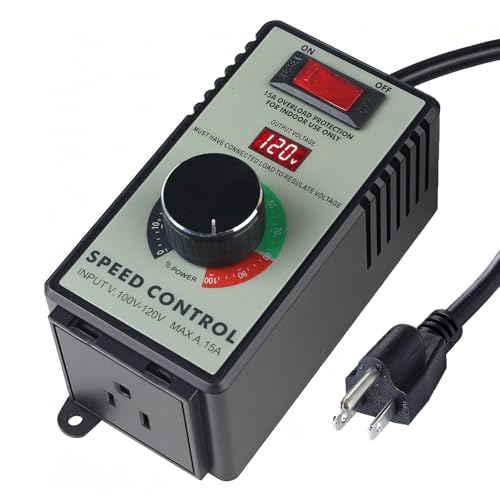
This controller is designed specifically for brushed AC motors, providing real-time voltage display and overload protection. It is best for inline duct fans, exhaust fans, ceiling fans, and common workshop tools. The unit supports up to 15A with a real-time LED voltage readout, helping you dial in exact speed, brightness, or temperature. It is not compatible with brushless or DC motors, or appliances that contain intricate circuitry like microwaves or washing machines. A key benefit is the built-in resettable overload protection, avoiding fuse replacement during extended use.
Who it’s best for: hobbyists and DIYers who run brushed AC motors, especially those who want precise voltage monitoring while controlling speed. Why chosen: it combines a clear LED readout with a robust 15A circuit protection, making it practical for a range of tools. Limitation: not suitable for motors with electronic boards or non-brushed designs.
AC Motor Speed Controller 100V-120V 15A Max

This model emphasizes protection features, including surge and peak protection plus RC absorption. It uses a clear LED display to show voltage in real time and has a flame-retardant shell. It’s suitable for resistive and inductive loads up to 2000W and 1500W respectively, with a 6-foot cord and US plug types. Best for: users needing a balance of safety features with straightforward knob-based speed control. Caution: rated at 10A continuous with recommended use near that limit for extended runs.
Azucyzi Versatile AC Motor Speed Controller

This speed controller highlights a compact design with a belt-clip feature for quick access on the job. It offers a robust LED voltage display and precise rotary knob control. Best for: portable work or belt-ready setups where easy access matters, such as fieldwork or mobile tool stations. Limitation: data suggests compatibility is for brushed motors; verify motor type before use to avoid incompatibility.
Sezbaifles Variable Speed Controller for 110-120V

This controller emphasizes multi-functionality with overload protection and a high-precision LED display. It’s designed for a variety of devices, including routers and polishing machines. Best for: users needing a higher wattage buffer for both resistive and inductive loads, with clear live voltage readings. Caution: ensure your load remains within the 15A limit for ongoing safety.
IGOYE 100V-120V 15A AC Motor Speed Controller

This model provides overload protection and an LED voltage display, suitable for various tools like drills, pumps, and fans. It’s designed to handle both resistive and inductive loads with a 15A max and 10A rated current. Best for: setups where a reliable automatic cut-off on overload is essential. Limitation: avoid use with devices that have built-in circuit boards or capacitive electronics.
Buying Guide: Key Considerations for 110V AC Motor Speed Controllers
- Motor type compatibility: Most controllers here are designed for brushed AC motors. Do not use with brushless or DC motors or devices with complex electronics.
- Current and wattage: Check the max current (A) and compatible wattage for resistive and inductive loads. Staying within recommended current supports longer life and safer operation.
- Protection features: Overload protection, surge protection, and RC absorption help protect equipment and the controller. Look for a resettable breaker rather than fuses for easier recovery.
- Voltage display: Real-time LED or digital voltage readouts aid precise speed control and repeatability across sessions.
- Casing and safety: Flame-retardant housings and robust internal components improve durability in workshop environments.
- Physical design: Length of cords, mounting options, and portability can matter for field use or limited workspace.
Practical Tips for Choosing the Right Controller
- For fixed workshop benches with a single tool type, prioritize models with the highest compatible current and a clear voltage readout.
- When speed control is essential for portable work, prefer compact units with belt clips or attachment features and easy setup.
- If you expect frequent overload events, choose a model with a robust auto-reset function to minimize downtime.
Frequently Asked Questions
- What motors can these controllers handle? Most listed controllers are designed for brushed AC motors at 110-120V and up to 15A max current; verify motor type before use.
- Can I use these with a brushless tool? No. These controllers are not compatible with brushless or DC motors or devices containing electronic circuit boards.
- Why is the LED voltage display useful? It helps you dial in precise speeds and monitor actual voltage delivered to the tool, improving repeatability.
- What happens if the current exceeds 15A? The built-in protection typically cuts power to prevent damage; some models require manual reset after the fault.
- Do these controllers regulate speed by voltage alone? Yes, most adjust the input voltage to the motor to change speed, which is effective for brushed AC motors.
- Are there any safety precautions? Ensure good ventilation and avoid extended operation near the maximum rating to reduce heat buildup and prolong controller life.