
Best 1000 Watt Full Spectrum LED Grow Lights for Indoor Gardening
Answering the search intent for powerful, energy-efficient growth lights, this guide highlights top 1000W full-spectrum LED options that are well-suited for seed starting through flowering. These picks emphasize energy efficiency, solid coverage, and reliable heat management. Ideal buyers include home growers expanding to 4×4 ft tents, hobbyists seeking year-round harvests, and small commercial setups wanting consistent yields without excessive electricity use. Below, you’ll find a quick comparison table and five carefully chosen models with practical, buyer-focused notes.
| Product | Best For | Why It Stands Out |
|---|---|---|
| Beelux 1000W LED Grow Light | 4×4 ft grow spaces | High efficiency, strong red spectrum boost, low noise cooling |
| Spider Farmer G1000W | Vertical grows & CO2 setups | Even coverage, high PPE, daisy-chain for multi-light scalability |
| ECOHOM 1000W | Versatile tents and greenhouses | Balanced full spectrum, energy efficiency, large coverage |
| KingLED KP1000 | Seed starting to harvest in tents | VEG/BLOOM modes, adjustable height, strong white/red mix |
| Madewell Living 1000W | Commercial-grade grow spaces | High-output with full spectrum including UV/IR, dimmable |
Beelux 1000W LED Grow Light For Indoor Plants

This Beelux model targets efficient replacement of traditional 1000W HPS/MH with only about 110W draw. It supports a 4×4 ft area and emphasizes a higher yield through added red LEDs. The cooling system uses an optical grade fireproof PC and an aluminum back cover, while six-sided convection aids heat dissipation. Best for growers who want lower running costs without sacrificing bloom potential. Caution: data notes 60% convection cooling but does not detail noise levels beyond “no noise.”
AGLEX 1000W LED Grow Lights
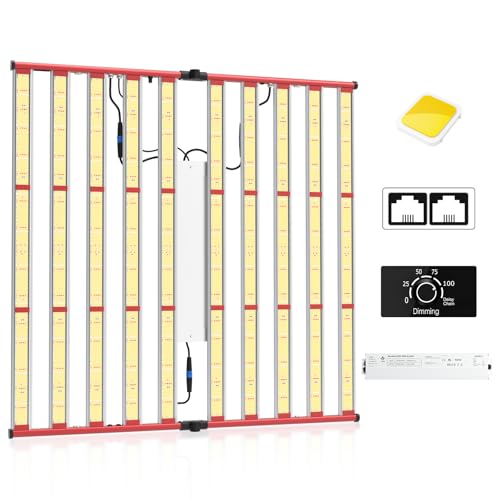
AGLEX’s 1000W fixture features a full spectrum including 3000K and 5000K whites, blue, red, and IR, suitable for a 6×6 ft area. It offers daisy-chain networking up to 100 lights and dimming control, which is helpful for commercial or multi-tent setups. The design emphasizes energy efficiency, with a high PPFD figure and coverage that competes with traditional 2000W HID systems. Best for scaled indoor grows where multiple fixtures operate in concert. Limitation: relies on external dimming controls for precise spectrum management in some rooms.
TATU 1000W LED Grow Light

TATU presents an all-stages spectrum including 660nm red and 430nm blue with white output to accelerate flowering while maintaining vegetative vigor. The unit emphasizes energy efficiency and a heat-dissipation design that reduces noise and helps maintain longevity. Best for growers facing chilly environments where year-round harvests are desired. Choose this if you want strong flowering cues without extra noise. Limitation: performance claims focus on efficiency and design rather than third-party testing data.
Spider Farmer G1000W LED Grow Light

Spider Farmer’s G1000W uses high-efficiency Bridgelux diodes and a 8-bar design for uniform edge-to-edge coverage. It delivers a PPE around 2.9 μmol/J and is suitable for 4×4 ft to 5×5 ft layouts, especially in vertical farming or CO2-enhanced rooms. The foldable design adds convenience for home setups. Best for commercial-style grows where uniformity and expansion capacity matter. Caution: the product relies on a robust power system to realize its full coverage advantages in larger tents.
ECOHOM 1000W LED Grow Light

ECOHOM’s fixture emphasizes a balanced full spectrum with a total of 3160 LEDs, including white, 6500K and 3000K diodes plus deep red and UV. It claims high efficiency with a PPE near 2.8 μmol/J and large, even coverage for 6×6 ft tents or greenhouses. Best for growers seeking a scientifically balanced spectrum that supports all stages from seed to harvest. Limitation: large array may require ample mounting space and airflow to maintain optimal temperatures.
Buying Guide: Key Considerations for 1000W Full Spectrum LED Grow Lights
- Coverage vs. Mounting Height: Determine the tent size (e.g., 4×4 ft, 5×5 ft) and aim for fixtures offering even distribution across the canopy. Higher PPFD is valuable, but ensure heat and electricity are manageable.
- Spectrum and Spectrum Tuning: Full-spectrum fixtures with white, blue, red, and IR/UV wavelengths support all growth stages. Some models offer VEG/BLOOM modes or dimming options for fine-tuning intensity.
- Energy Efficiency: Compare PPFD per watt and overall energy use. A 1000W labeled unit might draw less than 1000W in practice, reducing operating costs.
- Cooling and Noise: Look for convection cooling designs and quiet fans. Heat buildup can reduce LED efficiency and shorten lifespan.
- Connectivity and Expansion: Daisy-chain capabilities help scale a grow room or tent without a complex wiring setup. Consider dimming and remote controls if available.
FAQ
- What does 1000W LED grow light mean in practice?
The 1000W designation often reflects the equivalent HID performance or total LED power. Real electricity draw is typically lower; check the product’s actual wattage and PPFD values for a direct comparison. - Is full-spectrum better for beginners?
Yes, full-spectrum lights support all growth stages—from seedlings to flowering—reducing the need for spectrum switching and additional equipment. - Do I need dimming or a daisy-chain feature?
Dimming helps tailor light intensity to plant needs. Daisy-chain enables scalable setups, particularly in multi-tent environments or commercial grows. - How important is heat dissipation?
Excellent heat management preserves LED efficiency and longevity. Look for multi-surface fins, aluminum heat sinks, and airflow designs. - Can I use these lights in a standard grow tent?
Yes, most 1000W fixtures are designed for tents around 4×4 ft to 5×5 ft, but confirm ceiling height and mounting options to ensure proper canopy coverage.