
Best Tools to Identify Breakers for Fast Electrical Troubleshooting
Looking for the best tool to identify breakers quickly in a panel? This guide focuses on reliable circuit breaker finders that help professionals and DIYers pinpoint the correct breaker on 90–250V circuits. The top picks span features like built-in GFCI testing, LCD displays, non-contact voltage sensing, and combined diagnostic functions. Each option is described with who it’s best for, why it stands out, and a clear limitation to consider. Use this overview to choose a tool that speeds up panel work, reduces guesswork, and improves safety during electrical troubleshooting.
Summary table of chosen products:
- Klein Tools ET310KIT AC Circuit Breaker Finder Kit
- KAIWEETS KT301P Circuit Breaker Finder with LCD Display
- Klein Tools ET310 AC Circuit Breaker Finder
- Saker 3-in-1 Circuit Breaker Finder with GFCI Outlet Tester
- Circuit Breaker Finder & GFCI Outlet Tester with Digital LCD Display (FOCEMTA)
Klein Tools ET310KIT AC Breaker Finder Kit
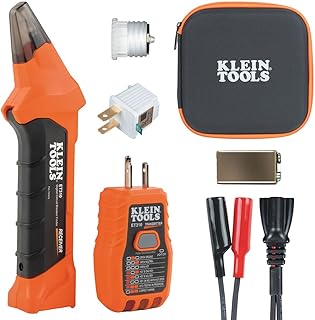
The ET310KIT combines a transmitter and receiver to quickly identify the correct circuit breaker for 90–120V AC circuits. It provides clear visual and audible cues when the right breaker is located, helping electricians and DIYers minimize panel searches. A built-in GFCI tester adds safety checks for wiring conditions. This kit is best for professionals who need a complete workflow from breaker identification to GFCI verification in one tool set.
Best for: Electricians who want an all-in-one kit for fast breaker hunting plus GFCI checks.
Why selected: It emphasizes precise identification and reliable feedback, reducing panel time and errors on standard residential circuits. The included accessories help streamline setup and testing.
Limitation: Primarily optimized for 90–120V circuits; may be less ideal for high-voltage or non-standard panel configurations without extra accessories.
KAIWEETS KT301P Circuit Breaker Finder with LCD

KT301P offers an all-in-one diagnostic tool that locates breakers, tests GFCI protection, and checks outlet wiring. It combines a circuit breaker finder, outlet tester, and GFCI tester in one compact device, making it suitable for both residential and commercial projects on 120V circuits. The large LCD with backlight shows voltage, wiring status, and signal strength for quick, intuitive diagnostics.
Best for: Pros and DIYers who want a single tool to diagnose breakers, outlets, and GFCI conditions quickly.
Why selected: The triple-function design reduces tool swaps, helping users diagnose complex panels with confidence. The backlit display improves readability in dim breaker boxes.
Limitation: Real-time voltage readouts are limited to 30–150V, which may be insufficient for higher voltage applications without additional equipment.
Klein Tools ET310 AC Breaker Finder

The ET310 uses a two-part system with a transmitter and receiver to identify the connected outlet or fixture and scan the panel for the correct breaker. It provides clear cues when the right breaker is found and is designed to streamline the locating process, particularly on standard electrical panels. This model emphasizes accuracy and ease of use in typical residential settings.
Best for: DIY homeowners and professionals who want straightforward, reliable breaker locating.
Why selected: The two-part approach visually confirms the correct breaker, reducing misidentification in busy panels. The built-in indication system aids quick decision making.
Limitation: Focused on standard residential panels; may require additional tools for more complex commercial panels or unusual wiring layouts.
Saker 3-in-1 Circuit Breaker Finder

Saker’s 3-in-1 tool combines breaker search, GFCI testing, and an NCV (non-contact voltage) detector. It features an LCD with readings for voltage (90–250V), wiring status, and signal strength, plus auto data hold to review results after unplugging. It’s designed for electricians and DIY users who want a single device capable of quick diagnostics and ongoing panel checks.
Best for: Inspectors and remodel teams who need a versatile tester with voltage display and NCV sensing.
Why selected: The combination of voltage data, wiring condition diagnostics, and GFCI testing provides a comprehensive view of panel health and wiring faults in one tool.
Limitation: The LCD readings cover a wide range, but users should verify compatibility with their specific panel voltages and wiring standards before use.
Circuit Breaker Finder & GFCI Tester With LCD Display

This lightweight, all-in-one tool combines breaker finding, outlet testing, and GFCI protection verification. It displays real-time voltage (90–135V) and signal strength on a dual-function LCD, helping users trace circuits with precision. The device also includes a red/green LED indicator and a large screen to diagnose up to six common wiring faults, including open circuits and reverse polarity.
Best for: Electricians and DIYers who value precise data readouts and a single device for hallmarks of wiring issues.
Why selected: The dual-display and automatic trip testing set this apart for methodical troubleshooting and documentation during panel work.
Limitation: The voltage range is optimized for 90–135V, so higher-voltage scenarios may require a different tool or additional testing steps.
Buying Guide: How to Choose the Right Breaker Finder
- Voltage range: Match tools to your typical panel voltage (90–135V, 90–250V, etc.).
- Functionality: Decide if you need a dedicated breaker finder, a multi-diagnostic tool, or a combination with GFCI testing.
- Display and readability: Backlit LCDs improve visibility in dim panels; consider auto-hold and data-log features for work logs.
- Indication method: Visual indicators plus audible cues speed up breaker identification in noisy environments.
- Portability and kit contents: Carrying cases, adapters, and batteries affect on-site efficiency and versatility.
- Safety features: Built-in GFCI testing and non-contact voltage sensing reduce risk during inspections.
- Panel types: For commercial or 240V/3-phase setups, ensure the tool supports higher voltage ranges and different wiring schemes.
Operational Tips
- Follow manufacturer instructions for transmitter and receiver alignment to maximize accuracy.
- Test a known circuit first to verify the device’s baseline performance in your environment.
- Use the NCV function to verify de-energized panels before further work.
- Keep spare batteries and protective storage to maintain tool readiness on job sites.
FAQ
- What is a circuit breaker finder best used for? It helps identify the correct breaker quickly within a panel to support safe electrical troubleshooting.
- Do these tools require additional testing equipment? Some models include GFCI testing and NCV sensing; others may require separate testers for full capability.
- Can I use these tools for commercial panels? Many models support 120V and some higher ranges; verify voltage compatibility for your setup.
- Are there safety considerations when using a breaker finder? Always verify de-energization status and follow proper electrical safety practices during testing.
- Is backlit LCD visibility important? Yes, it helps you read status in dim breaker rooms or cluttered panels.