
Best Washer Plug in Adapters for Reducing Laundry Frustration
If you’re trying to power a dryer or a washer with an incompatible outlet, a dedicated plug adapter can solve the problem. This guide highlights five practical adapters that help you connect older dryers, or mixed 3-prong to 4-prong setups, safely and efficiently. The best choice depends on your outlet type, voltage, and the plug configuration you need. Below, you’ll find a quick buyer’s table and clear recommendations for different scenarios.
| Product | Best For | Key Limitation |
|---|---|---|
| Dryer Adapter Cord (NEMA 5-15P to 10-30R) | Old or mixed 120V appliances in 10-30 receptacles | Not suitable for 240V devices |
| PlugSaf 3→4 Prong Dryer Adapter (14-30P to 10-30R) | Converting older 3-prong to modern 4-slot outlets | Not for high-power appliances like EV chargers |
| WELLUCK 3→4 Prong Dryer Adapter | Flexible reach for old dryers | 3→4 adapter designed for standard dryer use |
| ELEGRP Auto-Monitor GFCI Replacement Plug | Wet environments or near water sources | GFCI replacement, not a simple cord adapter |
| Eversimpleinc 4→3 Prong Dryer Adapter | Older homes with 3-prong outlets | Only suitable for 4→3 configurations |
Dryer Adapter Cord NEMA 5-15P to 10-30R
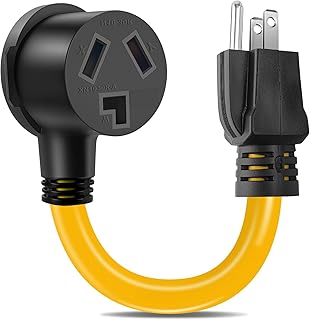
The NEMA 5-15P to 10-30R adapter from Aukzily Store is a heavy-duty option designed for 125V, 15A circuits. It uses 10 AWG copper conductors and a high-density PVC jacket for durability in typical home environments. This adapter is best for users who need to operate a dryer or other 120V devices from a 10-30R receptacle. It should not be used with 240V equipment, such as large clothes dryers rated for higher power. The adapter is simple to install and requires no wiring knowledge, making it suitable for quick on/off power needs. A potential limitation is that it cannot handle voltages or loads beyond 125V, so verify device compatibility first.
Who it’s best for: Homeowners or renters with 120V outlets looking to bridge a NEMA 5-15P plug to a NEMA 10-30R receptor for light to moderate loads. It’s a practical choice for temporary or infrequent use when you need to fit an older appliance into a different outlet.
PlugSaf 1.5Ft 3 Prong to 4 Prong Dryer Adapter

This adapter converts a NEMA 14-30P male plug to a NEMA 10-30R female receptacle, effectively letting an older 3-prong dryer plug work with a newer 4-slot outlet. It is ETL listed and rated for 125/250V, with a robust 10 AWG conductor. The unit includes a protective cover on the plug to help prevent accidental contact or damage. While convenient for reducing clutter and enabling compatibility, do not use this adapter for charging electric vehicles, electric stoves, or other high-power devices that exceed its 30A rating.
Who it’s best for: Renters or households upgrading to newer outlets who still have older 3-prong dryers. It’s a good choice when space is limited, thanks to its right-angle plug design that minimizes wall intrusion.
WELLUCK 3→4 Prong Dryer Adapter

This 1.5 ft adapter converts a 3-prong dryer cord to a 4-slot wall outlet (14-30P to 10-30R). It provides a flexible extension with a molded right-angle plug for easier placement in tight spaces. It emphasizes durability with high-temperature resistance and waterproof, flame- and corrosion-resistant properties. The 10 AWG copper wiring enhances continuity. A limitation is that it’s designed specifically for typical dryer loads, so avoid using it with unusually high-power devices not intended for dryers.
Who it’s best for: Home users who want a quick fix to connect a modern dryer to an older outlet while keeping installation simple and safe. It is well-suited for adaptable layouts where reach and space matter.
ELEGRP G1215PA2 Auto-Monitor GFCI Replacement Plug

The patented auto-monitor GFCI replacement plug provides automatic self-testing every 5 seconds to ensure continuous protection. It includes surge and lightning protection with a high resistance to moisture, achieving IP65 waterproof rating. This unit is UL/CUL listed and designed for 15A, two-wire, non-grounded circuits typically used with certain outdoor or damp environments. It is not a simple outlet adapter but a protective plug assembly intended for added safety in wet or damp settings.
Who it’s best for: Property owners or DIY installers who need enhanced protection around water sources, pools, pressure washers, or outdoor equipment. Choose this if protection against shock is a priority and a GFCI upgrade is appropriate for the setup.
Eversimpleinc 4 Prong to 3 Prong Dryer Adapter

This adapter lets you connect a new 4-prong dryer cord to a 3-prong old dryer receptacle, effectively bridging newer appliances with older outlets. Featuring a STW 10 AWG 3C design, it emphasizes straightforward installation for compatibility with homes built before 1997. Its primary use is as a compatibility bridge in older residences rather than a general power-extension solution. A potential limitation is that it is specifically a 4→3 configuration and should not be relied on for 4→4 or higher-power needs.
Who it’s best for: Homeowners with older wiring or outlets who want to continue using new 4-prong dryers with existing three-prong receptacles. It’s a practical, low-cost fix when rewiring isn’t feasible.
Buying Guide: How to Choose the Right Washer Plug In Adapter
Key questions to guide your selection include outlet type, voltage, and appliance power needs. Start by confirming the outlet your device uses and the receptacle you have available. Check the conductor size and insulation rating to ensure it matches or exceeds your device’s requirements. Consider the environment—humid or outdoor areas benefit from GFCI-protected or water-resistant designs. Also assess whether you need a simple adapter or a more protective assembly with built-in surge or fault protection.
Match the scenario to the product type:
- For simple conversions in dry indoor spaces, a basic 5-15P to 10-30R adapter is often sufficient.
- For older dryers and mixed-prong setups, look for 3→4 prong adapters with sturdy copper wiring and right-angle designs to save space.
- In damp or outdoor areas, consider GFCI-enabled or water-resistant adapters for added safety.
- Avoid high-power devices like EV chargers or space heaters with adapters not rated for their load.
Durability and materials matter. Look for 10 AWG or thicker conductors for better current handling and a robust jacket for abrasion resistance. Verify that the product is ETL or UL listed where applicable and that the rating aligns with the intended voltage and amperage.
FAQ
- Q: Can I use a dryer adapter for high-power appliances?
A: No. Most adapters are rated for typical dryer or 125V/15A loads. Do not use them with high-power devices such as EV chargers or ovens unless the rating matches the device. - Q: Do these adapters require tools to install?
A: No. Most are plug-and-play and designed for simple connections without wiring. Always confirm compatibility with your outlet before use. - Q: Are GFCI adapters safer for outdoor use?
A: Yes. GFCI-protected adapters reduce risk of electric shock in damp environments, making them a safer choice for outdoor installations. - Q: What does 3-prong to 4-prong mean in this context?
A: It refers to converting a older 3-prong dryer plug to fit a newer 4-slot outlet, typically by providing a compatible receptacle arrangement. - Q: Should I replace my outlet instead of using an adapter?
A: If you frequently need to power modern appliances with older outlets, upgrading the outlet or wiring may be safer and more reliable. Consult a licensed electrician for guidance. - Q: Can I mix different brands together?
A: Mixing adapters can increase connection complexity and potential safety concerns. Use a single adapter designed for your exact outlet and plug configuration whenever possible.