
Best 3-Phase kWh Meters for Accurate Power Monitoring
Find reliable 3-phase kWh meters that give real-time energy data, support common voltages, and fit your installation needs. This guide highlights five meters that are well-suited for commercial, industrial, or multi-circuit residential setups. Each option is explained with who it’s best for, potential limitations, and why it was selected for this list.
| Product | Best For | Why It Stands Out |
|---|---|---|
| Eyedro 3-Phase Energy Meter EB6-EW-E3 | Site with solar or net metering needs | Real-time kWh/W/A/V/PF data; WiFi or Ethernet; supports multiple voltage configurations |
| Universal Electric kWh Meter – Omnimeter Pulse v.4 | Systems needing pulse-output integration | Works with various pulse devices; flexible external relay control |
| Universal Electric kWh Meter – Omnimeter I v.3 | Modular kWh metering for mixed voltages | Wide voltage range; CTs sold separately; flexible frequency support |
| DAE P254-200-S KIT – 3 Phase 200A Submeter | UL-listed submetering in 3-phase panels | UL CTEP kit; 3 CTs included; RS485 output for bus monitoring |
| EKM Omnimeter Pulse v.4 (Universal) | General-purpose submetering with pulse outputs | 3-phase readiness; supports multiple pulse-output devices |
Eyedro 3-Phase Energy Meter EB6-EW-E3

The Eyedro EB6-EW-E3 3-phase meter is designed for real-time energy monitoring across kWh, watts, amps, volts, and power factor. It provides instant cost data and supports solar generation versus consumption, making it suitable for homes or small businesses with solar or net-metering needs. Best for buyers who want clear, real-time visibility and a choice between WiFi or Ethernet connectivity. Limitations include potential setup assistance needs from Eyedro Support to optimize installation.
- Best for: users needing real-time cross-compare of energy usage and solar generation.
- Connectivity: WiFi 2.4 GHz or wired Ethernet.
- Voltage options: 600V Delta, 480V/277V Wye, 208V/120V, and more.
Universal Single Phase Meter (Note: Included for reference)
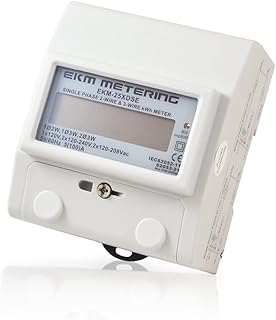
This reference item is included to illustrate related metering options that can integrate into a 3-phase system when needed. It’s most suitable for single-phase circuits within a larger 3-phase setup and should be paired with proper CTs and panel configurations.
Universal Electric kWh Meter – Omnimeter Pulse v.4

The Omnimeter Pulse v.4 supports counting pulses from up to three pulse-output devices and can control up to two external relays. This makes it suitable for systems that need external device signaling or integration with automation. Best for: users who require pulse-output data alongside standard kWh measurements. Caution: ensure compatibility with your pulse devices and relay logic before installation.
- Best for: pulse-output integration in multi-device monitoring.
- Voltage compatibility: Works with systems up to 480V.
- Limitations: Pulse-output devices must be wired correctly to avoid miscounts.
Omnimeter I v.3 – Universal kWh Meter

The Omnimeter I v.3 provides a flexible kWh metering solution across a broad voltage range. It supports 120 to 480 volts and CTs sold separately. Best for: projects needing a adaptable meter across various voltages with room to expand CT sensing as needed. Limitation: CTs are not included, which adds setup steps and costs.
- Best for: scalable metering in mixed-voltage environments.
- Voltage range: 120–480V; CTs optional.
- Limitation: requires separate CTs for 3-phase monitoring.
DAE P254-200-S KIT – 3 Phase Submeter

The DAE P254-200-S KIT provides a UL-listed 3-phase submeter solution with three CTs included and RS485 output. Best for: panel installations needing a ready-to-wire 3-phase submeter with data bus compatibility. Caution: ensure RS485 protocol compatibility with your data collection system.
Buying Guide
What to consider when choosing a 3-phase kWh meter
- Voltage and current ranges: Ensure the meter supports your system’s voltage (e.g., 208/120V, 480/277V) and current (CTs included or not).
- Connectivity: WiFi, Ethernet, or RS485 options affect installation and remote monitoring capabilities.
- Data granularity: Real-time readings for kWh, W, A, V, and PF help with energy management and demand charges.
- Pulse output and relays: Some meters offer pulse outputs or external relays for automation or reporting triggers.
- Expandability: CTs sold separately may be needed for full 3-phase monitoring; verify compatibility with your panel.
- UL/ETL listing and certifications: Important for commercial installations and code compliance.
Practical tips for deployment
- Map phases carefully during installation to ensure accurate phase alignment and CT placement.
- Prepare wiring diagrams that show CT orientation and meter connection points for future troubleshooting.
- Plan for future expansion by choosing meters that support additional CTs or external relays.
FAQ
- What is a 3-phase kWh meter used for?
It measures energy use across three electrical phases, helping monitor load balance, efficiency, and demand charges in multi-phase systems.
- Do these meters require CTs?
Many 3-phase meters use external CTs to measure current; CTs may be included or sold separately, depending on the model.
- Can I monitor solar production with these meters?
Yes, meters with real-time PF and power data can compare solar generation against load, aiding net metering insights.
- What connectivity options are common?
WiFi, Ethernet, and RS485 are common; choose based on your network infrastructure and data-collection needs.
- Is UL listing important?
For commercial installations or code compliance, UL or ETL listings help ensure safety and reliability.