
Best Standby Generator Automatic Transfer Switches for Home Backup
When choosing a standby generator automatic transfer switch (ATS), the goal is seamless, automatic power transfer during outages while protecting your home’s wiring. This guide highlights five top options, from service-entrance rated units to outdoor NEMA 3R enclosures. Best for homeowners seeking whole-home backup, best for indoor/outdoor versatility, and practical alternatives for mixed setups are covered. Each option includes who it’s best for, why it was selected, and a practical caveat to inform a confident purchase.
| Product | Best For | Key Benefit |
|---|---|---|
| RXSW200A3 200 Amp Automatic Transfer Switch | Full-home backup for Generac systems | Service entrance rated with robust power management |
| 200 Amp Automatic Transfer Switch for RXSW200A3 | Indoor/outdoor Generac setups | Versatile, weather-ready enclosure |
| Generac 100 Amp Legacy Automatic Transfer Switch | Outdoor-rated, reliable whole-house transfer | Open transition, protects grid and wiring |
| Nature’s Generator 50A Automatic Transfer Switch | Solar-compatible backup solutions | Grid-tie inverter friendly with parallel path |
| LEAPTREND 15A Manual Transfer Switch | Budget-friendly, quick DIY backup | Manual switch, not automatic |
RXSW200A3 200 Amp Automatic Transfer Switch
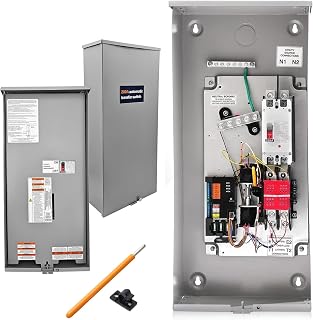
Best for Generac owners seeking a service-entrance rated, robust automatic transfer switch with strong power management and outdoor-ready enclosure.
What makes it stand out
- Large 200 Amp capacity suitable for whole-home backups
- Service Entrance rated for safer utility integration
- NEMA 3R aluminum enclosure designed for outdoor use
Caution: Installation should follow local codes; professional electrical work is often required.
200 Amp Automatic Transfer Switch for RXSW200A3
Best for Generac users needing outdoor-ready, service-entrance transfer with built-in power management.
Generac 100 Amp Legacy Automatic Transfer Switch

Best for outdoor installations needing a reliable 100 Amp transfer switch with SE-rated protection. It transfers automatically when power fails and isolates utility from generator power to prevent backfeed. The 100 Amp capacity supports a wide range of full-home loads at 120/240V.
Key considerations
- Open transition switching helps avoid backfeed risks
- Supports full 120V and 240V panels within its rating
Caution: For homes with higher power demands or future expansion, verify panel compatibility and load calculations.
Nature’s Generator 50A Automatic Transfer Switch

Best for solar-compatible backup systems needing an ATS that works with a variety of backup sources. It supports up to 50 amps and handles 120V, 120/240V, and 120/208V systems. Grid-tie inverter friendliness allows continuous operation of compatible inverters while delivering power to essential loads.
Why choose this
- Parallel power path supports grid-tie inverters
- Broad compatibility with solar, AFCI/GFCI breakers
Caution: It is designed to work with compatible solar/battery setups; verify your system’s compatibility before purchase.
LEAPTREND Manual Generator Transfer Switch

Best for budget-minded setups and quick DIY projects where a manual transfer is acceptable during outages. This unit directs power from a portable generator to essential 120V circuits. It also serves as a practical backup option for garages, basements, or home offices.
Note on automatic vs. manual
- This product is manual; it does not automatically switch power when outage occurs.
- Choose this if cost is a primary factor and you’re comfortable with manual switching.
Caution: Not suitable as a full-home automatic transfer solution; plan for a separate automatic ATS if entire-home reliability is required.
Buying Guide
What to consider when choosing an ATS
- Power needs: Match the ATS amperage to your service panel and expected load, including 120V and 240V circuits.
- Type: Automatic vs manual. Automatic transfer switches trigger during outages; manual require user action.
- Enclosure and location: Outdoor vs indoor units; look for weather-rated enclosures (NEMA classifications).
- Compatibility: Ensure the ATS is compatible with your generator make/model and existing panel.
- Open vs closed transition: Open transition prevents backfeed into the grid; important for safety and utility coordination.
Practical setup tips
- Consult a licensed electrician to verify load calculations and to ensure code-compliant installation.
- Plan for future expansion: choose an ATS with ample amperage if you anticipate adding loads or a larger generator.
- Consider integration with smart home or monitoring systems if you want outage notifications or remote status checks.
Common questions
- Do I need a service entrance rated ATS? If you want to control backfeed and meet utility interconnection requirements, yes.
- Can I use a 100 A ATS for a large home? It can back up critical circuits, but may not cover all high-demand loads; verify panel capacity.
- Are outdoor ATS enclosures weatherproof? Look for NEMA 3R or higher for outdoor use.
- Is a generator with an ATS enough for DIY installation? Some electrical work is required; professional installation is advised for safety and code compliance.
FAQ
- What is an automatic transfer switch (ATS)? An ATS automatically transfers electrical load from utility power to a backup generator when a power failure is detected, and back when power returns.
- Will an ATS protect my entire home? A properly sized service-entrance ATS can power your whole panel; ensure your generator capacity matches your loads.
- Can I install an ATS myself? Some jurisdictions allow limited DIY work, but most installations require a licensed electrician.
- What is an open transition transfer switch? It disconnects the utility and generator before switching, reducing backfeed risk but may cause a brief power interruption.
- Do all ATS units require a separate manual transfer switch? No; automatic units handle switching, while some setups include manual options for specific circuits.