
Best 220 Air Conditioner Plug Adapter: Practical Choices for Safe, Localized Power Use
When you need a reliable way to connect 220/240V devices to North American outlets, choose plug adapters designed for higher voltage use and solid construction. This guide highlights five well-suited adapters for travelers, workshop setups, and households with 220–240V equipment. It explains who each product is best for, why it was selected, and potential limitations to consider before purchasing.
Buyer summary table
| Product | Best For | Key Benefit | Limitation |
|---|---|---|---|
| 120V to 220-240V Plug Adapter (B0BZM4MFB8) | Lightweight, portable 120V to 240V devices | Sturdy materials; simple, tool-free use | Not a voltage converter |
| Toptekits Black NEMA 6-15P Universal Travel Plug Adapter (B07FKLLW2W) | International travelers to North America | Supports 208–240V; broad plug compatibility | Not for 110/120V receptacles |
| AC WORKS 30 Amp Dryer Outlet Adapter (B07GHBN2DK) | Heavy-duty HVAC or workshop outlets | Handles 30A circuits and classic dryer configurations | Primarily for certain outlet types |
| 2-Pack Toptekits Universal Travel Plug Adapter (B0FR55K3ZS) | Two adapters for simultaneous devices | Dual-pack convenience; 250V rating | Same voltage caveat as 208–240V use |
| 6-15P to 5-15R Electrical Converter (B0FDWLRC7B) | 110–250V range appliances | Versatile 3-pin to 2-flat blade configuration | Best for lower to mid-power devices |
120V to 220-240V Plug Adapter 5-15P to 6-15R

Best for: Lightweight use with 120V devices that require 6-15R receptacles in 220–240V environments. This adapter is described as a plug-only accessory, not a voltage converter, making it suitable for appliances within the adapter’s voltage range and power rating. Choose this if you need a compact, simple-to-use adapter for travel or home use with non-converting compatibility.
Why selected: It combines sturdy construction with easy, tool-free operation. Its compact size (approximately 32x32x72 mm) makes it convenient for travel or storage. Avoid this if you need actual voltage conversion or high-power devices beyond its design.
Caution: Always cut power before plugging or unplugging, and do not use for high-power appliances beyond the adapter’s limit.
Toptekits Universal Travel Plug Adapter, 110–250V

Best for: International travelers who need to fit European, UK, Australian, or other plugs into North American NEMA 6-15R outlets. Not intended for use with 110–120V receptacles; designed for 208–240V circuits in the US and Canada.
Why selected: It offers broad international compatibility with a North American 6-15P plug interface. The model is designed to support up to 250V, aligning with most travel electronics. Limitation: It does not convert voltage, and use should be restricted to devices suited for 208–240V service.
2-Pack Toptekits Universal Travel Plug Adapter (US 6-20P to International)
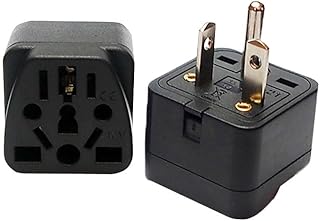
Best for: Travelers needing a backup or multi-device solution when visiting North America with 6-20 outlets. The dual-pack provides flexibility for simultaneous devices.
Why selected: It supports converting EU, UK, AU, NZ, and CN plugs to US 6-20 outlets, expanding compatibility for 220–240V devices. Limitation: Like other travel adapters, it does not convert voltage; verify device voltage compatibility before use.
6-15P to 5-15R Electrical Converter Plug

Best for: Converting 6-15P to 5-15R configurations across 110–250V ranges. Good for mid-power appliances that fit into a standard 5-15R receptacle in North American outlets.
Why selected: It’s built with durable materials and designed for straightforward use. Suitable for kitchens, workshops, or service areas where different plug types must share outlets. Caution: Not recommended for high-power devices like air conditioners; verify power draw and device voltage before use.
Buying Guide: Key Considerations for 220/240V Plug Adapters
What will you plug in?
Check the voltage rating of your device and ensure the adapter is intended for 208–240V devices if you plan to use it in that range. Adapters do not convert voltage; they only adapt plug shapes.
Is it a converter or a simple adapter?
Distinguish between voltage-converting devices and simple plug adapters. For most household electronics and appliances designed for 208–240V, an adapter is sufficient. For devices that run on 110–120V, you need a voltage converter and a compatible plug adapter.
Power handling and safety
Look for durable materials and clear load ratings. Avoid adapters with vague specs for high-wattage devices. Ensure that the adapter is not blocking air vents or creating overheating risks.
Travel vs. home use
Travel adapters prioritize compact size and broad plug compatibility. Home-use adapters may emphasize sturdier construction for frequent plugging and unplugging.
Compatibility with outlets
Verify outlet types in your region. Some adapters are designed specifically for NEMA 6-15R or 5-15R sockets and will not fit every outlet without a compatible receptacle.
FAQ
- Can I use a 220V adapter with any 110V device? No. Adapters do not convert voltage. Using a 220V-rated adapter with a 110V device won’t provide the correct voltage and may be unsafe. Use a voltage converter if needed.
- Are these adapters safe for high-wattage appliances? Most are not intended for high-wattage devices like air conditioners. Check the power rating and avoid overloading the adapter.
- Do any of these adapters convert voltage? The listed products are designed as plug adapters, not voltage converters. If you need voltage conversion, select a converter designed for your appliance’s wattage.
- Can I use these adapters for travel? Yes. Several options are built for travel, offering compact size and broad international compatibility with North American outlets.
- What should I do before using an adapter? Confirm device voltage, ensure the adapter’s rating matches the load, and always unplug before motor starts or stops to avoid surges.
- Do these require tools? Most are tool-free; simply plug into the outlet and then plug your device into the adapter.