
Best Switches for LED Light Strips: Inline, Dimmer, and PWM Options
Answer: Inline switches, dimmer controls, and PWM-driven dimmers are the most practical switches for LED light strips. Inline on/off switches are best for simple, quick power control. Dimmer switches are ideal when you want adjustable brightness. PWM dimmers are preferred for smoother, flicker-free dimming on longer runs. This guide highlights five reliable options, who they’re best for, and practical caveats to help you choose.
| Product | Best For | Key Benefit |
|---|---|---|
| TronicsPros LED Strip Light Inline On/Off Switch Cable | Simple on/off control for 12V strips | Compact inline switch with 12V DC compatibility |
| weideer DC12V-24V LED Strip Lights Dimmer Switch PWM | Users needing stepless brightness | Smooth PWM dimming across 0%-100% |
| Gebildet LED Strip Light Inline On/Off Switch Cable | Budget inline switch option | Basic on/off control for common 12V strips |
| TronicsPros Inline Switch Cable 12V/24V (2 Pack) | Reliable dual inline switches | 2-pack convenience with standard 5.5×2.1mm DC jack |
| HUALAND 4pcs DC 12V Inline Switch Kit | Bulk inline switches for multiple runs | Easy plug-in, no soldering required |
TronicsPros 2pcs Inline On/Off Switch Cable
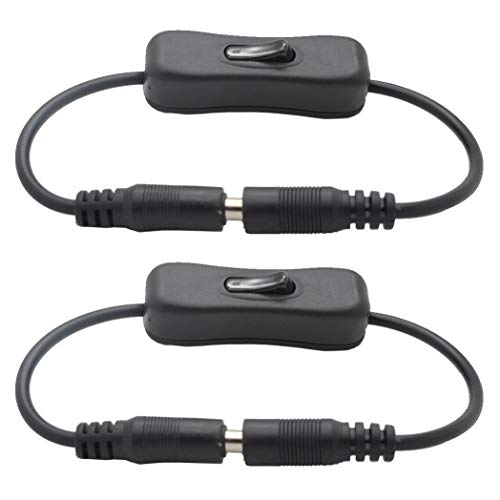
This inline switch cable offers a straightforward on/off function for 12V LED strips. It uses a 5.5×2.1mm DC connector and supports up to 2A, making it suitable for common COB, SMD5050, 3528, 2835, and 5630 strip configurations. Best for hobby projects, under-cabinet lighting, and quick installations where you want immediate power control without changing a controller or driver.
Who it’s best for: DIY enthusiasts and installers needing a simple, reliable switch in a compact 30 cm cable. Why selected: It’s compact, widely compatible with typical 12V LED strips, and easy to wire. Caution: Do not exceed 2A to avoid overheating.
weideer PWM Dimmer Rotary Switch for LED Strips

This PWM dimmer provides stepless brightness control for DC12V-24V LED strings with a 5.5×2.1mm connector. The knob adjusts brightness from 0% to 100% with low flicker at low levels. It’s best for mood lighting, under-cabinet accents, and decorative LED tapes where variable brightness is desired. Best for: users who want smooth dimming without noticeable flicker. Limitation: rated for up to 2A per color; never connect to AC mains or non-DC drivers.
Gebildet 5-Pack Inline Switch Cable Kit

This kit includes five inline on/off switch cables for 12V LED strips. Each cable uses a 5.5×2.1mm DC connector and provides a simple power toggle on long runs or multi-line installations. Best for: projects needing separate control points along a longer strip. Strength: multiple switches in one order. Caution: ensure each connection remains within rated current (2A max) to prevent overheating.
TronicsPros 2pcs Inline Switch Cable, White

This is another two-pack inline switch option from TronicsPros, featuring a 12V DC rocker style switch on a 30 cm cord. It’s best for installations requiring discrete, low-profile switches for LED strips on furniture, displays, or hidden installations. Best for: users who want a clean look with a simple power toggle. Caution: verify total current remains under 2A per cable to avoid overheating.
HUALAND 4-Pack Inline Switch Extension Cable Kit

4-pack inline switch cables designed for LED strip projects requiring quick, solder-free connections. Each cable uses a 5.5×2.1mm DC jack and is suitable for 12V LED strips and other low-voltage accessories. Best for: bulk installations across rooms or decor projects with multiple control points. Limitation: 2A per cable maximum; ensure your strip segments do not exceed this current when running in parallel.
Buying Guide
What switch type should I choose?
Inline on/off switches are the simplest and most affordable, ideal for straightforward power control. Dimmer switches enable adjustable brightness, which is useful for task lighting and ambiance. PWM dimmers offer smooth, flicker-free dimming at a wide range of voltages, making them preferable for longer runs or sensitive LEDs.
Voltage, current, and compatibility
Most LED strips operate at 12V, with some drivers supporting up to 24V. Ensure the switch or dimmer supports the same voltage and can handle the current your strip draws. A 2A rating is common for many small inline switches. If running longer strips or multiple segments, consider devices that allow higher total current or use multiple switches.
Connector and installation considerations
Most common switches use a 5.5mm x 2.1mm DC barrel connector. Double-check the inner pin diameter if you encounter variations (2.1mm vs 2.5mm). Inline cables simplify installation by avoiding soldering, but plan cable routing to prevent pinching or heat buildup. For dimmers, confirm compatibility with constant voltage drivers and avoid constant current drivers unless specified.
Best practices for reliability
- Keep connections dry and free from moisture or humidity that could corrode contacts.
- Avoid exceeding the rated current to prevent overheating and shorten wire life.
- When using dimmers, test at low brightness first to ensure stable operation without flicker.
- For multi-room or multi-strip setups, label cables to simplify maintenance and future replacements.
Installation tips and common pitfalls
- Plan a power source that minimizes long runs of unregulated DC cable; short, direct runs improve brightness consistency.
- Use a powered hub or driver capable of handling combined load if you centralize power distribution.
- Avoid mixing different dimming technologies in a single line (e.g., PWM with non-PWM drivers) unless explicitly compatible.
FAQ
- What is the difference between an inline switch and a dimmer for LED strips? Answer: An inline switch toggles power on/off; a dimmer adjusts brightness, with PWM dimmers offering smoother control for most LEDs.
- Can I use these switches with any LED strip? Answer: They are intended for low-voltage DC strips (commonly 12V or 24V). Check the strip’s voltage and current requirements before pairing with a switch or dimmer.
- Do PWM dimmers cause flicker? Answer: High-quality PWM dimmers are designed to minimize flicker, but very long runs or incompatible drivers can introduce flicker at low brightness settings.
- Is it safe to daisy-chain multiple inline switches? Answer: It’s possible, but ensure each cable’s current rating is not exceeded; evaluate total current for all connected segments.
- Do these switches require soldering? Answer: Most inline switch kits are plug-and-play with standard DC jacks, avoiding soldering.
- What if my DC connector size differs (2.1mm vs 2.5mm)? Answer: Use a switch cable that matches your strip’s connector size to ensure a secure fit and proper contact.