
Best 4 Gauge Red Battery Cable Options for Auto, Marine and Solar Projects
Looking for reliable 4 gauge red battery cable options? This guide highlights five top choices that balance flexibility, durability, and value for automotive, marine, solar, and generator applications. Each product is explained with who it’s best for, key strengths, and a practical limitation to consider.
Buyer snapshot table
| Product | Best For | Why It Stands Out |
|---|---|---|
| Shirbly 4 Gauge Battery Cable, 30FT Red | Outdoor, heavy-duty automotive and solar setups | High strand count pure copper, broad temperature range |
| HiFind 4 Gauge AWG Power Ground Cable 20 Ft | Shielded, EMI-sensitive installations | CCA with aluminum shield for EMI resistance, ETL certified |
| Ancor 113502 Tinned Copper Battery Cable | Harsh marine environments | Tinned copper for corrosion resistance, ultra-flexible |
| Shirbly 4 Gauge Battery Cable, 10FT Red + 10FT Black | Compact, dual-color quick-connects | Two colors in one package, same copper quality |
| HiFind 4 Gauge 15 Ft Red Power/Ground Wire | Budget-friendly flexible wiring | CCA with OFC blend, good flexibility |
Shirbly 4 Gauge Battery Cable, 30FT Red

This 30-foot red power lead uses fully annealed pure copper with a 673-strand 0.2mm AS wire and an EPDM insulation sheath. It is designed for automotive, battery, solar, and generator applications and is rated up to 600 volts. Temperature tolerance spans -58°F to +221°F, with solvent and fire resistance. Best for: outdoor, heavy-duty power runs in rugged environments. Limitation: length may require careful routing to avoid excessive voltage drop in long runs.
HiFind 4 Gauge AWG Power Ground Wire Cable 20 Ft
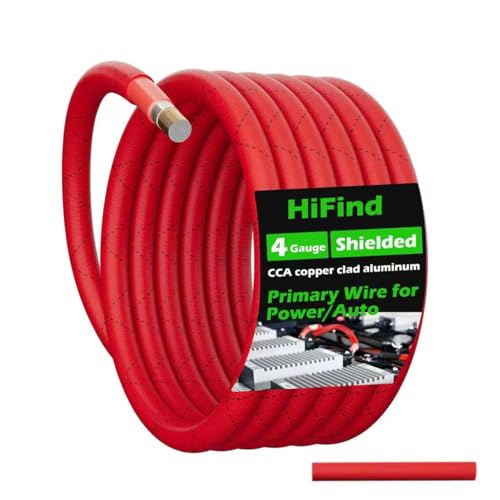
This shielded 4 AWG cable uses copper-clad aluminum (CCA) with an aluminum foil shield to resist EMI. It is lightweight, flexible, and rated for harsh environments with temperatures from -58°F to +221°F. It is ETL-certified for safety, making it suitable for outdoor, marine, solar, and industrial uses. Best for: installations where EMI resistance and flexibility matter. Caution: shield adds cost and complexity; ensure proper shielding needs before use.
Ancor 113502 Tinned Copper Battery Cable, 4 AWG

This 25-foot red 4 AWG marine-grade wire uses tinned copper strands for corrosion resistance and ultra-flexible Type 3 construction. The tinned copper design improves longevity in saltwater environments, and the strand construction helps resist fatigue from vibration. Best for: long-lasting marine wiring with exposure to moisture. Limitation: longer runs may require careful routing to maintain voltage efficiency.
Shirbly 4 Gauge Battery Cable, 10FT Red + 10FT Black

This dual-length set provides 10 feet each of red and black 4 AWG copper wire with the same OFC construction and EPDM insulation as the longer Shirbly cable. It offers strong flexibility and a broad temperature range for automotive, solar, and generator projects. Best for: projects needing both positive and negative runs in one package. Caution: ensure color-coding matches your circuit plan to avoid confusion during installation.
HiFind 4 Gauge 15 Ft Red Power/Ground Wire

This 15-foot red power/ground cable uses true 4 AWG gauge with copper-clad aluminum and a soft PVC jacket for flexibility. It is designed for automotive, solar, marine, and generator use, offering a balance of price and performance. Best for: budget-conscious projects needing reliable power transfer with good flexibility. Limitation: reduce run length if EMI sensitivity or shielding is a requirement, as this option is less shielded than some alternatives.
Buying Guide
What to consider when choosing a 4 gauge red battery cable
- Conductor material: Pure copper offers maximum conductivity and flexibility. Copper-clad aluminum (CCA) is lighter and more affordable but may have higher resistance.
- Insulation and jacket: EPDM insulation provides heat, moisture, and chemical resistance for outdoor use. PVC jackets add flexibility but check temperature ratings for your environment.
- Shielding: EMI shielding helps protect sensitive electronics but adds cost and stiffness. Consider if your system includes radios, amplifiers, or other EM-sensitive gear.
- Marine versus automotive: Marine-grade wires often use tin-plated conductors for corrosion resistance; this is advantageous in saltwater environments.
- Temperature and voltage ratings: Ensure the cable can handle your system’s operating temperature range and voltage.
- Gauge and length: For 4 AWG, plan cable length to minimize voltage drop. Longer runs may require thicker gauge or parallel conductors in critical paths.
- Color coding: Red is typically positive, black is negative. In dual-length packages, confirm color assignments match your wiring plan.
FAQ
- What is the main advantage of 4 AWG copper cables?
They provide strong current carrying capacity with lower resistance, improving performance in automotive, marine, and solar systems. - When should I choose shielded versus unshielded 4 AWG cables?
Choose shielded if there is significant electromagnetic interference from nearby devices or long runs. - Are tin-plated copper cables better for marine use?
Yes, tin plating improves corrosion resistance in saltwater environments and prolongs life in harsh marine conditions. - What should I consider when choosing length?
Longer runs increase resistance and voltage drop; measure carefully and consider routing to keep runs efficient. - Is copper-clad aluminum acceptable for high-power applications?
It can be a cost-effective option with good flexibility, but may have higher resistance than pure copper in demanding power needs. - Do these cables require special tools for installation?
Use standard wire crimping tools, protective gloves, and correct terminals to ensure secure connections.