
Best PVDF Syringe Filters 0.22μm for Lab Filtration and Protein Recovery
For researchers seeking dependable PVDF syringe filters with 0.22 μm pore size, this guide highlights five strong options. These filters are best for applications requiring low protein binding, clean sample prep, and reliable performance across a range of pH levels. Ideal buyers include molecular biology technicians, environmental analysts, and QA/QC labs handling cell culture media, buffers, and analytes where high protein recovery matters. The following table summarizes key choices to compare at a glance.
| Product | Brand | Pore Size | Diameter | Best For |
|---|---|---|---|---|
| PVDF Syringe Filter, 0.22μm 13mm, Hydrophilic, PK of 100 | COBETTER | 0.22 μm | 13 mm | High protein recovery in small-volume samples |
| zoomto PVDF Syringe Filter Hydrophilic,13mm 0.22um,Non-Sterile,100PCS | zoomto | 0.22 μm | 13 mm | Low protein binding, autoclave-ready |
| PVDF Syringe Filter, 0.22μm 33mm, Hydrophilic, PK of 100 | COBETTER | 0.22 μm | 33 mm | Lower hold-up volume, larger filtration area |
| Sterile Syringe Filters PVDF 25 mm Diameter 0.22 um Pore Size Individually Packaged 10/pk | Biomed Scientific | 0.22 μm | 25 mm | Sterile, individually packaged for QC |
| PVDF Syringe Filter, 0.22μm 25mm, Hydrophilic, PK of 100 | COBETTER | 0.22 μm | 25 mm | Balanced flow and protein recovery |
COBETTER PVDF Syringe Filter 13mm 0.22μm

The COBETTER 13 mm, 0.22 μm PVDF filter is hydrophilic and non-sterile. It features a blue color-coded outer ring and a polyethylene housing. It uses a PVDF membrane with very low protein binding and supports a pH range of 1–8. The inlet is a female luer lock and the outlet is a male luer slip. Pack size is 100. Very low protein binding and high mechanical stability are highlighted. Best for small-volume samples where protein recovery is critical. A potential limitation is the 13 mm diameter, which provides less filtration area than larger formats.
- Best for: small-volume sample filtration with high protein recovery.
- Better for: labs needing low hold-up volume and minimal sample loss.
- Caution: smaller diameter may limit throughput for viscous samples.
zoomto PVDF Syringe Filter 13mm 0.22μm
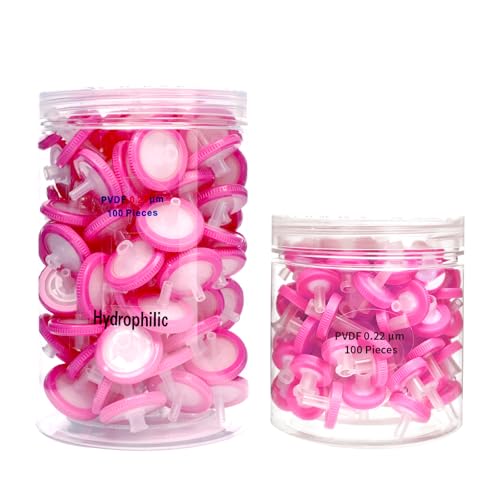
zoomto’s 13 mm, 0.22 μm PVDF filters are hydrophilic and non-sterile, sold in a 100-piece pack. The membrane offers very low protein binding to maximize protein recovery. It uses a PVDF housing with a threaded Luer lock design and is autoclave-ready. Best for labs that require sterile-ready workflows and high sample integrity. Note: this model is non-sterile by default and requires sterilization if needed.
- Best for: labs needing durable, autoclave-ready filters.
- Better for: high-volume users who want a large pack count.
- Caution: non-sterile status; plan sterilization if required.
COBETTER 33mm PVDF Syringe Filter 0.22μm

This 33 mm COBETTER filter offers the same hydrophilic PVDF membrane with excellent protein recovery, but with a larger filtration area. It shares a blue color-coded outer ring and a polyethylene housing. Inlet is a female luer lock and the outlet a male luer slip. The product is packed as a PK of 100. Best for applications requiring higher flow rates or larger sample volumes. A limitation is the larger unit size, which may not be suitable for very compact filtration setups.
- Best for: higher throughput or larger samples.
- Better for: labs needing reduced hold-up volume and more efficient filtration.
- Caution: larger diameter may require more storage space and compatible equipment.
Biomed Scientific Sterile PVDF 25mm Filter 0.22μm

Biomed Scientific offers sterile PVDF syringe filters at 25 mm diameter with a 0.22 μm pore size. The filters are individually packaged and gamma irradiated, supporting clean QC processes. Inlet is a female luer and the outlet is a male slip luer. Suitable for sterile workflows and cell culture work where sterility and traceability are required. A potential drawback is the sterile packaging that adds cost and may be unnecessary for non-sterile applications.
- Best for: applications requiring sterile filtration and easy QC tracking.
- Better for: labs prioritizing sterility and validated packaging.
- Caution: sterile packaging can add cost and longer lead times.
COBETTER 13/25mm Hybrid 0.2μm Sterile Filter Set

COBETTER’s sterile PVDF syringe filters feature a 0.2 μm final filter build with a double-layer hydrophilic PVDF membrane. The design provides low extractables and low absorption, aiming to minimize sample losses. It is appropriate for sterile filtration of cell culture media, buffers, and reagents, while a 0.2 μm pore size is suitable for ensuring sterility. Choose this if sterility is crucial and you work with sensitive biological materials.
- Best for: sterile workflows requiring low sample loss.
- Better for: users wanting a two-stage filtration approach (prefilter and final filter).
- Caution: verify compatibility with your sterilization requirements and handling procedures.
Buying Guide: PVDF Syringe Filters 0.22μm
What to look for when choosing
Key factors include pore size (0.22 μm is standard for many sterile and non-sterile filtrations), membrane material (PVDF for low protein binding), diameter (13, 25, or 33 mm affecting flow and hold-up volume), and housing design (Luer lock vs. slip fittings). Consider whether you need sterile packaging and whether the filters must withstand autoclaving or gamma irradiation for QC workflows.
When to choose smaller vs larger diameters
Smaller diameters (13 mm) are ideal for low-volume samples and compact setups with minimal hold-up volume. Larger diameters (25–33 mm) provide higher filtration throughput and greater membrane area, reducing filtration time for viscous or larger-volume samples.
Sterile vs non-sterile use cases
Sterile filters are essential for cell culture, media, and reagent filtration where contamination must be avoided. Non-sterile options can be adequate for environmental samples, buffers, and testing workflows where sterility is not a concern.
Compatibility and handling tips
- Ensure the inlet is compatible with your syringe or Luer system.
- Avoid using filters beyond their pH range (most 1–8), unless specified otherwise.
- Check for low hold-up volume if precise sample recovery is critical.
Common trade-offs
Higher filtration area (larger diameter) improves throughput but requires more storage space and may not fit all holders. Sterile packaging reduces contamination risk but can increase cost. Consider your lab’s workflow, available equipment, and budget when selecting.
Frequently Asked Questions
- What does 0.22 μm indicate? It indicates the pore size of the membrane, suitable for removing bacteria and many particulates while preserving most proteins in solution.
- Which filter is best for cell culture media? A sterile 0.22 μm PVDF syringe filter with appropriate diameter (often 25 mm) is commonly used for sterile filtration of media and buffers.
- Can PVDF filters be autoclaved? Some PVDF housings are autoclave-compatible, but verify the product specifications before sterilization.
- Is hydrophilic PVDF better than hydrophobic for protein-rich samples? Yes, hydrophilic PVDF tends to yield lower protein binding and higher protein recovery in many applications.
- When should I choose 33 mm over 13 mm? Choose 33 mm for higher filtration area and throughput; choose 13 mm for compact setups and small volumes.
- Are these filters suitable for viscosity? For very viscous samples, larger diameter and higher flow ratings help, but always test for your specific sample.