
Best Wireless Low Voltage Switches for Home Automation
For buyers seeking convenient, cable-free control of low-voltage devices, wireless switches provide reliable on/off capability without wiring. This guide highlights five top options and explains who each is best for. These picks suit smart lamps, LED strings, garage or workshop controls, and DIY low-voltage projects. Use the buying guide to compare range, compatibility, and ease of setup, so you can pick a switch that fits your needs and living space.
| Product | Best For | Key Point |
|---|---|---|
| Zoiinet Black Remote Control Outlet | General household appliances, elderly or disabled users | Removable remote switch with up to 300 ft range |
| 12V-36V Remote Switch (2CH) | DIY low-voltage circuits, lights, fans | Dual-channel remote receiver for small projects |
| RVBOATPAT Wireless Remote Switch | Anti-theft or security-related low-voltage control | Long-range RF remote control module |
| Micro Wireless Relay Switch | Low-power DC projects, LED lighting | Momentary 433MHz relay, compact module |
| QIACHIP 433MHz Universal Switch | Christmas lights, low-power DC loads | Ground-switching design with up to 2A output |
Zoiinet Black Remote Control Outlet

Best for: general household appliances and easy accessibility for seniors or disabled users. Why: The remote doubles as a wall switch, and the buckle design lets you remove it from the plate or mount it on a wall. The remote has a 300 ft signaling range, allowing control through walls and windows, which improves convenience in larger rooms or multi-room layouts.
Why selected: This option emphasizes flexibility and DIY expandability, enabling one switch to control multiple plugs or several switches to control a single plug. It also interoperates with Zoiinet’s receivers and light sockets, broadening potential use cases.
Caution: The system relies on a remote-based layout; if you need full fixture hard-wiring, this may not replace a traditional wall switch in every room. Range can vary by environment and obstacles.
12V-36V Remote Switch (2CH)

Best for: DIY electronics enthusiasts and small projects requiring dual-channel control. Why: Provides two remote-controlled outputs suitable for low-voltage devices like LED strips and fans. The dual-channel setup enables independent or synchronized control, useful in testing and prototyping.
Why selected: It broadens application possibilities beyond single-device control, giving more flexible integration into a DIY system. The data hints at compatibility with various low-voltage loads and easy setup, making it a practical choice for experimentation.
Caution: It is oriented toward low-voltage applications; for mains-powered appliances, ensure appropriate safety and compatibility with your circuit. Check the receiver/controller pairing specifics before use.
RVBOATPAT Wireless Remote Switch

Best for: security-focused low-voltage control or anti-theft integration. Why: The long-range RF remote control module supports broader coverage for entry points like doors or security devices, enhancing monitoring without wiring.
Why selected: The device emphasizes remote control for anti-theft and security scenarios, useful in small systems that need simple remote access without direct wiring to the controller.
Caution: RF-based systems can experience interference; verify compatibility with existing security components and ensure proper enclosure to prevent accidental triggering.
Micro Wireless Relay Switch

Best for: low-power DC projects and LED/DIY circuits. Why: This compact relay module supports ON/OFF control for small loads, ideal for testing or integrating into custom projects where space is limited.
Why selected: The product fits tight spaces while offering reliable 433MHz RF control, making it a practical building block for hobbyists and educational setups.
Caution: Designed for loads up to around 2A; higher power devices should use an external relay or a more robust controller.
QIACHIP 433MHz Universal Wireless RF Remote Control Switch
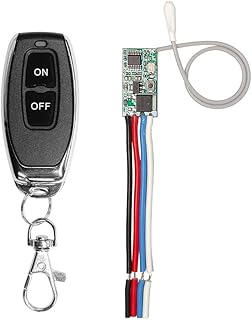
Best for: Christmas light strings and low-power DC loads. Why: The design emphasizes wireless control with a focus on easy LED/string light usage, offering straightforward operation in festive setups or small automation tasks.
Why selected: It provides a universal RF remote solution for basic, non-wiring-required control, useful for temporary or seasonal installations without modifying existing circuits.
Caution: The controller uses ground-switching logic, which is normal for this model but may require wiring awareness to ensure correct polarity in your setup.
Buying Guide: Key Purchase Considerations
- Compatibility: Check voltage and current ratings to ensure the switch matches your low-voltage loads. Some units are optimized for 12V–36V systems, others for DC LEDs or small motors.
- Range and Environment: Remote range can be affected by walls, metal, or interference from other RF devices. Consider a model with a longer advertised range if your space has obstacles.
- Control Type: Decide between a wall-mountable remote, a battery-free wall switch, or a portable remote that can be stuck on walls. Some designs enable one-to-many control (one remote for many plugs) or many-to-one control (many remotes for one plug).
- DIY Expandability: If you plan to expand later, choose a system that supports adding receivers or multiple switches to control a single device or multiple devices.
- Safety and Wiring: Some products rely on negative-side switching; ensure you understand wiring implications and safety, especially for non-professional setups.
- Durability and Use Case: For seasonal decorations or portable setups, a compact, weather-resistant or easy-to-mount solution may be preferable.
FAQ
- What is a wireless low-voltage switch?
It is a device that lets you turn low-voltage loads on and off remotely without hard-wiring, using a wireless remote or receiver module.
- Are these safe for home use?
Yes, when installed according to manufacturer instructions and within intended voltage/current ratings. Avoid wiring a device beyond its specified limits.
- Can I expand these systems later?
Many models support adding receivers or additional remotes for broader control, but verify compatibility before purchasing.
- What should I consider about range?
Environmental factors like walls, metal, and electronic interference can reduce range. Choose a model with a higher advertised range if needed.
- Is negative-side switching common?
Yes, several units use negative-side switching. This means the switch interrupts the ground path rather than the positive line.