
Best CNC Controller 3 Axis: Top Standalone Controllers for Precision Machining
Finding the right CNC controller 3 axis setup hinges on reliability, compatibility, and ease of use. This guide highlights five standout options suited for hobbyists, small shops, and professional prototyping. The selections emphasize offline standalone controllers, GRBL-based boards, and versatile 3-axis systems that pair well with common stepper motors and servos. Each entry includes best-use scenarios, notable features, and practical caveats to help you compare quickly and choose confidently.
Quick product comparison
| Product | Best For | Key Benefit | Limitation |
|---|---|---|---|
| CNCTOPBAOS DDCSV4.1 | Gantry machines with dual motors | High-frequency pulse output up to 500KHz | More complex setup for beginners |
| RATTMMOTOR 23HS2430B + DM556S | 4-axis capability in compact form | Wide microstepping control | Separate driver needed for each axis |
| CNCTOPBAOS DDCSV3.3 | Standalone control with MPG | 4 axes, 500KHz per axis | Firmware-specific features may vary |
| Fafeicy USB Controller | USB-based 4-axis control | Simple wiring, versatile I/O | Pulse frequency capped at 100KHz |
| Genmitsu 3018-PRO | Beginner-friendly 3-axis kit | GRBL control with community support | Limited industrial-grade features |
CNCTOPBAOS DDCSV4.1 4 Axis Offline Controller
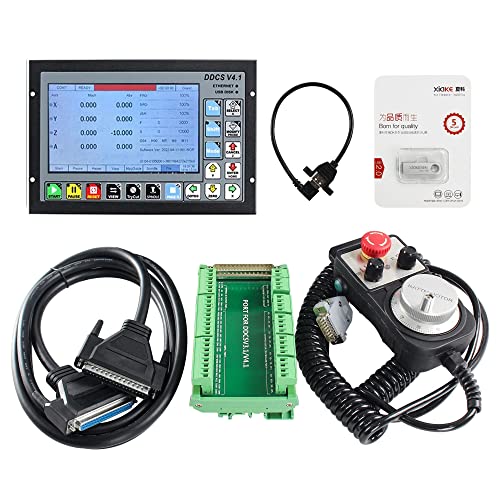
The CNCTOPBAOS DDCSV4.1 is a standalone motion controller with 4 axes, designed for CNC machines requiring independent axis control. It features a 7-inch TFT screen with 1024×600 resolution and 17 operation keys for quick on-device adjustments. Best for gantry-style setups or multi-motor configurations where a compact, offline controller is preferred. The controller supports ARM9 core processing and FPGA core algorithms, enabling responsive interpolation and precise motion. Spindle options include analog 0-10V and servo configurations, with a Slave function for X, Y, or Z axes in dual-motor configurations.
Who this is for: shops needing offline operation, dual-motor X–Y setups, and higher-frequency interpolation. It’s suitable for users who value standalone control without a computer connection and want flexible spindle options.
Why selected: The combination of high-frequency output (up to 500 KHz per axis) and multi-axis capability makes it a strong choice for precise, synchronized motion in more complex machines. The 2–4 axis support and GPIO inputs/outputs broaden integration options. Caution: setup can be more involved for first-time users due to its feature-rich interface.
RATTMMOTOR 3 Axis Nema23 Driver Kit
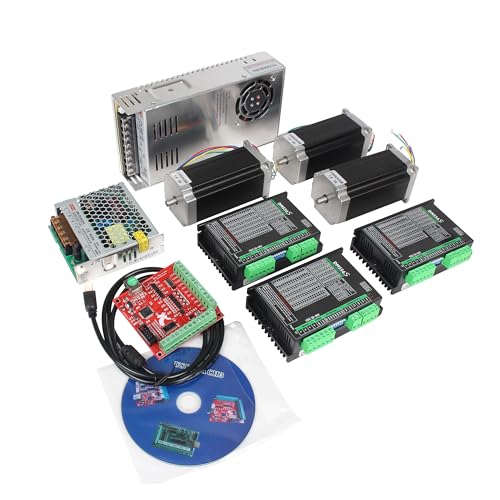
This kit pairs a Nema23 stepper motor (57x57x112mm) with a DM556S driver, offering strong torque and smooth microstepping for 3-axis control. Best for tight, compact CNC setups that require reliable 2-phase stepping and precise positioning. The driver supports a wide microstepping range (200–51200 subdivision) and operates with 20–50V DC input, delivering stable performance for standard hobbyist and small workshop applications.
Who this is for: users building or upgrading a small 3-axis CNC engraver or mill with a need for smooth, quiet operation and good torque. Why selected: strong motor and driver pairing with broad microstepping capability provides flexible tuning. Caution: full system performance depends on proper wiring and power supply stability; mismatched voltages can affect step accuracy.
CNCTOPBAOS DDCSV3.3 4 Axis Offline Controller

The DDCSV3.3 is an upgraded 4-axis motion controller designed for standalone operation, featuring a 5-inch TFT screen and a 500 KHz per-axis limit for high-precision control. It supports G-code input from a USB flash disk and uses an ARM9 main control chip with an FPGA core, enabling flexible jog modes and continuous or defined-distance movement. Analog spindle control (0–10V) and PWM options add versatility for various spindle configurations.
Who this is for: users who want a compact offline controller with USB G-code input and robust axis control, suitable for small-to-mid-sized milling or routing tasks. Why selected: it blends offline operation with high-frequency hardware to improve responsiveness. Caution: some users may rely on manual G-code generation and may need to adjust for non-FANUC-compatible codes.
Fafeicy USB Controller for 4-Axis CNC

This 4-axis motion control board emphasizes USB-based operation and straightforward wiring. It is designed to connect four stepper or servo drives and supports multiple inputs for limit switches, estops, probes, and homing. With a maximum pulse frequency of 100KHz, it’s well-suited for hobbyist engraving and light milling tasks where simple setup and reliable control are priorities.
Who this is for: beginners and makers who want an easy entry point to 4-axis control with clear wiring and USB connectivity. Why selected: simplicity and compatibility with common stepper/servo configurations. Caution: the 100KHz limit may restrict extremely fast-axis movements in high-speed milling applications.
Genmitsu CNC 3018-PRO Router Kit

The Genmitsu 3018-PRO is a popular 3-axis desktop CNC router kit designed for beginners and DIY enthusiasts. It uses GRBL control, enabling users to run G-code files and manage movements with open-source software like Candle. The raised-base design improves stability, and the compact footprint makes it ideal for learning CNC carving, engraving, and milling across wood, acrylic, PCB, and lightweight plastics.
Who this is for: beginners and makers exploring CNC basics and small projects. Why selected: strong community support and straightforward GRBL-based workflow. Caution: not optimized for heavy-duty milling or high-rigidity applications; performance depends on proper bit selection and feed rates.
PGFUN Upgraded DSP A11E 3-Axis Controller
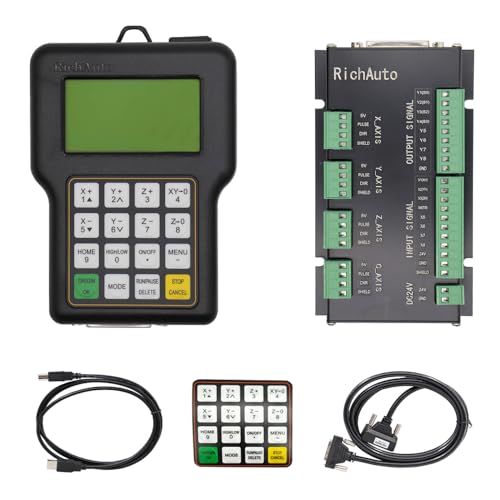
The Upgraded Richauto DSP A11E offers a 3-axis motion control solution with robust software compatibility, including TYPE3, ARTCAM, Mastercam, and other major CAM packages. It supports large G-code files, power-fail safeguards, and a multi-coordinate memory feature for resilient operation. The I/O design allows expansion to accommodate secondary development needs.
Who this is for: users running more advanced CAM workflows on CNC routers or engraving machines who require compatibility with popular software packages and memory-safe operation. Why selected: versatile software compatibility and strong memory features. Caution: more complex setup may be needed for users unfamiliar with DSP-based controllers.
NYMOLABS 4-Axis USB Offline Controller

The NYMOLABS 4-Axis USB controller features a 7-inch IPS touchscreen and is designed for GRBL-based desktop CNC routers. It emphasizes offline operation with USB communication and broad compatibility with common 3018 and similar machines. The IPS display offers a broader, crisper interface than smaller screens for more comfortable control during long sessions.
Who this is for: users needing a larger display while controlling a GRBL-based 3- or 4-axis machine offline. Why selected: improved usability through a touch interface and offline operation. Caution: ensure firmware compatibility with your specific GRBL board to avoid control discrepancies.
SWTHM 3-Axis GRBL Controller

This 3-axis controller uses a 32-bit processor with GRBL firmware for faster computations and precise control. It includes a user-friendly Grblcontrol interface for setting motion parameters, speeds, and real-time monitoring. It also supports limit switches, PWM outputs, and manual control buttons for practical safety and control during operations.
Who this is for: users seeking a high-performance GRBL-based control with an intuitive interface. Why selected: strong processing power and convenient software integration. Caution: ensure your machine’s electronics and power supply align with the controller’s input requirements for reliable operation.
Buying Guide: How to Choose the Right CNC Controller 3 Axis
- Offline vs. online control: Do you prefer standalone operation without a PC, or do you need live PC-based control?
- Axis count: Are you planning a 3-axis machine, or do you anticipate expanding to 4 axes or more?
- Pulse frequency and precision: Higher MHz/KHz capabilities generally deliver smoother interpolation and finer detail.
- Spindle and I/O compatibility: Check analog spindle support, PWM options, and input/output counts to match your hardware.
- Software ecosystem: Ensure compatibility with your CAM/CAD workflow (GRBL, TYPE3, ArctCAM, Mastercam, etc.).
- Ease of use: Assess display size, interface responsiveness, and on-device jog/controls for day-to-day operations.
Frequently Asked Questions
- What is a CNC controller 3 axis?
A controller that directs movements along three axes (X, Y, and Z) to perform precise milling, engraving, or routing tasks, often combining motor drivers and software to execute G-code.
- Do I need an offline controller for a beginner setup?
No, but an offline controller can simplify learning by removing computer dependencies and providing straightforward, dedicated control hardware.
- What determines suitability for a 4-axis upgrade?
Axis support, driver availability, and firmware compatibility determine whether you can upgrade to a 4th axis without reorganizing hardware layouts.
- Is higher KHz always better for milling?
Higher frequencies typically allow faster, smoother interpolation, but machine rigidity, drive electronics, and controller capabilities also limit actual performance.
- Which controller is best for beginners?
3-axis GRBL-based systems with strong community support and straightforward software, such as Genmitsu 3018-PRO, are often recommended for starters.