
Best Indoor Timer Light Switches for Energy Saving and Convenience
Discover the best indoor timer light switches to automate lighting, reduce energy use, and add everyday convenience. This guide focuses on in-wall digital timers and mechanical timers ideal for homes, offices, and vacation setups. It helps buyers choose the right model based on wiring, programming needs, and compatibility with LED or CFL bulbs. The top picks below suit different buyers: DIYers seeking 7-day programmable control, renters needing simple, reliable scheduling, and security-conscious users wanting motion-like occupancy simulation.
| Product | Best For | Key Benefit |
|---|---|---|
| BN-LINK 7 Day Programmable In-Wall Digital Timer | Homeowners and DIYers needing flexible weekly schedules | 18 on/off programs, DST/random mode, multi-pole options |
| BN-LINK U47 Indoor Mini 24-Hour Mechanical Timer | Budget-conscious setups and simple daily repeats | 30-minute intervals, 24-hour repeat, easy dial |
| BN-LINK 7 Day In-Wall Digital Timer (No Backlight) | Clean interface for wall switches | Same 7-day planning with no backlight |
| myTouchSmart In-Wall Digital Timer | Versatile control with override options | 4 programmable buttons, battery backup |
| GE 7-Day In-Wall Digital Timer | Smart Sunrise/Sunset adjustments | SunSmart feature with randomization |
BN-LINK 7 Day Programmable In-Wall Digital Timer Switch

Best for homeowners who want flexible weekly scheduling with multi-device options, including 3-way wiring. This model supports 18 on/off programs, random and daylight saving time (DST) modes, and neutral wire requirements for compatibility with a range of fixtures.
Caution: Requires neutral in the wall box for full feature support. Not backlit, which may affect visibility in dark settings.
BN-LINK U47 Indoor Mini 24-Hour Mechanical Timer

Best for budget-minded setups that need straightforward daily cycles. The U47 offers 24-hour repeat cycles with 30-minute adjustment granularity, ideal for lamps, fans, small appliances, and seasonal lighting like Christmas decor.
- Spacing and dial-based setup make it approachable for renters or first-time timer users.
- 2-pack option allows parallel control of multiple devices.
Limitation: Mechanical timers have fewer advanced features than digital models, such as no DST or random-on modes.
BN-LINK 7 Day In-Wall Digital Timer (No Backlight)
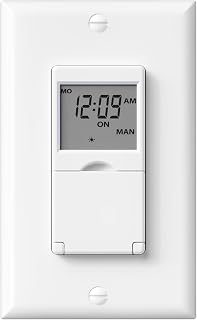
Best for users who prefer a backlight-free control panel in bedrooms or hallways. This 7-day digital timer supports 18 on/off programs with DST and random modes, and can be used as a single-pole or 3-way switch in compatible designs.
Why chosen: Strong scheduling versatility with a neutral requirement for stable electrical performance.
myTouchSmart In-Wall Digital Timer

Best for users who want multiple on/off programs plus override controls. The timer provides 4 programmable buttons and 2 override buttons, and it supports LED, CFL, incandescent, and dimmable bulbs. Battery backup preserves settings during outages.
- Blue LED indicators help verify active programs at a glance.
- Suitable for indoor/outdoor lighting when installed in weather-protected locations.
Caution: Verify compatibility with dimmable lighting if you plan to use dimmable LEDs or CFLs with dimming features.
GE 7-Day In-Wall Digital Timer

Best for households seeking adaptive daylight scheduling. GE’s SunSmart technology adjusts sunrise and sunset times throughout the year, easing routine programming and aligning lighting with real-world daylight. It supports up to seven ON/OFF programs per week and includes a randomization feature for added security realism.
- Single-pole or 3-way compatibility with a neutral wire improves wiring flexibility.
- White and light almond faceplates provide versatile aesthetic options.
Caution: Randomization can alter times unpredictably within a 30-minute window, which may affect time-sensitive routines.
Buying Guide: How to Choose the Best Indoor Timer Light Switch
- Installation and wiring: Determine if you need a single-pole or 3-way switch. Confirm the wall box has a neutral conductor if the timer requires it.
- Programmability: Decide between digital with 7-day programming or a simple 24-hour mechanical timer. Consider the need for DST, randomization, or sunrise/sunset adjustments.
- Backlight and visibility: Decide if a backlit display is important for dark environments or if a no-backlight model suits your aesthetic.
- Energy-saving features: Look for features like occupancy simulations (random mode), energy offsets, and the ability to schedule multiple devices.
- Bulb compatibility: Check whether the timer supports LED, CFL, incandescent, and dimmable bulbs, especially for dimmed lighting setups.
- Reliability and backup: Battery backup or memory retention during power outages helps preserve schedules without reprogramming.
- Security and use cases: Use random or vacation modes to simulate occupancy when away from home.
FAQ
- What is a 7-day programmable timer good for?
answer: It lets you set different on/off programs for each day of the week, ideal for routine lighting, fans, and seasonal devices. - Do these timers require a neutral wire?
answer: Some models require a neutral for full feature support; check the product specs to confirm wiring needs. - Can I use these timers with LED bulbs?
answer: Many timers support LED and CFL bulbs, but verify compatibility, especially with dimmable LEDs. - What’s the benefit of a startup with sunrise/sunset adjustments?
answer: It aligns outdoor or entry lighting with real daylight, improving convenience and energy efficiency over the year. - Is random mode safe for home security?
answer: Yes, it creates occupancy-like lighting patterns to deter intruders when you’re away. - Which timer is best for renters?
answer: A simple 24-hour mechanical timer or a compact in-wall digital timer with straightforward setup is often easiest to install and manage.