
Best Power on Delay Timer Solutions for Smart, Efficient Control
If you need reliable power-on delay timers for automation, lighting, or equipment start sequencing, these five models represent strong choices across different voltage ranges and control needs. They’re suitable for DIY projects, industrial setups, and home automation. This guide highlights who each timer is best for, why it was selected, and any practical limitations to consider.
Quick reference table of the selected products:
- Delay On Make Timer, QD-068 — 0.03 to 10 min, 19-288 VAC/DC
- GRT8-M1 Multifunction Timer Relay — 0.1 seconds to 10 days, 12-240V
- Techbee Digital Repeat Cycle Timer — 24-hour programmable, 120V
- NSI TORK C412H Spring-Wound Twist Timer — 12-hour mechanical timer
- NSI TORK C530M Commercial Twist Timer — 30 minutes, 12 AWG
Delay On Make Timer, QD-068 — Adjustable Delay

Best for small-to-mid scale projects needing a compact delay before power-on. It supports a wide input range of 19-288 VAC or DC and can set delays from 0.03 to 10 minutes. This makes it suitable for lighting, small motors, and control circuits. Choose this if you want a simple, adjustable delay within a compact package.
Who it’s best for: hobbyists and small machine setups that require a straightforward, adjustable Power-On Delay without complex wiring. Why selected: compact form factor and adjustable delay range suit quick-start sequencing.
Caution: ensure the supply voltage matches the device rating (AC or DC) to avoid mis-tiring the control circuit. The unit’s manual details should be consulted for best results.
GRT8-M1 Multifunction Time Relay — Wide Time Range

Best for industrial or automation tasks needing multiple timing modes in one relay. It supports a broad range from 0.1 seconds to 10 days with AC230V (50-60Hz) operation and 16A contact rating. The LED indicators help monitor status. This is ideal when you need versatile timing functions (Delay On, Delay Off, and more) in one DIN-rail package.
Who it’s best for: integrators and technicians who need a multi-function timer with clear status indication. Why selected: wide delay range and multiple functions reduce the need for separate modules.
Caution: wiring and function selection require careful reference to the model options (A, B, C, D, E). Incorrect function choice can produce unexpected timing results.
Techbee Digital Infinite Repeat Cycle Timer
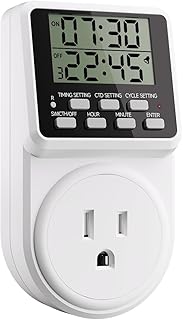
Best for households seeking flexible daily automation with multiple modes. This 24-hour programmable indoor timer offers countdown and on/off control, plus a short cycle option. It’s especially handy for appliances and devices that should run at specific times daily, with a built-in battery memory for outages.
Who it’s best for: busy households and light-duty automation where a simple daily schedule is needed. Why selected: 3-in-1 capabilities provide more versatility than single-function timers.
Caution: note that heavy-duty or high-current appliances may require a timer rated for higher loads than a basic indoor model. Check the device’s current rating against your load before use.
NSI TORK C412H Spring-Wound Twist Timer

Best for commercial or institutional settings needing reliable, simple timing. It features a 12-hour spring-wound mechanism with a metal plate, providing a robust mechanical option for controlling lights or motors without electronics. Choose this if you want a durable, analog timer with predictable behavior.
Who it’s best for: facilities and venues requiring a hard-wired, mechanical timer. Why selected: proven performance in continuous-use environments. Caution: mechanical timers have no electronic delay modes beyond preset intervals; integration is straightforward but less flexible than digital options.
NSI TORK C530M Commercial Timer

Best for automatic shut-off needs in commercial wiring. The C530M provides a 30-minute length with a steel/metal plate appearance and 12 AWG capacity, suitable for motors and lights. Choose this if you operate in a commercial setting and require a mechanical timer with predictable cycling.
Who it’s best for: commercial installers and facilities managers. Why selected: mechanical reliability for motor or light control with a defined interval.
Caution: not ideal for precise electronic delays; use when a fixed interval mechanical timer suffices.
Buying Guide
- What load and voltage does your system require? Choose timers with appropriate voltage compatibility (AC vs DC) and current ratings for your devices.
- What type of timer suits your setup? Digital timers offer flexible delays and multiple modes; mechanical/twist timers excel in robustness and simplicity.
- Do you need multiple timing modes in one unit? If yes, opt for a multifunction relay like the GRT8-M1 to reduce component count.
- Is back-up power or outage memory important? Timers with built-in memory help preserve programs during outages.
- What installation environment will you use them in? Indoor plug-in versus DIN-rail mounted units differ in mounting and protective enclosures.
FAQ
- What is a power-on delay timer used for? It delays the start of power to a device to coordinate sequencing or energy use.
- Can I use these timers with both AC and DC loads? Some models support wide ranges (e.g., 19-288 VAC or DC); confirm your exact voltage needs.
- Are digital timers better for complex schedules? Yes, digital timers offer more programmable options and longer delay ranges.
- Do these timers require separate power for operation? Some have built-in supply, others rely on the line voltage; check each model’s wiring requirements.
- What indicates proper operation? Look for clear status indicators (LEDs) and mechanical indicators on analog timers to confirm timing state.
- Is installation hazardous? For high-Current or line-Voltage devices, follow proper electrical safety standards or consult a professional.